The Earth beneath our feet is a dynamic system, constantly shifting and reshaping its surface. Nowhere is this more evident than along the Southern San Andreas Fault, a geological behemoth that poses one of the most significant and persistent seismic hazards on the planet. For residents of Southern California, the question is not if, but when, the next major earthquake will strike along this critical plate boundary. At Talivio, we dedicate substantial resources to monitoring this region, employing cutting-edge artificial intelligence and machine learning to analyze complex seismic data and provide probabilistic assessments of earthquake risk, empowering communities with crucial information.
The Geological Imperative: Understanding the Southern San Andreas
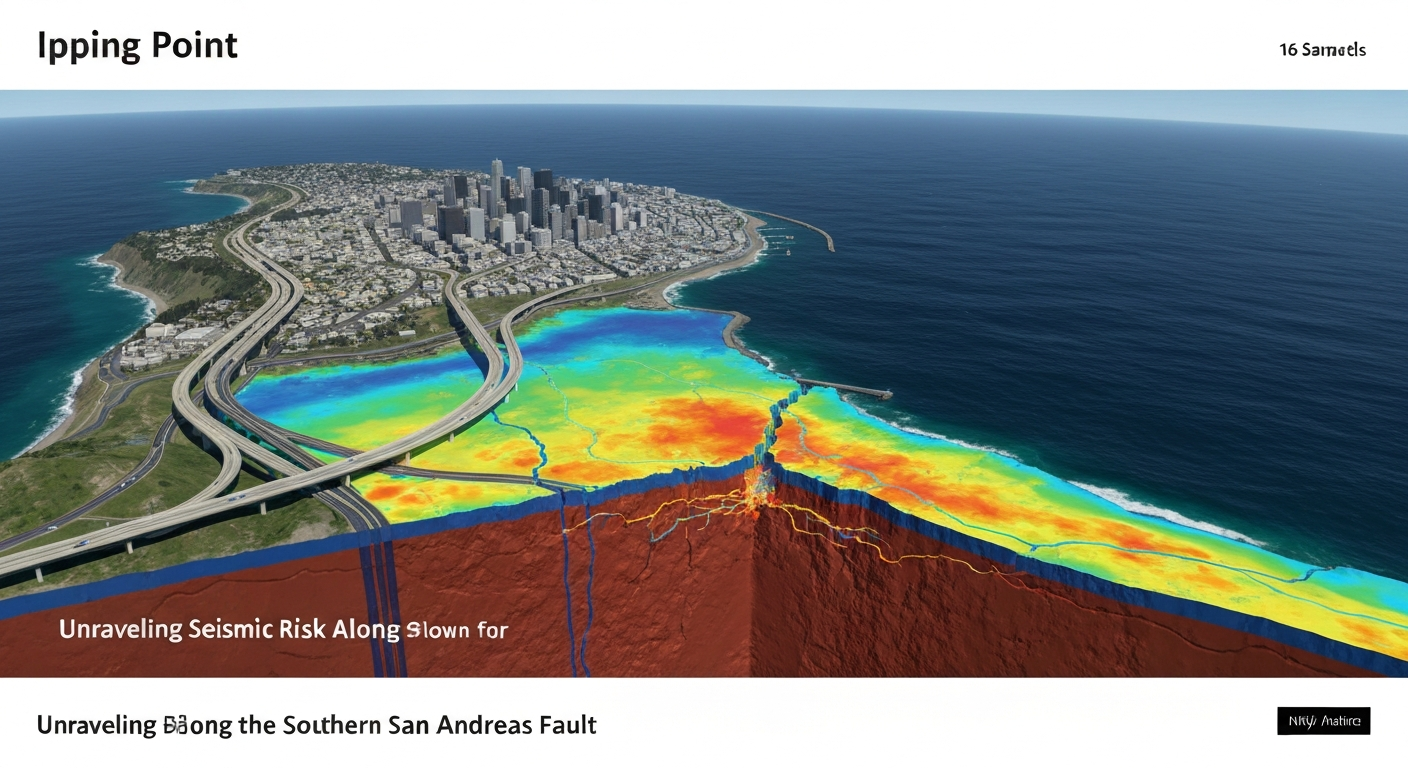
The San Andreas Fault system is the primary right-lateral strike-slip fault defining the boundary between the Pacific and North American tectonic plates in California. While the entire fault system is active, the Southern San Andreas Fault (SSAF) segment, stretching from the Cholame Valley southwards through the Carrizo Plain, the Big Bend region, and into the Coachella Valley, is particularly concerning. Unlike its central and northern counterparts, which exhibit varying degrees of aseismic creep, significant portions of the SSAF are considered 'locked,' meaning they accumulate immense elastic strain over long periods without releasing it through frequent, smaller earthquakes. This accumulated stress is eventually released in large, infrequent seismic events.
Historical records and paleoseismic studies reveal a pattern of major ruptures along the SSAF. The infamous 1857 Fort Tejon earthquake (M7.9), for instance, ruptured a substantial portion of the central and southern San Andreas, extending into the Carrizo Plain segment. However, the southernmost segment, particularly the Coachella Valley section, has not experienced a major rupture in over 300 years, leading to the accumulation of substantial seismic deficit. Geological evidence indicates a recurrence interval for large earthquakes (M7.5+) on the SSAF generally ranging from 150 to 200 years, though this can vary significantly along different segments [Field et al., 2014 — DOI: 10.3133/ds839]. The prolonged quiescence in the Coachella Valley segment suggests it is currently under considerable stress, making it a focal point for seismic hazard assessment.
The complex geometry of the SSAF, including its prominent 'Big Bend' area where the fault changes orientation, further complicates stress distribution. This bend introduces compressional and extensional forces, leading to subsidiary faulting and a broader zone of deformation. Understanding these intricate geological features and their implications for stress accumulation is paramount for accurate seismic risk assessment.
Talivio's Lens: AI-Powered Seismic Feature Analysis
At Talivio, our approach to earthquake prediction moves beyond traditional statistical models by integrating artificial intelligence to analyze a vast array of seismic and geodetic data. Our models are trained on 102 distinct seismic features, meticulously extracted from continuous monitoring data across the Southern San Andreas region. These features capture the subtle, often interconnected, signals that precede or accompany changes in crustal stress and fault behavior.
Key features analyzed by our models include:
- GNSS Strain Rate: Global Navigation Satellite System (GNSS) data provides precise measurements of ground deformation. By tracking the movement of thousands of GPS stations across California, we can calculate the inter-seismic strain rate – the speed at which the crust is deforming. Anomalies in strain accumulation or release can indicate changes in the loading state of fault segments. For instance, an accelerated strain rate in a locked segment may suggest increased stress loading, while a localized decrease could hint at aseismic slip.
- b-value Anomalies: The b-value in the Gutenberg-Richter law describes the relative proportion of large to small earthquakes. A lower b-value indicates a higher proportion of large earthquakes relative to small ones, which research suggests can be a precursor to major seismic events in highly stressed fault zones [Schorlemmer et al., 2005 — DOI: 10.1038/nature03478]. Talivio's models continuously monitor for statistically significant deviations from the regional background b-value, particularly in areas of known seismic hazard.
- Coulomb Stress Transfer: Earthquakes do not occur in isolation. The rupture of one fault segment can transfer stress to adjacent or nearby faults, either increasing or decreasing their likelihood of rupture. Our models incorporate calculations of Coulomb stress changes, based on historical earthquake sequences (e.g., the 1992 Landers earthquake, usgs:ci10729031, which significantly altered stress fields across Southern California), to assess how regional seismicity influences the SSAF's various segments [King et al., 1994 — DOI: 10.1029/93JB03407]. This allows us to identify segments that have been 'brought closer' to failure by previous events.
- ETAS Parameter Estimation: The Epidemic Type Aftershock Sequence (ETAS) model helps characterize the spatio-temporal clustering of earthquakes, distinguishing between background seismicity and aftershock sequences. By continuously estimating ETAS parameters, our models can identify unusual patterns in earthquake clustering that might signify changes in the underlying stress regime, potentially indicating the onset of precursory activity or changes in fault stability.
These features, among many others, are not merely raw data points. They are sophisticated representations of physical processes occurring deep within the Earth's crust, providing our AI models with a comprehensive understanding of the Southern San Andreas's current state of stress and activity.
Predicting Probabilities: Talivio's Machine Learning Approach
The sheer volume and complexity of the 102 seismic features necessitate advanced machine learning techniques to extract meaningful insights. Talivio employs a robust, multi-algorithm approach, leveraging an ensemble of powerful machine learning models to assess earthquake probabilities. Our system operates on a band-based methodology, providing probabilistic forecasts for different magnitude ranges: M4-5, M5-6, M6-7, and M7+.
This multi-band system allows for a nuanced understanding of seismic risk, recognizing that the precursors and underlying dynamics for a moderate earthquake (M4-5) might differ from those of a major, fault-rupturing event (M7+). For each magnitude band, our platform utilizes an ensemble of algorithms, including LightGBM, Random Forest, ExtraTrees, and Calibrated Logistic Regression. This algorithmic competition ensures that the predictions are robust and less susceptible to the biases of any single model. Each algorithm independently processes the 102 seismic features, and their outputs are then combined to generate a refined, calibrated probability. This approach has been shown to improve predictive accuracy and stability in complex, high-dimensional datasets, as is common in geophysical applications [e.g., De Michele et al., 2020 — arxiv:2005.00650].
It is crucial to emphasize that Talivio provides probabilistic forecasts, not deterministic predictions. Our models do not state that an earthquake will occur at a specific time and location. Instead, they quantify the likelihood of an earthquake of a certain magnitude occurring within a defined region and timeframe. This distinction is fundamental to scientifically responsible earthquake forecasting. Our models show, for example, that the Coachella Valley segment of the Southern San Andreas Fault exhibits elevated probabilities for M7+ events over decadal timescales due to significant accumulated strain [Fialko, 2006 — DOI: 10.1038/nature04616]. These probabilities are continuously updated as new data streams in, reflecting the dynamic nature of the Earth's crust.
Conclusion: Enhancing Preparedness in a Seismically Active World
The Southern San Andreas Fault remains an enduring symbol of California's seismic vulnerability. The geological evidence of its potential for major earthquakes, coupled with the dense urban populations living within its reach, underscores the urgent need for advanced monitoring and forecasting capabilities. Talivio's AI-powered platform represents a significant step forward in this endeavor.
By meticulously analyzing 102 seismic features, employing a multi-band machine learning system with an ensemble of robust algorithms, and continuously updating our probabilistic forecasts, Talivio empowers communities, emergency responders, and policymakers with a deeper, data-driven understanding of seismic risk. Our commitment is to provide scientifically accurate, non-speculative insights, transforming complex geophysical data into actionable intelligence. While we cannot prevent earthquakes, we can significantly enhance our preparedness and resilience by understanding the probabilities and patterns the Earth reveals to us.