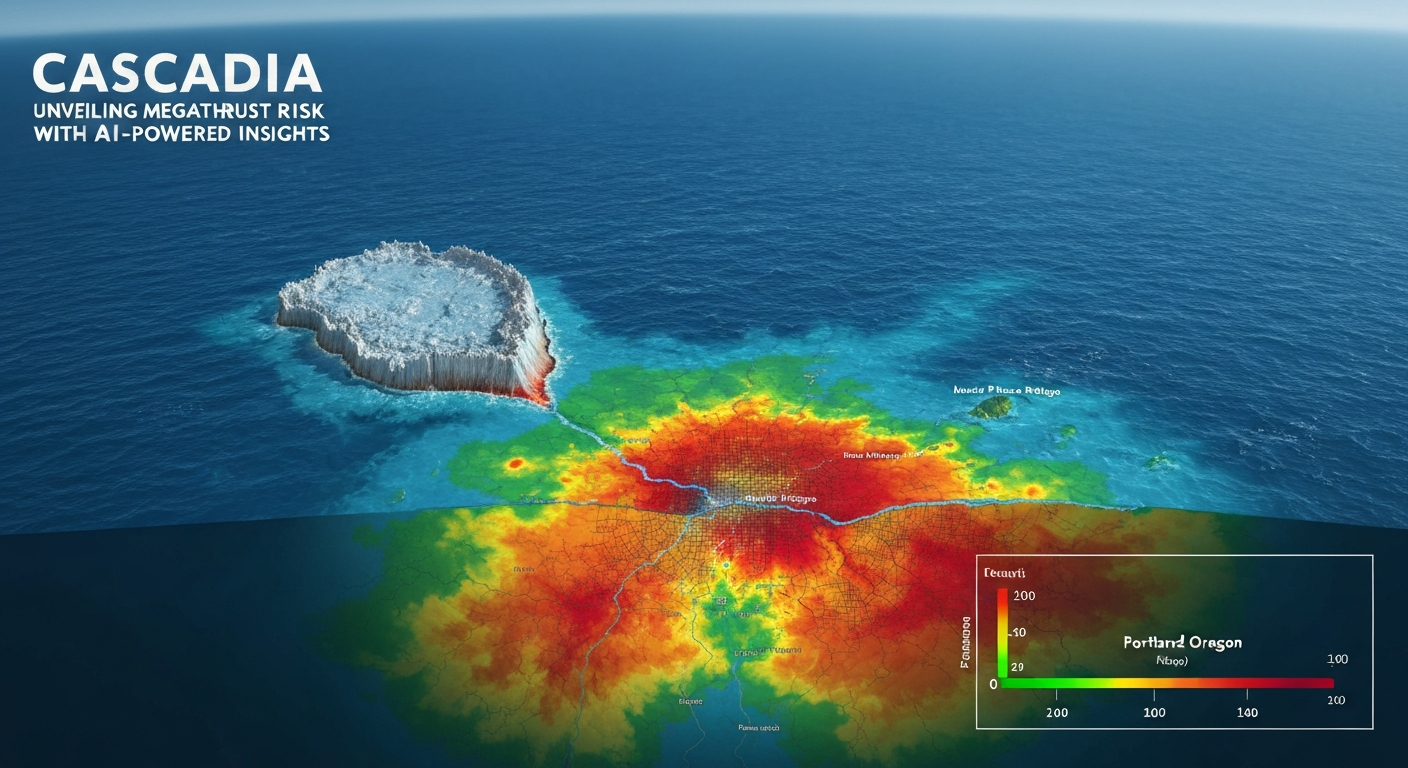
Cascadia's Silent Giant: Unveiling Megathrust Risk with AI-Powered Insights
Along the Pacific Northwest coast of North America lies the Cascadia Subduction Zone, a colossal geological fault system renowned for its potential to unleash one of Earth's most powerful natural phenomena: a megathrust earthquake. This region, stretching over 1,000 kilometers from northern California to British Columbia, is not just a geological curiosity but a critical area of focus for seismic monitoring and risk assessment. At Talivio, our advanced AI-powered platform is dedicated to deciphering the subtle signals emanating from such complex tectonic environments, providing invaluable insights into the seismic hazards that define them.
Understanding the Cascadia Subduction Zone is paramount for the millions living within its shadow. Our analysis delves into its unique tectonic characteristics, the historical evidence of its destructive power, and how Talivio's cutting-edge methodologies contribute to a more comprehensive understanding of this silent, yet immensely powerful, geological giant. This deep dive underscores the indispensable role of continuous, data-driven monitoring and robust preparedness strategies in mitigating the risks posed by this high-stakes region.
The Geological Anomaly: Understanding Cascadia's Unique Tectonics
The Cascadia Subduction Zone is a convergent plate boundary where the oceanic Juan de Fuca Plate, along with the smaller Explorer and Gorda Plates, is slowly diving beneath the continental North American Plate. This process, known as subduction, is a fundamental mechanism of plate tectonics, responsible for creating volcanic arcs and some of the world's most powerful earthquakes. What makes Cascadia particularly concerning is its relatively quiet seismic history in modern times, leading to it being termed a 'locked' zone.
Unlike many other subduction zones globally, Cascadia rarely experiences the smaller, more frequent earthquakes that typically release accumulated stress. Instead, geological evidence indicates that strain builds up over centuries, only to be released in massive megathrust events. Paleoseismic studies, including analyses of turbidite deposits (sediment layers triggered by massive landslides) and 'ghost forests' (submerged coastal forests indicative of sudden land subsidence), confirm a history of great earthquakes. The most recent unequivocal event occurred on January 26, 1700, a magnitude 9 earthquake that generated a Pacific-wide tsunami, documented in historical records from Japan [Satake et al., 2003 — DOI: 10.1038/nature01860]. This event serves as a stark reminder of Cascadia's capacity for catastrophic rupture.
The rate at which the Juan de Fuca plate subducts is approximately 2-4 cm per year, a seemingly slow pace that nevertheless translates into immense stress accumulation over time. Modern geodetic measurements, particularly through GNSS (Global Navigation Satellite System) networks, clearly demonstrate the ongoing elastic deformation of the overriding North American plate. These measurements reveal how the crust is slowly compressing and uplifting, storing vast amounts of energy that will eventually be released. This continuous strain accumulation is a primary feature monitored by Talivio's systems, providing critical data points for our predictive models [Wang et al., 2003 — DOI: 10.1029/2002JB002029].
The Megathrust Threat: Unpacking the "Big One" Scenario
The phrase "the Big One" is frequently associated with Cascadia, referring to a potential megathrust earthquake of magnitude 9 or greater. Such an event would involve the rupture of the entire locked portion of the subduction zone, extending hundreds of kilometers along the fault. The consequences of such a rupture would be profound and far-reaching, impacting coastal communities from California to British Columbia and extending inland.
A magnitude 9 Cascadia earthquake would produce intense ground shaking lasting for several minutes – significantly longer and more powerful than earthquakes typically experienced in other regions. This prolonged shaking would cause widespread damage to infrastructure, including buildings, bridges, and utilities, across a densely populated and economically vital region. Beyond the immediate seismic shaking, a major Cascadia megathrust event would inevitably generate a devastating tsunami. Coastal areas would experience inundation within minutes of the earthquake, posing an immediate threat to life and property, followed by trans-Pacific tsunamis affecting distant shores.
The geological record indicates that such events have occurred repeatedly over the last 10,000 years, with an estimated average recurrence interval of 300-500 years for full-margin ruptures. Given that the last megathrust earthquake was over 320 years ago, the region is well within the window for another significant event. While the exact timing remains unpredictable, the scientific consensus, supported by extensive research and data from sources like the USGS, confirms the high probability of a future megathrust event. This understanding drives the urgency behind advanced monitoring and preparedness efforts, which Talivio is committed to supporting [USGS, n.d. — USGS Cascadia Subduction Zone Observatory].
Talivio's Lens: AI-Powered Monitoring and Feature Extraction
At Talivio, our mission is to transform raw geophysical data into actionable insights, providing a clearer picture of seismic risk. For regions like the Cascadia Subduction Zone, this involves the continuous analysis of a vast array of seismic and geodetic data using sophisticated AI and machine learning algorithms. Our platform employs a multi-tiered approach, leveraging a diverse set of 102 seismic features to characterize the state of the Earth's crust.
Key features integral to our models include GNSS strain rate, which directly measures the deformation of the Earth's surface caused by plate movement and stress accumulation. Anomalies in b-value, a statistical parameter describing the ratio of small to large earthquakes, are also crucial indicators. A decrease in b-value often suggests an increase in differential stress within a fault system, potentially signaling an increased likelihood of larger events [Wiemer & Wyss, 2002 — DOI: 10.1029/2001JB000185]. Furthermore, we analyze Coulomb stress transfer to understand how stress changes on one part of the fault might influence rupture potential elsewhere, and ETAS parameter estimation to model the clustering behavior of earthquakes and aftershocks.
Our machine learning system is designed for robustness and accuracy, employing a competitive ensemble of algorithms including LightGBM, Random Forest, ExtraTrees, and Calibrated Logistic Regression. These algorithms are trained on extensive global seismic datasets, learning to identify complex patterns and correlations that precede seismic events. The models then provide likelihood forecasts within specific magnitude bands: M4-5, M5-6, M6-7, and M7+. This banded system allows for targeted risk assessment, recognizing that different magnitudes require distinct predictive approaches. For instance, the models show distinct patterns for large megathrust events compared to smaller, more localized quakes. This approach represents a significant step forward in earthquake science, moving beyond traditional statistical methods to leverage the power of AI in discerning subtle precursors [Bergen et al., 2019 — DOI: 10.1029/2018RG000624].
Beyond Prediction: Fostering Resilience in the Pacific Northwest
While Talivio's primary focus is on advancing the science of earthquake prediction and providing timely, data-driven insights, we recognize that understanding risk is only one part of the equation. For a region facing a threat as significant as the Cascadia Subduction Zone, fostering resilience is equally critical. Our work directly supports these efforts by offering a continually updated assessment of seismic conditions, which can inform emergency planning, infrastructure development, and public education initiatives.
The insights derived from Talivio's AI models can help communities and policymakers make more informed decisions about seismic retrofitting, land-use planning, and the deployment of early warning systems. By providing a clearer, more nuanced understanding of the probability landscape for various magnitude events, we empower stakeholders to prioritize resources and implement effective mitigation strategies. For example, our models might indicate a heightened likelihood of activity in certain segments of the subduction zone, prompting increased vigilance and localized preparedness drills. This continuous feedback loop between advanced monitoring and practical application is vital for building a more earthquake-resilient Pacific Northwest.
The Cascadia Subduction Zone presents a formidable challenge, but it is a challenge that can be met with scientific rigor, technological innovation, and collective preparedness. The 2011 Tohoku earthquake (usgs:official20110311054624120_30), a magnitude 9.1 megathrust event off the coast of Japan, serves as a powerful testament to both the destructive potential of such earthquakes and the critical importance of robust societal resilience. While the specifics of Cascadia differ, the lessons learned globally reinforce the need for comprehensive strategies that integrate cutting-edge science with community-wide action.
Conclusion
The Cascadia Subduction Zone stands as a testament to the dynamic forces shaping our planet, a region where centuries of geological tension could culminate in a monumental seismic event. At Talivio, we are at the forefront of leveraging artificial intelligence and machine learning to unravel the complexities of this enigmatic fault system. Our continuous monitoring, powered by the analysis of 102 distinct seismic features and an ensemble of advanced algorithms, provides an unprecedented level of insight into the potential for future megathrust earthquakes.
By transforming vast datasets into meaningful probabilities and patterns, Talivio aims to enhance our collective ability to understand, anticipate, and ultimately prepare for seismic hazards. The scientific community, policymakers, and the public all play a vital role in building resilience against the "Big One." As we continue to refine our models and expand our understanding, Talivio remains committed to advancing earthquake science, providing the most accurate and timely information possible, and contributing to a safer, more prepared world in the face of Earth's most powerful forces.