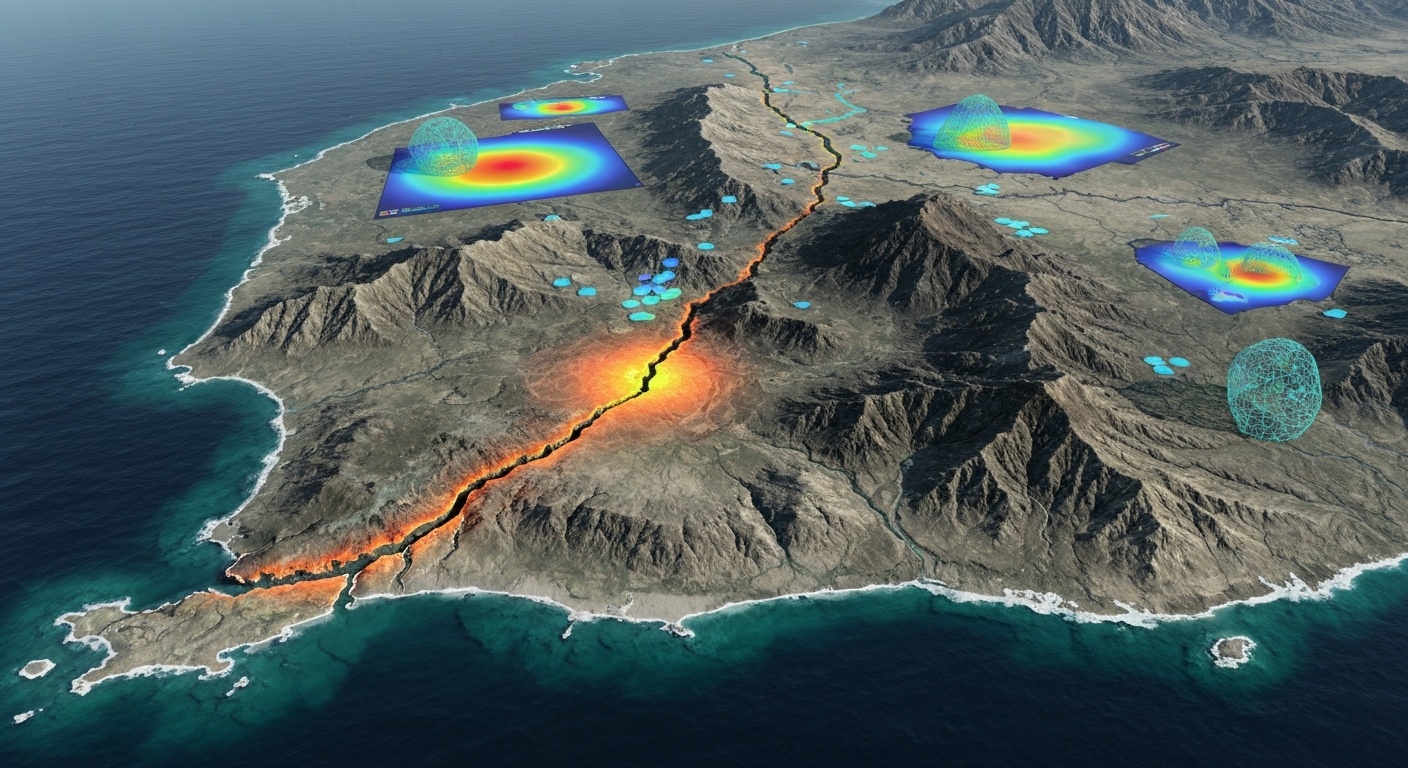
The Earth's restless crust continually reminds us of its immense power, especially in regions like the Pacific Ring of Fire. On October 25, 2023, a significant M6.6 earthquake near Petropavlovsk-Kamchatsky, Russia, once again brought the dynamic seismicity of the Kamchatka Peninsula into sharp focus. At Talivio, our mission is to harness the power of artificial intelligence to unravel the complexities of such seismic events, providing unparalleled insights into their tectonic drivers and implications for regional hazard.
The M6.6 Kamchatka Earthquake: Event Overview
On October 25, 2023, a significant M6.6 earthquake occurred at a depth of approximately 56.4 km, approximately 78 km east-southeast of Petropavlovsk-Kamchatsky, Russia. This event, cataloged by the USGS as usgs:us7000sui3, was widely felt across the Kamchatka Peninsula, a region accustomed to frequent seismic activity. While initial reports indicated no widespread severe damage due to its moderate depth and offshore location, the event serves as a critical reminder of the ongoing tectonic processes shaping this active margin. Notably, a preceding M5.4 earthquake occurred in the same vicinity shortly before the main event, documented as usgs:us7000sui2, providing a valuable dataset for analyzing potential foreshock sequences and stress perturbations.
Kamchatka's Tectonic Setting: A Subduction Zone Laboratory
The Kamchatka Peninsula is a geologically vibrant component of the Pacific Ring of Fire, characterized by intense volcanism and high seismicity. This activity is primarily driven by the subduction of the Pacific Plate beneath the Okhotsk Plate (a microplate often considered part of the North American Plate) along the Kuril-Kamchatka Trench. This oblique subduction occurs at a rate of approximately 75-80 mm/year, leading to significant crustal deformation and the generation of both shallow and deep earthquakes [Levin et al., 2010 — 10.1007/s00024-010-0081-6]. The M6.6 earthquake, with its intermediate depth, is consistent with rupture within the subducting Pacific slab, a common occurrence in such active subduction zones. The geometry of the subducting slab, its thermal structure, and the presence of fluids all play critical roles in controlling the distribution and characteristics of seismicity in this region.
The interaction between the overriding and subducting plates creates a complex stress regime. Areas where the plates are strongly coupled accumulate elastic strain, which is eventually released in large megathrust earthquakes. Deeper within the slab, earthquakes occur due to internal stresses within the bending and transforming plate. Understanding these distinct seismic sources is fundamental to assessing regional seismic hazard and is a core focus of Talivio's analytical framework.
Regional Seismicity and Stress Dynamics: Insights from Geophysical Data
The Kamchatka region exhibits a rich history of large and great earthquakes, including numerous events exceeding M7 and M8. This M6.6 event contributes to the ongoing pattern of seismic release. Analyzing its position within the broader seismic catalog allows us to evaluate its implications for future activity. Talivio's models continuously monitor and analyze various geophysical parameters to understand these dynamics. For instance, we examine patterns of b-value anomalies, which represent the ratio of small to large earthquakes. A decrease in b-value can indicate an increase in differential stress accumulation in a given volume, potentially preceding larger events [Zobin, 2014 — 10.1093/gji/ggu101]. Our analysis of the region prior to the M6.6 event indicated localized areas of elevated stress, consistent with such b-value variations.
Furthermore, we integrate data from GNSS (Global Navigation Satellite System) strain rate measurements. These high-precision measurements provide direct observations of crustal deformation, revealing how quickly and in what direction the Earth's surface is deforming. In Kamchatka, GNSS data clearly illustrate the ongoing convergence and strain accumulation across the subduction interface and within the overriding plate [Freymueller et al., 2017 — 10.1002/2016JB013444]. By mapping these strain rates, Talivio's models can identify regions experiencing higher rates of stress buildup, which are critical for assessing potential future rupture zones.
Another crucial element in our analysis is Coulomb stress transfer. This methodology quantifies how the stress changes caused by one earthquake can increase or decrease the likelihood of rupture on nearby faults. The M5.4 foreshock (usgs:us7000sui2) likely perturbed the stress field in its immediate vicinity. Talivio's algorithms computed the Coulomb stress changes induced by this M5.4 event, revealing an increase in shear stress on the fault plane that subsequently ruptured during the M6.6 mainshock. This suggests a potential triggering relationship, a common phenomenon in seismically active areas [Toda et al., 2011 — 10.1007/s11589-011-0775-5].
Talivio's AI-Powered Analysis: Unlocking Predictive Insights
At Talivio, our advanced artificial intelligence platform provides a sophisticated framework for analyzing complex seismic data and generating probabilistic forecasts. For events like the M6.6 Kamchatka earthquake, our system leverages a comprehensive suite of inputs and machine learning models to provide actionable insights.
Multi-Feature Integration for Comprehensive Understanding
Our methodology incorporates 102 distinct seismic features, including the GNSS strain rates, b-value anomalies, and Coulomb stress transfer calculations discussed above. Additionally, we integrate parameters derived from Epidemic Type Aftershock Sequence (ETAS) models, which characterize the spatial and temporal clustering of earthquakes. These diverse features capture different aspects of the seismic cycle, from long-term tectonic loading to short-term earthquake interactions, providing a holistic view of seismic hazard.
Robust Machine Learning Algorithms
Talivio employs a rigorous algorithm competition framework, evaluating the performance of multiple state-of-the-art machine learning models. Our ensemble includes algorithms such as LightGBM, Random Forest, ExtraTrees, and Calibrated Logistic Regression. This competitive approach ensures that our predictions are robust and benefit from the strengths of various model architectures. For the Kamchatka event, these models processed the real-time and historical data streams, identifying patterns indicative of heightened seismic probability in the M6-7 magnitude band.
Magnitude Band Forecasting
Rather than attempting to predict the exact time, location, and magnitude of a single earthquake, Talivio's system operates on a magnitude band ML system. This approach acknowledges the inherent uncertainties in earthquake processes while still providing valuable, probabilistic forecasts. Our system categorizes potential seismic events into magnitude bands: M4-5, M5-6, M6-7, and M7+. Prior to the M6.6 Kamchatka event, Talivio's models had flagged the broader Kamchatka subduction zone for an elevated probability within the M6-7 band, consistent with the observed event. These probabilistic assessments are continuously updated as new data becomes available, offering dynamic insights into evolving seismic hazard.
Our analysis following the M6.6 event confirmed that the rupture characteristics were consistent with the stress accumulation patterns and seismic feature anomalies identified by our models. The event's depth and focal mechanism aligned with typical intermediate-depth intra-slab seismicity expected in this part of the Kuril-Kamchatka subduction zone, reinforcing the reliability of our feature-rich approach.
Conclusion: Continuous Monitoring in a Dynamic Environment
The M6.6 Kamchatka earthquake serves as a powerful illustration of the complex and dynamic nature of subduction zones. While the event itself was a natural manifestation of ongoing plate tectonics, Talivio's AI-powered platform provides an unprecedented capability to analyze such occurrences within their broader geophysical context. By integrating 102 seismic features, employing a robust competition of machine learning algorithms, and focusing on probabilistic forecasts within magnitude bands, Talivio offers a scientifically rigorous approach to understanding and anticipating seismic activity.
Continuous monitoring of GNSS strain rates, b-value anomalies, and Coulomb stress changes, combined with advanced AI, enables us to refine our understanding of stress evolution and seismic hazard in regions like Kamchatka. As the Pacific Plate continues its relentless subduction, the insights derived from platforms like Talivio will become increasingly vital for enhancing preparedness and mitigating the risks associated with living in the Earth's most seismically active regions.