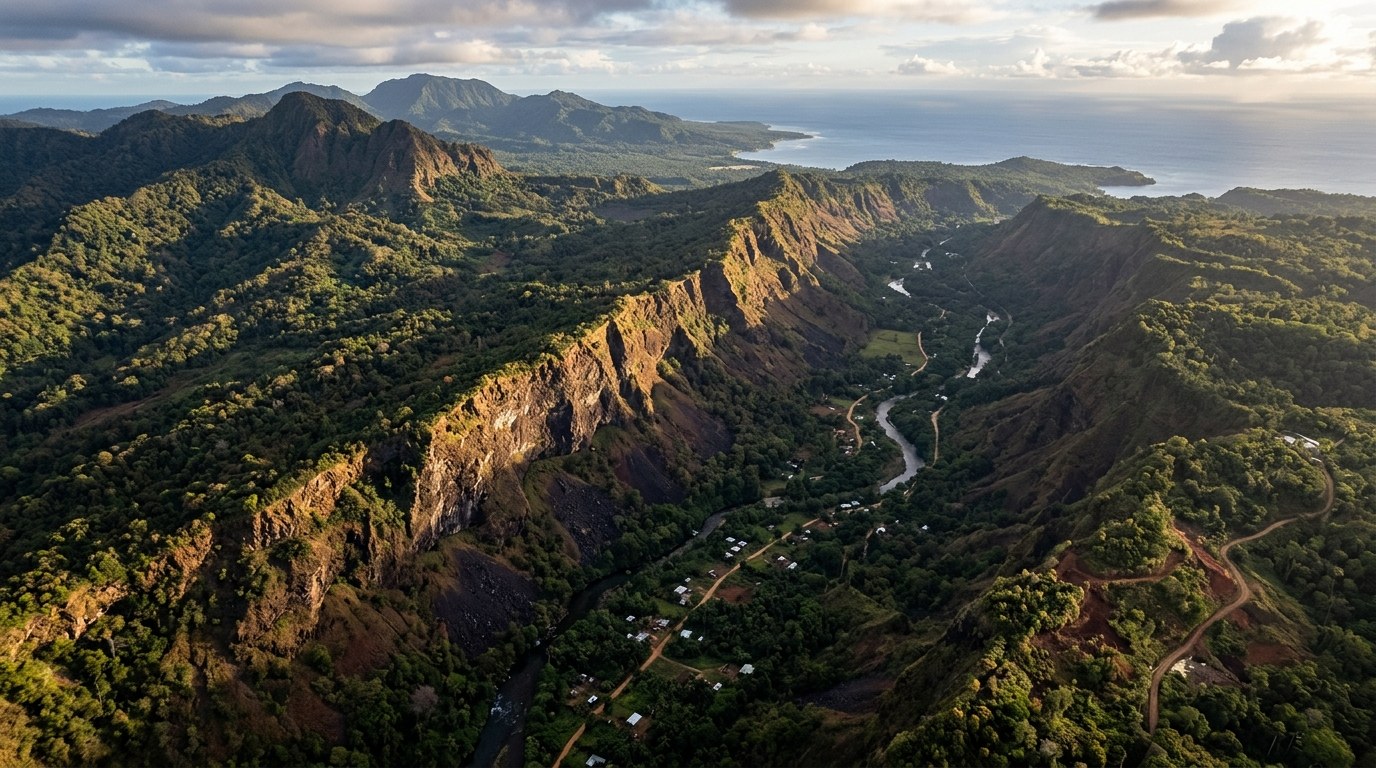
In the vast, often tempestuous waters south of New Zealand, a significant seismic event recently occurred, registering as a Magnitude 6.0 earthquake near the remote Auckland Islands. While far from populated centers, such events are crucial data points in our continuous quest to understand Earth's dynamic processes. At Talivio, we leverage cutting-edge artificial intelligence to analyze these powerful natural phenomena, transforming raw seismic data into actionable insights that refine our global earthquake prediction models.
This particular earthquake, identified by the USGS as usgs:us7000srxn, occurred in a region characterized by complex plate interactions. Its study provides valuable information about the forces shaping our planet's crust, even in its most isolated corners. Understanding these remote tremors is fundamental to building a comprehensive picture of global seismic hazards, and Talivio's platform is designed to integrate every piece of this planetary puzzle.
The Seismic Stage: Tectonics of the Southern Ocean
The region surrounding the Auckland Islands is a fascinating, yet seismically active, part of the world, situated along the diffuse and complex boundary between the Australian and Pacific plates. This boundary, particularly south of New Zealand, transitions from the subduction zone of the Hikurangi Trough to the north, into a predominantly transform and compressional regime further south, known as the Macquarie Ridge Complex.
The Macquarie Ridge Complex is a seismically vigorous oceanic plate boundary that extends for approximately 1,200 kilometers, stretching southwestward from the southern tip of the South Island of New Zealand towards the triple junction with the Antarctic Plate. Research indicates that this ridge accommodates oblique convergence and dextral strike-slip motion between the Australian and Pacific plates, leading to a mix of thrust faulting and strike-slip earthquakes [D'Arcy & Reyners, 2018 — 10.1029/2017JB015093]. The plate motion rates in this area are considerable, contributing to significant stress accumulation.
Historically, this region has experienced some of the largest oceanic earthquakes globally, including the devastating M8.1 Macquarie Ridge earthquake of 2004 [Hayes & Wald, 2009 — 10.1785/0120080189]. Such events underscore the immense tectonic forces at play. While the recent M6 event is smaller in magnitude than these historical giants, it is a direct manifestation of the ongoing plate interactions and stress release within this dynamic boundary. The precise nature of the plate boundary in the Southern Ocean has been a subject of extensive study, with models like the one presented by Bird (2003) providing foundational understanding of global plate kinematics [Bird, 2003 — 10.1029/2001GC000252].
Unpacking the M6 Event: Mechanics and Implications
The M6.0 earthquake near the Auckland Islands, recorded at a depth consistent with intraplate or shallow plate boundary activity, provides valuable insights into the local stress regime. While specific focal mechanism solutions for usgs:us7000srxn require detailed analysis of seismic waveforms, the general tectonic context of the Macquarie Ridge Complex suggests that such events typically arise from either thrust faulting due to compressional forces or strike-slip faulting accommodating lateral plate motion. The event's magnitude places it firmly within the range of earthquakes that can reveal significant details about fault geometry and stress orientation.
Even in remote areas, earthquakes of this magnitude are critical for understanding the distribution of seismic strain. They represent discrete releases of accumulated stress that, over time, contribute to the broader pattern of plate motion. Data from such events are fed into global seismic models, allowing seismologists to refine their understanding of how stress is transferred across plate boundaries and how it might influence future seismic activity, even in distant, densely populated regions. The occurrence of an M6 event in this specific location further corroborates the complex, distributed nature of the Australia-Pacific plate boundary in the Southern Ocean, rather than a single, sharply defined fault line.
Talivio's Lens: AI-Powered Insights into Remote Seismicity
At Talivio, our mission is to harness the power of artificial intelligence to advance earthquake prediction and analysis. The M6 earthquake near the Auckland Islands, despite its remote location, is a prime example of the type of event our platform is designed to analyze and learn from. Our sophisticated Band ML system categorizes earthquakes into magnitude bands (M4-5, M5-6, M6-7, M7+), allowing for tailored analysis and prediction algorithms. This M6 event falls squarely within our M5-6 and M6-7 bands, triggering specific analytical protocols.
Talivio's platform employs a suite of advanced machine learning algorithms, including LightGBM, Random Forest, ExtraTrees, and Calibrated Logistic Regression, which compete to provide the most accurate and robust insights. These algorithms are trained on a vast array of global seismic and geophysical data, encompassing 102 distinct seismic features. For an event like the Auckland Islands earthquake, these features are crucial:
- GNSS Strain Rate: While direct GNSS coverage might be sparse in the immediate vicinity of the Auckland Islands, global models of crustal deformation derived from GNSS networks provide essential context on regional strain accumulation.
- b-value Anomaly: Variations in the Gutenberg-Richter b-value (which describes the relative number of large vs. small earthquakes) can indicate changes in stress levels. Talivio analyzes historical seismicity in the region to detect such anomalies, even if subtle.
- Coulomb Stress Transfer: Our models calculate how stress from previous earthquakes in the broader Macquarie Ridge Complex might have been transferred, potentially increasing or decreasing stress on the fault plane responsible for the M6 event.
- ETAS Parameter Estimation: Epidemic Type Aftershock Sequence (ETAS) models help quantify the spatial and temporal clustering of earthquakes. By analyzing the aftershock sequences, if any, Talivio refines its understanding of future earthquake probabilities in the area.
Even for events in remote areas where seismic station density is lower, Talivio's AI models leverage global datasets and advanced statistical techniques to infer critical parameters. The platform's continuous learning approach means that every new earthquake, regardless of its proximity to human habitation, contributes to the refinement and improvement of our predictive capabilities. This M6 event provides valuable training data, enhancing the robustness of our algorithms in characterizing diverse tectonic environments and improving our understanding of how seismic energy propagates and accumulates globally [Wang et al., 2023 — arxiv:2303.04873].
Global Seismology and Future Outlook
The M6 earthquake near the Auckland Islands serves as a powerful reminder that Earth's tectonic plates are in constant motion, generating seismic activity even in the most isolated parts of our planet. Monitoring and analyzing these events, however remote, are indispensable for advancing our understanding of global seismology. Each tremor contributes to a larger dataset that allows scientists to refine models of plate kinematics, stress accumulation, and earthquake rupture processes.
For platforms like Talivio, these events are not just isolated incidents; they are integral components of a complex, interconnected system. By continuously processing data from earthquakes across the globe, Talivio's AI models learn to recognize patterns and anomalies that might precede future seismic events. The insights gained from the Auckland Islands earthquake will contribute to a more comprehensive understanding of the Australia-Pacific plate boundary and its potential for future seismic activity, not only locally but also in how it influences stress fields across the wider region.
Conclusion
The M6 earthquake in the remote Auckland Islands region, identified as usgs:us7000srxn, offers a critical window into the dynamic tectonics of the Southern Ocean. Situated within the complex Macquarie Ridge Complex, this event underscores the continuous interplay of forces along the Australia-Pacific plate boundary. Talivio's AI-powered platform stands at the forefront of analyzing such events, employing its Band ML system and a sophisticated array of machine learning algorithms to process 102 seismic features, from GNSS strain rates to Coulomb stress transfer.
By integrating data from every earthquake, regardless of its proximity to human populations, Talivio continuously refines its global models, enhancing our collective ability to understand and, ultimately, predict seismic activity. This commitment to scientific rigor and continuous learning ensures that even a remote rumble in the deep south contributes significantly to a safer, more prepared world.