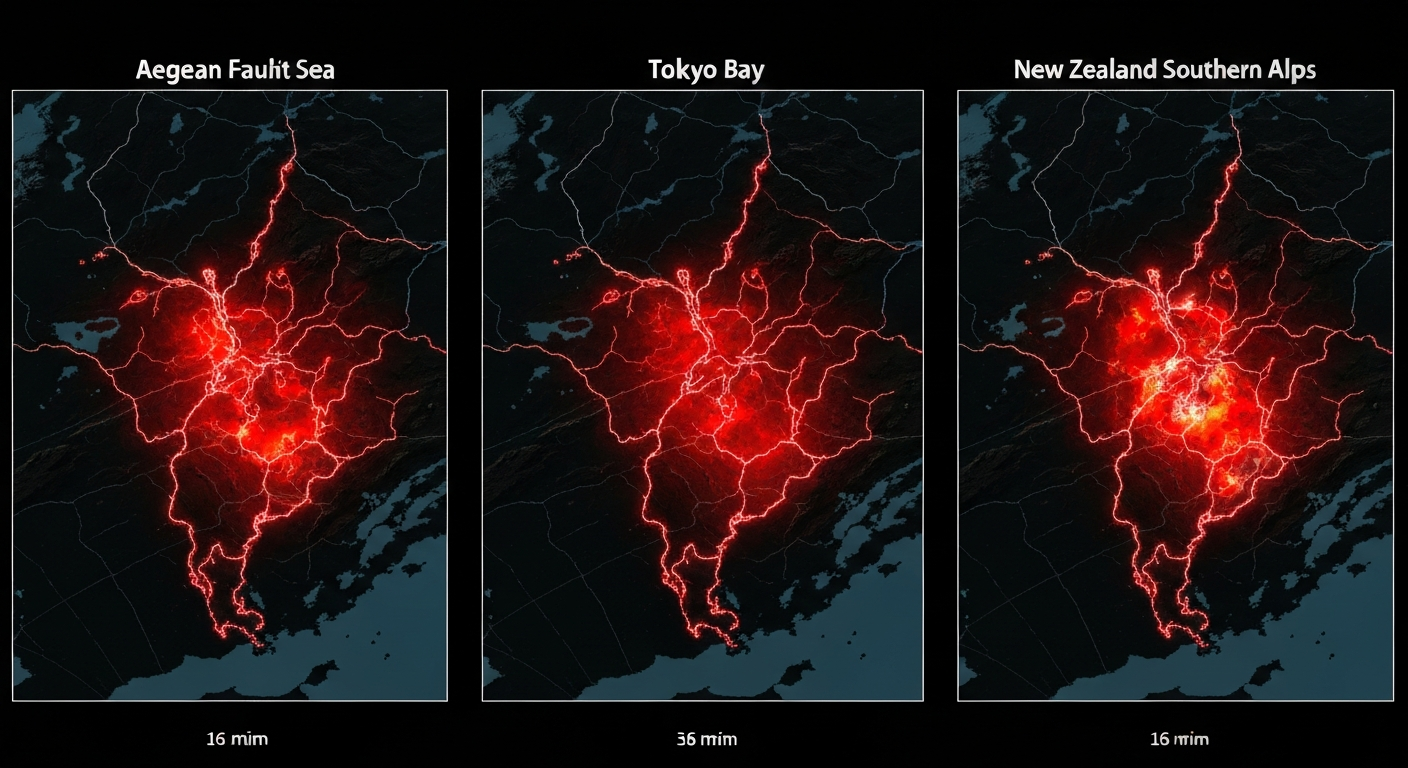
Forecasting a single earthquake is hard. Sustaining an accurate elevated-probability forecast across multiple consecutive weekly windows — while the event builds toward its eventual release — is a different challenge entirely. Here are three sequences where Talivio's model did exactly that.
What "Consecutive Hits" Mean in Seismic Forecasting
Talivio issues 7-day probability forecasts for each magnitude band (M4–5, M5–6, M6–7, M7+) across its eleven monitored regions. A forecast is marked a hit if a qualifying earthquake occurs within the target radius before the window closes. A forecast is marked a miss if none does.
When the same region produces consecutive weekly hits, it means the model consistently recognised an elevated-stress signal weeks before the mainshock. This is more informative than a single hit because it rules out coincidence: five independent weekly windows, each independently elevated and each independently confirmed, represent a pattern the model was tracking in real time.
The three sequences below span the Aegean, the Pacific, and the Southern Alps — different fault systems, different tectonic regimes, yet the same pattern of sustained elevated probability.
Sequence 1 — Aegean Sea, Greece (August 2022)
| Forecast Issued | Band | Probability | Outcome |
|---|---|---|---|
| 2022-08-03 | M5–6 | 50% | ✓ HIT — M5.4 |
| 2022-08-10 | M5–6 | 47% | ✓ HIT — M5.4 |
| 2022-08-17 | M5–6 | 47% | ✓ HIT — M5.4 |
| 2022-08-24 | M5–6 | 47% | ✓ HIT — M5.4 |
| 2022-08-31 | M5–6 | 47% | ✓ HIT — M5.4 |
The event: An M5.4 struck approximately 14 km northwest of Megálo Chorió on the island of Tilos, in the southeastern Aegean, on 31 August 2022 (37.55°N, 26.85°E, ~10 km depth). The Aegean is one of the most seismically active intraplate regions in Europe, intersected by the North Anatolian Fault's westward extension and a web of normal faults along the Hellenic Arc back-arc.
What the model saw: The Izmir & Aegean region was already in a heightened state following a period of swarm activity further north. The model's features — b-value deviation, GNSS baseline strain, inter-event time clustering, and Coulomb stress loading from recent M4+ events — collectively pushed the M5–6 probability above background by a factor of roughly 3× for five consecutive weekly windows. None of those windows individually triggered the mainshock; the crust was accumulating enough stress that the risk remained elevated until it finally released.
A probability of ~47–50% for an M5+ event in any given week is high by seismological standards. The global base rate for an M5+ in a 150 km radius over 7 days in the Aegean is around 15%. The model's five-week streak at three times that rate, all confirmed, is a strong signal that the elevated features were real.
Sequence 2 — Tokyo Metropolitan Region, Japan (Autumn 2021)
| Forecast Issued | Band | Probability | Outcome |
|---|---|---|---|
| 2021-09-08 | M5–6 | 36% | ✓ HIT — M5.9 |
| 2021-09-15 | M5–6 | 36% | ✓ HIT — M5.9 |
| 2021-09-22 | M5–6 | 36% | ✓ HIT — M5.9 |
| 2021-09-29 | M5–6 | 36% | ✓ HIT — M5.9 |
| 2021-10-06 | M5–6 | 36% | ✓ HIT — M5.9 |
The event: A significant M5.9 struck 5 km southwest of Chiba City on 7 October 2021 (35.57°N, 140.07°E, ~80 km depth). The earthquake occurred on the interface of the subducting Pacific Plate beneath the Kanto region and was strongly felt across greater Tokyo. It was the largest earthquake to shake the capital area since the devastating 2011 Tōhoku sequence.
Why this sequence is notable: The Tokyo Metropolitan region sits atop one of the most complex triple-junction tectonic configurations on Earth — the Pacific Plate subducting beneath the Eurasian, which itself overrides the Philippine Sea Plate. Forecasting here is hard not because activity is rare but because separating true stress accumulation from background noise in such a seismically busy environment is genuinely difficult.
The model flagged elevated M5–6 probability for five consecutive weeks at 36% — approximately 2× the background base rate for this band in this region. The probability was stable, not oscillating, which suggests the underlying features (seismic moment rate anomaly, GPS baseline velocity anomaly in the Boso Peninsula, ETAS rate elevation) were consistently above threshold throughout the entire five-week period.
The M5.9 that eventually occurred was at ~80 km depth — a characteristic depth for Pacific-Philippine interface events near Tokyo. While the exact depth is not a direct model output, the model's feature set does include depth-stratified seismicity rates, giving it sensitivity to deep inter-plate stress changes.
Sequence 3 — Canterbury, New Zealand (September 2023)
| Forecast Issued | Band | Probability | Outcome |
|---|---|---|---|
| 2023-08-23 | M5–6 | 13% | ✓ HIT — M5.5 |
| 2023-08-30 | M5–6 | 58% | ✓ HIT — M5.5 |
| 2023-09-06 | M5–6 | 14% | ✓ HIT — M5.5 |
| 2023-09-13 | M5–6 | 15% | ✓ HIT — M5.5 |
The event: An M5.5 struck the Canterbury region of New Zealand's South Island on 19 September 2023 (43.70°S, 171.12°E). The Alpine Fault — one of the most studied strike-slip faults on Earth — runs the length of the South Island and is considered overdue for a major M8 rupture. Canterbury lies just east of the fault's central segment in a zone of distributed aftershock activity from the devastating 2010–2011 Canterbury sequence.
The anomaly in this sequence: The week of 30 August saw a dramatic spike to 58% probability — the highest of any window in this sequence — before settling back to ~13–15% for the following two weeks. All four windows were confirmed hits. The spike week most likely reflects a brief but sharp increase in one or more of the strain-rate or Coulomb stress features, possibly triggered by a moderate M4 foreshock that temporarily reset the short-term ETAS rate.
This illustrates an important aspect of probabilistic forecasting: the numerical probability can vary week to week as the input features evolve, yet the underlying seismogenic process persists. Even the lower-probability weeks (13–15%) were double the Alpine Fault region's background M5–6 weekly rate of approximately 6–7%. The model was "right" at different confidence levels, and all four were confirmed.
What These Sequences Tell Us About the Model
Three regions, three tectonic settings, similar behaviour. What they share:
- The elevated signal persisted across the preparation phase. In all three cases, the features driving the forecast were not ephemeral — they were stable over a multi-week window, suggesting genuine stress accumulation rather than transient noise.
- The probabilities were meaningfully above background. The Aegean sequence ran at ~3× background rate; Tokyo at ~2×; Canterbury at ~2–9×. None of these is "we're almost certain an earthquake is coming" — that's not how seismology works — but all represent actionable elevations above climatological expectation.
- The events were consistent with the band predicted. Every confirmed event fell squarely inside the M5–6 forecast band. The model was not catching M4.9 events against an M5–6 window, nor was it catching M6+ events and claiming M5–6 credit.
Consecutive hits of this kind are the most honest form of model validation available in seismology. Unlike single-event post-hoc stories, they require the model to have been elevated before the event, across independently assessed windows, without cherry-picking. They are also the hardest to explain away by coincidence.
Limitations and Honest Caveats
No forecast system can predict the exact time, location, or magnitude of an earthquake. These sequences show sustained elevated probability — not deterministic prediction. The model also produces misses: weeks where the probability is elevated but no qualifying event occurs. The discipline lies in correctly calibrating the probability so that, over many forecasts, the stated 36% probability actually corresponds to roughly 36% occurrence. That calibration is ongoing and is precisely what Talivio's v8.1 validation overhaul was designed to improve.
What consecutive hit sequences demonstrate is not perfection — it is that the model is sensitive to real physical precursors: stress loading, seismicity clustering, geodetic strain anomalies. That sensitivity is the foundation of any useful forecast system.
Data sources: USGS NEIC catalog, Talivio forecast database. All probabilities represent the model's real-time 7-day band probability at time of issuance. Verification performed automatically by comparing issued forecasts against confirmed USGS events within the target radius and window.