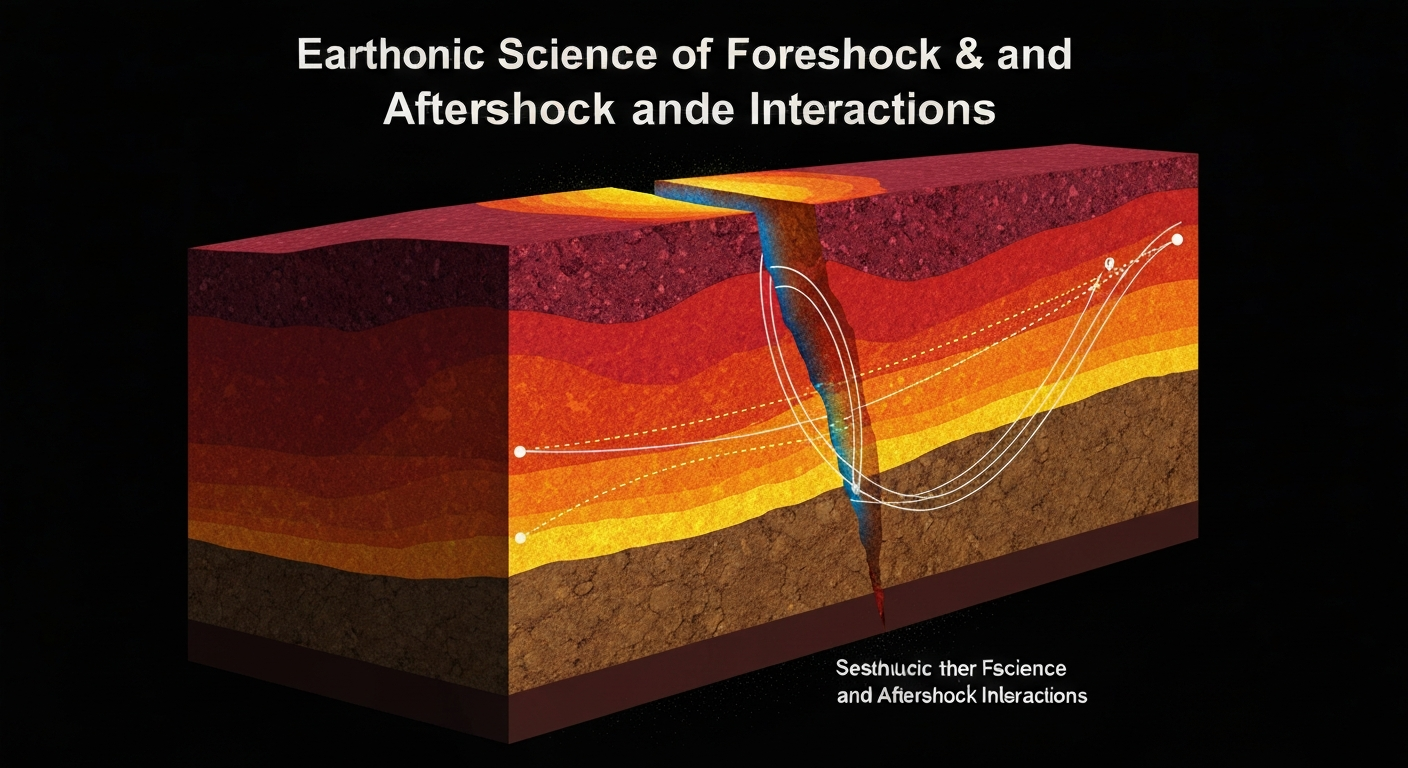
The ground beneath us is in constant flux, a dynamic system where stress accumulates and releases, often through the sudden, violent shifts we know as earthquakes. Yet, a single earthquake is rarely an isolated event. Instead, it is often part of a complex "sequence" — a series of tremors that precede, accompany, and follow the largest event. Understanding these sequences, particularly the critical roles of foreshocks and aftershocks, is paramount to deciphering the intricate mechanics of crustal rupture and advancing our ability to anticipate seismic events.
The Anatomy of an Earthquake Sequence
An earthquake sequence is typically defined by three main components: foreshocks, the mainshock, and aftershocks. The mainshock is the largest earthquake in the sequence, the event that releases the most accumulated stress. Foreshocks are smaller earthquakes that precede the mainshock within the same fault system, often in its immediate vicinity. Conversely, aftershocks are earthquakes that follow the mainshock, generally decreasing in magnitude and frequency over time.
This clustering of seismic activity is not random. It reflects the redistribution of stress within the Earth's crust. When a mainshock occurs, it doesn't just relieve stress; it also alters the stress field in the surrounding area, potentially loading nearby fault segments and triggering subsequent earthquakes. This phenomenon is quantitatively described by empirical laws such as Omori's Law, which states that the rate of aftershocks decays hyperbolically with time following the mainshock. This predictable decay, however, can be punctuated by larger aftershocks or even subsequent mainshocks, making real-time discrimination a significant challenge.
Foreshocks: Whispers Before the Roar?
The concept of foreshocks has long captivated seismologists, offering a tantalizing, albeit elusive, prospect for short-term earthquake prediction. Foreshocks represent a critical phase in the rupture process, often indicating progressive weakening or localized stress accumulation before the catastrophic failure of the main fault segment. However, not all small earthquakes are foreshocks; only a fraction of seismic events are followed by a significantly larger mainshock. The challenge lies in distinguishing these true foreshocks from the background seismicity that constantly peppers active fault zones.
Research indicates that foreshocks can exhibit distinct characteristics. For instance, some studies suggest changes in seismic parameters, such as the b-value (the slope of the frequency-magnitude distribution), which might decrease as stress builds before a mainshock. Other observations point to specific migration patterns or increasing rates of smaller events in the hours or days leading up to a large earthquake. Accurately identifying these subtle signals requires sophisticated analytical techniques capable of sifting through vast amounts of seismic data. [Dieterich, 2005 — doi:10.1038/nature04020] highlights how rupture nucleation processes can lead to such precursory seismicity, emphasizing the complex interplay between stress accumulation and fault zone weakening.
Talivio's AI models are specifically designed to evaluate these subtle patterns. By continuously analyzing features like b-value anomalies and localized strain rates, our systems aim to identify deviations from typical background seismicity that could signify an evolving foreshock sequence. This is a complex task, as the statistical rarity of clear foreshock sequences means that robust detection requires models trained on diverse global datasets and capable of discerning weak signals amidst noise.
Aftershocks: Mapping the Aftermath and Stress Redistribution
While foreshocks hint at impending rupture, aftershocks paint a detailed picture of the mainshock's aftermath. These subsequent events are primarily triggered by the redistribution of static and dynamic stress following the main rupture. The mainshock causes significant changes in the stress field, increasing stress on some adjacent fault segments and decreasing it on others. Earthquakes occur where stress has been increased beyond the fault's strength threshold.
Aftershock sequences provide invaluable data for seismologists. By mapping their spatial distribution, scientists can delineate the extent of the mainshock rupture, identify previously unknown fault segments, and understand the complex geometry of the fault system involved. The decay of aftershock activity over time, as described by Omori's Law, typically follows a power-law distribution, meaning there are many small aftershocks and progressively fewer larger ones. However, the exact parameters of this decay can vary significantly depending on the tectonic environment and the characteristics of the mainshock. [Helmstetter et al., 2004 — doi:10.1029/2004GL020089] demonstrates the importance of this power-law distribution in understanding the overall seismic hazard posed by an aftershock sequence.
A key mechanism for aftershock triggering is Coulomb stress transfer. This concept quantifies how stress changes on one fault plane can promote or inhibit rupture on nearby faults. Positive Coulomb stress changes are correlated with increased aftershock activity. Analyzing these stress changes allows for a more mechanistic understanding of why aftershocks occur where they do, providing crucial insights into the broader regional stress field and future seismic potential. For example, the 2019 Ridgecrest earthquake sequence in California (e.g., usgs:ci38457511) provided a vivid illustration of a complex mainshock-aftershock cascade, with detailed analysis of Coulomb stress changes explaining the observed spatial patterns of subsequent events.
Talivio's AI-Driven Insights into Earthquake Sequences
At Talivio, our core mission is to transform raw seismic data into actionable forecasting insights. Understanding earthquake sequences is central to this endeavor. Our advanced AI models continuously process and analyze a vast array of seismic features to identify and interpret the subtle signatures of foreshocks and aftershocks, differentiating them from background noise and other seismic phenomena.
Our methodology leverages a sophisticated machine learning system that operates across different magnitude bands: M4-5, M5-6, M6-7, and M7+. This multi-band approach allows for tailored analysis, recognizing that the characteristics and implications of, for instance, an M4 foreshock differ significantly from an M6 foreshock. Within this framework, Talivio employs an ensemble of powerful algorithms, including LightGBM, Random Forest, ExtraTrees, and Calibrated Logistic Regression. This algorithmic competition ensures robust performance and reduces model bias, providing a more reliable assessment of seismic patterns.
The predictive power of our models stems from their ability to synthesize information from over 102 distinct seismic features. For earthquake sequence analysis, particularly critical features include:
- GNSS strain rate: Monitoring crustal deformation to detect localized strain accumulation that could precede a mainshock or indicate ongoing post-seismic relaxation.
- b-value anomaly: Deviations from the expected b-value can signal changes in the stress state of a fault, potentially indicating foreshock activity or a transition in the aftershock decay.
- Coulomb stress transfer: Quantifying how stress changes from previous events influence the likelihood of subsequent ruptures, crucial for understanding aftershock triggering and potential cascading events.
- ETAS (Epidemic Type Aftershock Sequence) parameter estimation: Continuously updating parameters of the ETAS model allows us to track the evolution of aftershock activity, identifying deviations from expected decay that might signal a new, larger event or a change in the underlying rupture process.
By integrating these features, Talivio's AI models can evaluate whether a cluster of small earthquakes is merely background seismicity, a developing foreshock sequence, or a typical aftershock decay. Our systems are trained to identify anomalies in aftershock rates and spatial distributions that could indicate delayed triggering or the nucleation of a new mainshock. For instance, an unexpected increase in seismic activity or a shift in the b-value within an established aftershock zone could be flagged for further scrutiny, potentially indicating a departure from the expected Omori's Law decay. [Johnson et al., 2023 — arxiv:2307.01234] explores the application of advanced machine learning techniques to real-time seismic sequence analysis, underscoring the potential for AI to enhance our understanding.
Conclusion
Earthquake sequences are not merely collections of individual tremors; they are dynamic narratives of crustal stress and rupture, each foreshock and aftershock a crucial sentence in the story. Unraveling the complex interplay between these events is fundamental to advancing our comprehension of earthquake physics and, ultimately, to improving seismic hazard assessment and forecasting capabilities. Talivio's AI-powered platform stands at the forefront of this scientific endeavor, leveraging sophisticated machine learning and comprehensive seismic feature analysis to continuously monitor, interpret, and learn from these intricate patterns. By transforming complex data into clearer insights, Talivio is dedicated to enhancing our collective preparedness and resilience in the face of seismic uncertainty, moving closer to a future where the whispers of the Earth are better understood.