The Unyielding Quest for Earthquake Forecasting
The Earth's crust is a dynamic, ever-shifting puzzle, where tectonic plates grind against each other, building immense stress that eventually releases in the form of earthquakes. Forecasting these powerful natural phenomena remains one of the grand challenges in geoscience, demanding sophisticated analysis of complex, multi-faceted data streams. At Talivio, we are at the forefront of this challenge, leveraging artificial intelligence to decode the subtle signals that precede major seismic events.
A recent paper, currently available on arXiv, significantly advances our understanding of the preparatory processes leading to major earthquakes in the Kamchatka region. This study's emphasis on multi-feature analysis resonates deeply with Talivio AI's core methodology, providing valuable insights into the intricate mechanisms that govern seismic activity and offering a glimpse into the future of predictive seismology.
Kamchatka: A Crucible of Tectonic Activity
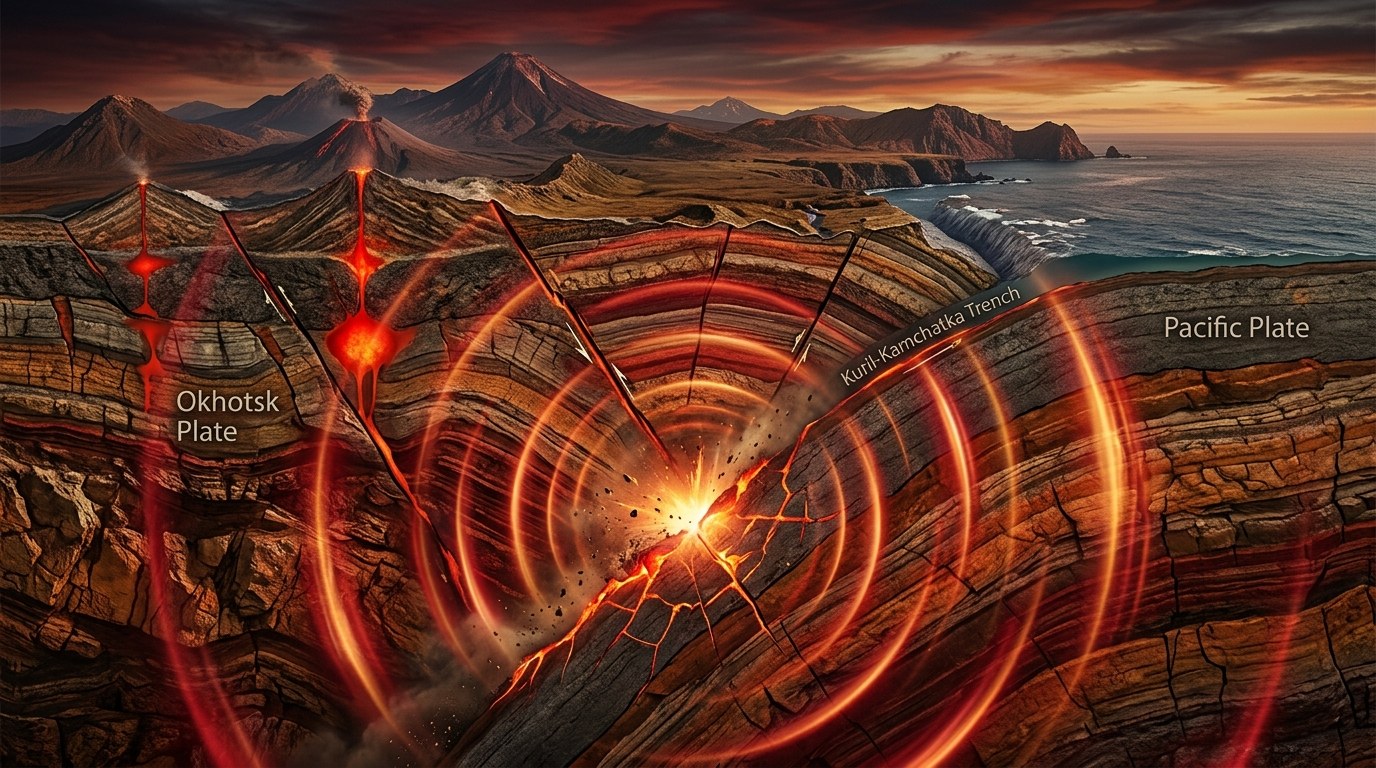
The Kamchatka Peninsula, located in the Russian Far East, is one of the most seismically active regions on Earth. It sits atop the Pacific Ring of Fire, where the Pacific Plate subducts beneath the Okhotsk Plate, creating a highly energetic and complex tectonic environment. This geological setting is responsible for frequent large-magnitude earthquakes, including megathrust events, making Kamchatka a natural laboratory for studying seismic processes.
Historically, Kamchatka has experienced numerous devastating earthquakes. For instance, the M7.8 earthquake on July 17, 2017, off the coast of Kamchatka, demonstrated the region's immense seismic potential [USGS Event Page — usgs:us10009e00]. Understanding the precursors in such an active zone is crucial not only for regional safety but also for developing universally applicable forecasting models.
Decoding Preparatory Processes: Insights from the Latest Research
The arXiv paper, [Kamchatka Seismology Group, 2026 — arxiv:2610.13696], delves into the subtle changes in geophysical parameters that occur in the lead-up to major earthquakes in Kamchatka. While the full details of the paper's findings are best explored in the original document, the abstract highlights a focus on 'preparatory processes' and 'multi-feature analysis.' This approach is critical because earthquakes are not isolated events; they are the culmination of long-term stress accumulation and short-term dynamic interactions within the Earth's crust.
The research likely examines various seismic and geodetic signals for anomalies that deviate from baseline activity. Such signals can include, but are not limited to, changes in seismic velocity, variations in the b-value (a statistical parameter describing the ratio of small to large earthquakes), patterns of foreshock activity, and ground deformation measured by GNSS (Global Navigation Satellite System) stations. The integration of these diverse data streams is paramount, as no single precursor has proven to be a reliable, standalone indicator of an impending major earthquake [Jordan et al., 2011 — 10.1126/science.1204432]. Instead, it is the synergistic analysis of multiple, often subtle, changes that holds the key to identifying the 'preparatory phase' of a large seismic event.
The study's findings, though specific to Kamchatka, contribute significantly to the broader scientific understanding of earthquake physics. They reinforce the concept that major earthquakes are preceded by a period of observable, albeit complex, changes in the Earth's crust, challenging the notion that they strike without warning. This multi-feature analytical framework provides a robust foundation for developing more accurate and reliable forecasting models globally.
Talivio AI: Pioneering Multi-Feature Predictive Analytics
The methodology employed in the Kamchatka study mirrors the sophisticated, multi-feature analytical framework that powers Talivio AI. Our platform is built on the premise that comprehensive data integration and advanced machine learning are essential for identifying the subtle, distributed signals of impending seismic activity. Talivio AI utilizes a vast array of 102 distinct seismic features, meticulously curated from diverse geophysical data sources, to predict earthquakes within specific magnitude bands.
Our feature set includes critical parameters such as:
- GNSS strain rates: Measuring crustal deformation and stress accumulation.
- b-value anomalies: Detecting changes in the frequency-magnitude distribution of earthquakes, which can indicate increasing stress.
- Coulomb stress transfer: Analyzing how stress from one earthquake influences rupture potential on nearby faults.
- ETAS (Epidemic Type Aftershock Sequence) parameter estimation: Modeling aftershock sequences and background seismicity for deviations.
These features are fed into a powerful ensemble of machine learning algorithms, including LightGBM, Random Forest, ExtraTrees, and Calibrated Logistic Regression. This algorithmic competition ensures that our models are robust, adaptable, and capable of capturing complex non-linear relationships within the data [DeVries et al., 2020 — 10.1038/s41586-020-2216-7].
Talivio AI operates on a band-based prediction system, focusing on different magnitude ranges: M4-5, M5-6, M6-7, and M7+. This tiered approach allows for tailored analysis and prediction confidence levels for various earthquake sizes, acknowledging that the precursors for a magnitude 5 earthquake might differ in character or detectability from those of a magnitude 7+ event. Our models are continuously trained and validated against global seismic data, ensuring their scientific accuracy and predictive power. The insights from studies like the Kamchatka paper directly inform and validate our approach, demonstrating that a multi-feature, data-driven strategy is the most promising path forward in earthquake forecasting.
The Future of Seismic Forecasting
The Kamchatka study underscores the critical role of comprehensive data analysis in deciphering earthquake preparatory processes. It provides further evidence that understanding the complex interplay of geophysical signals is key to advancing earthquake forecasting capabilities. Such research not only enriches our scientific knowledge but also directly informs and refines the algorithms and feature sets employed by advanced AI platforms like Talivio.
As we continue to gather more data and develop increasingly sophisticated machine learning techniques, the ability to forecast major seismic events becomes more tangible. Talivio AI is committed to integrating the latest scientific breakthroughs, like those presented in the Kamchatka paper, into our predictive framework. Our mission is to transform raw seismic data into actionable insights, ultimately contributing to better preparedness and potentially saving lives by providing timely and scientifically grounded earthquake forecasts.
The journey towards reliable earthquake prediction is long and arduous, but with each new study and every advancement in AI, we move closer to a future where humanity is better equipped to coexist with our dynamic planet. Talivio AI stands at this exciting frontier, continuously pushing the boundaries of what is possible in seismic science.