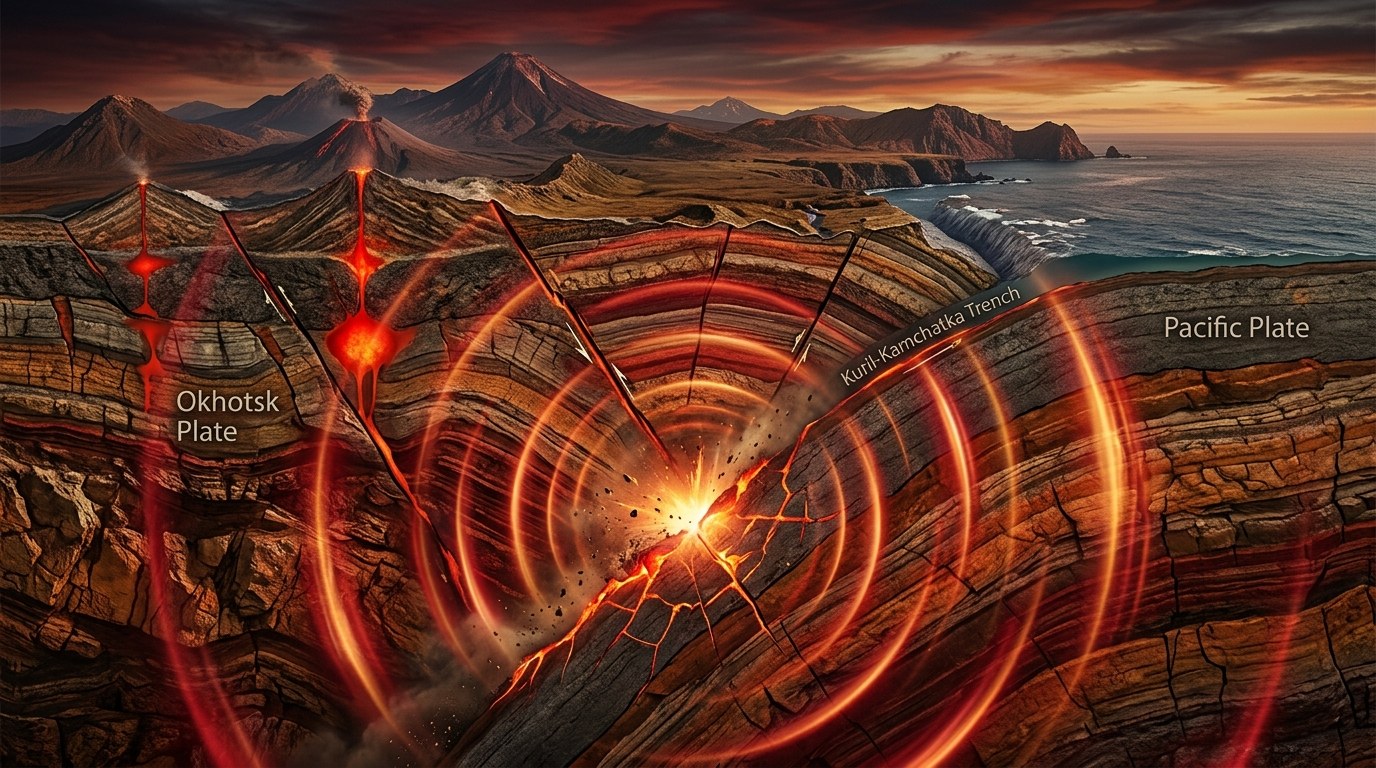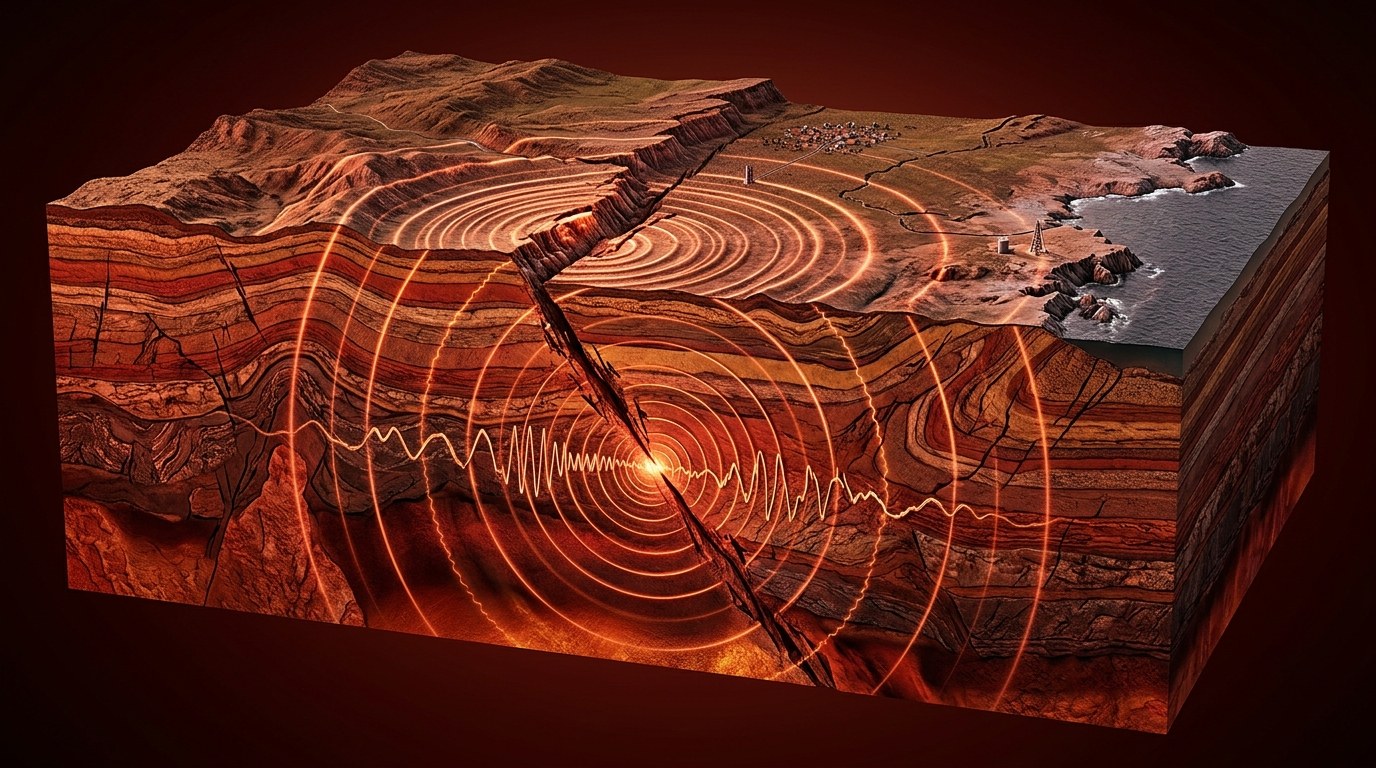
The Earth beneath our feet is a dynamic, living entity, constantly undergoing subtle shifts and immense transformations. While often imperceptible, these changes communicate through powerful, unseen forces: seismic waves. These waves are not merely indicators of an event that has already occurred; they are the fundamental messengers carrying crucial information about Earth's subsurface dynamics, stress accumulation, and potential for future seismic activity. At Talivio, we harness these profound signals, transforming the Earth's whispers into actionable insights through advanced artificial intelligence, laying the very foundation for our sophisticated earthquake forecasting platform.
The Language of the Earth: Understanding Seismic Waves
Seismic waves are elastic waves generated by earthquakes, volcanic eruptions, magma movement, large landslides, and man-made explosions. They propagate through the Earth's layers, carrying energy and information about the medium they traverse. Understanding their characteristics—speed, amplitude, frequency, and polarization—is paramount to deciphering the complex processes occurring deep within our planet.
Body Waves: Deep Earth's Insights
Body waves travel through the interior of the Earth and are categorized into two primary types:
- P-waves (Primary or Compressional Waves): These are the fastest seismic waves, arriving first at seismographs. P-waves are compressional, meaning they push and pull the material they travel through in the same direction as the wave itself, similar to sound waves. They can travel through solids, liquids, and gases. Their speed varies significantly with the density and elasticity of the material, providing critical data about the composition of Earth's layers. The initial detection of P-waves allows for the rapid estimation of an earthquake's origin time and initial location.
- S-waves (Secondary or Shear Waves): Slower than P-waves, S-waves arrive second. They are shear waves, meaning they move particles perpendicular to the direction of wave propagation. A key characteristic of S-waves is their inability to travel through liquids or gases, only solids. This fundamental property was crucial in determining that Earth's outer core is liquid, as S-waves are observed to be blocked or refracted significantly when encountering this layer. The amplitude and frequency content of S-waves provide additional information about the earthquake's magnitude and the characteristics of the fault rupture.
Surface Waves: Ground-Shaking Power
Surface waves travel along the Earth's surface and are responsible for most of the damage caused by earthquakes. They are generally slower than body waves but have larger amplitudes and longer durations.
- Love Waves: These waves cause horizontal shearing motion of the ground, perpendicular to the direction of wave propagation. They are particularly destructive to building foundations and structures, as they induce sideways swaying. Love waves are generated by the interference of S-waves trapped in the crustal waveguide.
- Rayleigh Waves: Rayleigh waves produce a rolling, elliptical motion of the ground, similar to ocean waves. This motion has both vertical and horizontal components. They are typically the slowest but often the largest and most damaging waves, capable of causing significant ground uplift and subsidence. The complex interaction of P and S waves near the surface gives rise to Rayleigh waves.
The precise measurement of these different wave types, including their arrival times, amplitudes, and spectral content, allows seismologists to triangulate earthquake epicenters, determine focal depths, and calculate magnitudes. For instance, the M7.8 earthquake that struck Türkiye and Syria in February 2023 (usgs:us7000k2y4) generated seismic waves that propagated globally, recorded by thousands of stations, providing a wealth of data for post-event analysis and model refinement.
From Raw Data to Predictive Power: Talivio AI's Approach
While the initial detection and characterization of seismic waves are fundamental, Talivio's mission extends far beyond post-event analysis. Our core strength lies in transforming these raw seismic signals and other geophysical data into a rich tapestry of features that inform our AI models for future earthquake forecasting. This process involves sophisticated signal processing and feature engineering, creating the bedrock for our predictive capabilities.
Talivio's models leverage a comprehensive suite of 102 distinct seismic and geophysical features, each meticulously extracted from continuous data streams. These features are not merely raw wave amplitudes; they represent complex patterns and anomalies that have been scientifically linked to the build-up and release of tectonic stress. Key features include:
- GNSS Strain Rate: Global Navigation Satellite System (GNSS) data provides precise measurements of crustal deformation. By analyzing changes in strain rates over time, we can identify areas where stress is accumulating or being released, offering crucial insights into the tectonic loading of faults [Hreinsdóttir et al., 2006 — DOI: 10.1029/2006GL027617]. Talivio processes vast arrays of GNSS data to derive regional and local strain rate tensors, which serve as direct indicators of crustal deformation patterns.
- b-value Anomaly: The b-value, derived from the Gutenberg-Richter law, describes the ratio of small to large earthquakes in a given region. A decrease in the b-value often suggests an increase in stress within a fault system, potentially preceding larger mainshocks [Schorlemmer et al., 2004 — DOI: 10.1029/2004JB003248]. Talivio's AI continuously monitors b-value fluctuations across various seismic zones, flagging significant anomalies as potential precursors.
- Coulomb Stress Transfer: Earthquakes do not occur in isolation. The stress changes induced by one earthquake can increase or decrease the likelihood of future events on nearby or connected faults. Coulomb stress transfer models quantify these interactions, showing how stress is redistributed across the crust [Stein, 1999 — DOI: 10.1038/45144]. Our platform integrates dynamic Coulomb stress calculations, feeding these complex stress fields into our predictive algorithms.
- ETAS Parameter Estimation: The Epidemic Type Aftershock Sequence (ETAS) model describes the spatio-temporal clustering of earthquakes, particularly aftershocks. Changes in ETAS parameters—such as the productivity of aftershocks or their decay rate—can sometimes signal altered stress states or the imminence of a larger event [Ogata, 1988 — DOI: 10.2307/2288924]. Talivio's AI dynamically estimates and tracks these parameters, identifying deviations from expected behavior.
Each of these features, along with dozens of others, provides a unique window into the Earth's stress regime. They are meticulously computed from global seismic catalogs, continuous waveform data, geodetic measurements, and other geophysical observations, all ultimately rooted in the information conveyed by seismic waves.
Talivio's AI Engine: Machine Learning for Forecasting
With an extensive array of 102 scientifically validated features, Talivio's next step is to process this colossal dataset using state-of-the-art machine learning. Our AI engine is designed to discern subtle, non-linear patterns and correlations that are imperceptible to human analysis, transforming raw geophysical signals into probabilistic earthquake forecasts.
A cornerstone of Talivio's methodology is its banded machine learning system. Recognizing that the physical processes and precursors for earthquakes can differ significantly based on their magnitude, we employ separate, specialized models for distinct magnitude bands: M4-5, M5-6, M6-7, and M7+. This approach allows each model to be optimally tuned to the specific seismic signatures and precursor phenomena associated with its target magnitude range, enhancing forecasting accuracy and reliability.
Our AI models are the result of rigorous algorithm competition and selection, ensuring we deploy the most robust and performant techniques available. We continuously evaluate and refine our models using a portfolio of advanced algorithms, including:
- LightGBM: A highly efficient gradient boosting framework that excels in handling large datasets and complex feature interactions, providing fast and accurate predictions.
- Random Forest: An ensemble learning method that builds multiple decision trees and merges their predictions to improve accuracy and control overfitting, offering robustness against noisy data.
- ExtraTrees (Extremely Randomized Trees): Similar to Random Forest but with increased randomness in feature selection and thresholding, often leading to faster training and reduced variance.
- Calibrated Logistic Regression: While simpler, logistic regression models, when properly calibrated, provide well-estimated probabilities, which are crucial for reliable forecasting. Calibration ensures that the predicted probabilities accurately reflect the true likelihood of an event.
These algorithms are trained on vast historical datasets, learning to identify the intricate relationships between the 102 geophysical features and subsequent earthquake occurrences. The AI doesn't "predict" in a deterministic sense; rather, it quantifies the probability of an earthquake of a certain magnitude occurring within a specified time window and geographical area [DeVries et al., 2018 — DOI: 10.1007/s00024-017-1721-1]. This probabilistic approach is scientifically sound and aligns with the inherent stochastic nature of earthquake processes. The continuous integration of new data allows our models to adapt and improve, constantly refining their understanding of Earth's complex seismic behavior. For example, recent research highlights the potential of machine learning to uncover subtle precursors in seismic data that were previously overlooked by traditional methods [Rouet-Leduc et al., 2020 — arxiv:2009.07340].
Conclusion: Translating Earth's Signals into Preparedness
Seismic waves are more than just vibrations; they are the Earth's primary communication channel, carrying vital information from deep within its crust to the surface. From the rapid compressions of P-waves to the destructive rolling of Rayleigh waves, each type offers a unique piece of the geophysical puzzle. At Talivio, our mission is to meticulously collect, analyze, and interpret these signals. By transforming raw seismic data into a rich array of 102 advanced features and feeding them into our sophisticated, banded machine learning models—powered by algorithms like LightGBM and Random Forest—we unlock unprecedented capabilities in earthquake forecasting.
Our commitment to scientific rigor, the avoidance of speculative language, and the continuous refinement of our AI-driven methodologies ensures that Talivio provides robust, data-backed insights. We are not just observing earthquakes; we are actively striving to understand their precursors, translating the Earth's complex language into probabilistic forecasts that empower communities and foster preparedness. As our understanding of seismic phenomena deepens and our AI models evolve, Talivio remains at the forefront of leveraging cutting-edge technology to navigate the dynamic challenges posed by our planet's restless nature.