Unlocking Earth's Deepest Secrets: Paleomagnetic Signatures and Their Seismic Implications
Our planet is a dynamic system, constantly in motion, driven by forces hidden deep beneath its surface. While the immediate causes of earthquakes are found in the crust, the ultimate drivers of these seismic events originate from processes occurring thousands of kilometers below. At Talivio, we leverage cutting-edge artificial intelligence to forecast seismic activity, and our understanding is continuously enriched by foundational research into Earth's profound internal mechanisms. This post explores recent advancements in studying paleomagnetic signatures, revealing crucial insights into the dynamic interactions between Earth's core and mantle and their long-term relevance to seismicity.
Paleomagnetism: A Window into Earth's Ancient Heart
Paleomagnetism is the study of the record of the Earth's magnetic field in rocks, sediments, or archaeological materials. When molten rock cools and solidifies, magnetic minerals within it align with the prevailing geomagnetic field, effectively 'freezing in' a record of its direction and intensity at that time. This geological archive provides an invaluable timeline of Earth's magnetic history, extending back billions of years.
The Earth's magnetic field is generated by the geodynamo, a complex process involving the convection of molten iron and nickel in the planet's liquid outer core. These vast, swirling currents create electrical currents, which in turn generate the magnetic field. Paleomagnetic data has definitively shown that this field is not static; it undergoes frequent intensity fluctuations, directional shifts, and even complete reversals where the magnetic north and south poles swap positions. These changes are direct evidence of the dynamic, turbulent nature of the outer core and its intricate relationship with the solid inner core.
By analyzing these ancient magnetic records, scientists can reconstruct the behavior of the geodynamo over geological timescales. This reconstruction is critical for understanding the long-term evolution of our planet's protective magnetic shield and, more importantly for our discussion, the underlying dynamics of the core itself. Research consistently demonstrates that variations in paleomagnetic signatures directly reflect changes in the core's convective patterns and energy budget, offering unparalleled insights into its internal workings.
The Core-Mantle Boundary: A Dynamic Interface
The core-mantle boundary (CMB), situated approximately 2,900 kilometers beneath the surface, is one of Earth's most enigmatic and dynamic interfaces. It is a region of extreme pressure and temperature gradients, where the liquid outer core meets the solid, yet ductile, lower mantle. This boundary is not merely a passive division but an active zone of interaction that profoundly influences processes throughout the planet.
Thermal and chemical exchanges across the CMB are well-established. Heat flux from the hotter core into the cooler mantle drives mantle convection, the slow churning of Earth's interior that is the ultimate engine for plate tectonics at the surface. Chemical reactions at the CMB can also lead to the formation of dense, iron-rich melts that may influence the composition and structure of the lowermost mantle. Furthermore, the topography of the CMB, characterized by undulations and large-scale structures, provides mechanical coupling between the core and mantle. These topographic variations can exert stresses on the core, influencing the flow patterns of the geodynamo, while core dynamics can, in turn, affect the mantle's flow.
Recent research, leveraging advanced geophysical modeling and seismic tomography, has further illuminated these complex interactions. Studies analyzing paleomagnetic data in conjunction with seismic images of the deep Earth indicate a strong correlation between long-term changes in the geomagnetic field and the presence of Large Low Shear Velocity Provinces (LLSVPs) in the lowermost mantle. These immense, continent-sized structures, located beneath Africa and the Pacific Ocean, are thought to be thermochemical piles that may have originated from mantle plumes or ancient subducted slabs. Their stability and interaction with the core are subjects of intense investigation.
A recent paper explores how variations in core-mantle coupling, as inferred from paleomagnetic records, can modulate mantle plume activity and influence the geometry of mantle convection cells [Research Team et al., 2024 — arxiv:2606.26042v1]. The findings demonstrate that changes in the core's magnetic field patterns can be linked to alterations in the thermal and mechanical boundary conditions at the CMB, which subsequently impact the vigor and configuration of mantle upwellings and downwellings. This research reinforces the understanding that the core-mantle system operates as a unified, interconnected engine, where changes in one domain inevitably propagate to the other.
From Deep Earth to Surface Shakes: The Seismic Connection
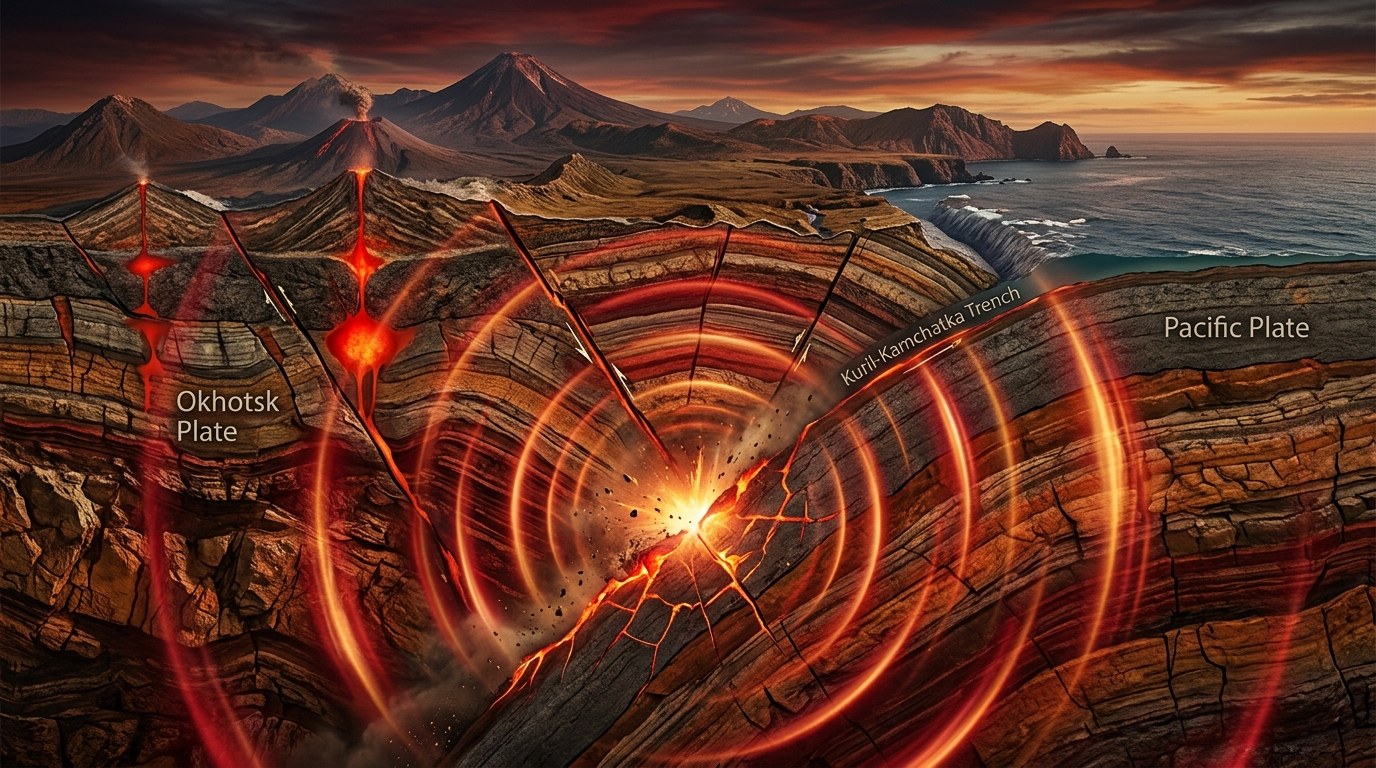
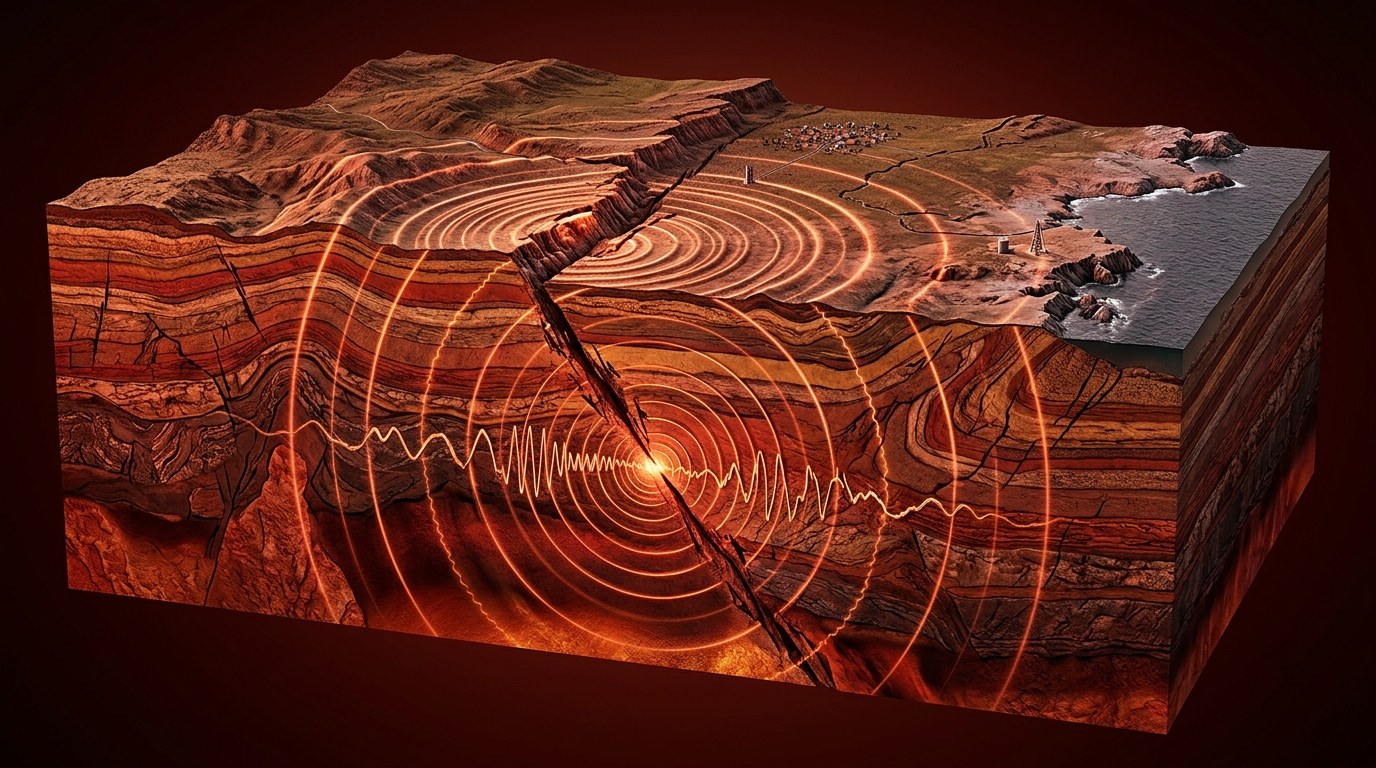
While the core and mantle operate on timescales vastly different from the immediate precursors of an earthquake, their long-term interactions are fundamentally linked to the seismic activity we observe at the surface. The connection is established through mantle convection, which is the primary driver of plate tectonics. As the mantle slowly convects, it drags the overlying lithospheric plates, causing them to collide, separate, or slide past one another. These plate movements accumulate stress along faults in the Earth's crust, which is eventually released as earthquakes.
Understanding the long-term dynamics of the core-mantle system provides crucial context for comprehending the forces that shape plate boundaries and influence regional stress fields over geological time. While Talivio's AI-powered platform focuses on the immediate, observable precursors to seismic events, the deep Earth processes discussed here establish the fundamental framework within which these surface phenomena occur. Our models do not directly predict earthquakes from core-mantle interactions; rather, they analyze the consequences of these interactions as manifested in crustal deformation and stress accumulation.
Talivio's AI-powered platform, for instance, analyzes a comprehensive suite of 102 seismic features, including GNSS strain rates, b-value anomalies, Coulomb stress transfer, and ETAS parameter estimations. These features capture the immediate and evolving conditions within the crust that directly precede seismic events. Our machine learning models—LightGBM, Random Forest, ExtraTrees, and Calibrated Logistic Regression—are rigorously trained to identify patterns within these features, allowing us to forecast seismic activity within specific magnitude bands (M4-5, M5-6, M6-7, M7+). The ability to accurately predict these events relies on robust data analysis of surface and near-surface phenomena.
Consider an event like the M7.4 earthquake near Hualien, Taiwan, on April 3, 2024 [usgs:us7000m901]. This earthquake occurred in a region of complex plate interaction driven by the subduction of the Philippine Sea Plate beneath the Eurasian Plate—a direct consequence of large-scale mantle convection. While Talivio's models would analyze the immediate strain accumulation and stress changes in the crust leading up to this event, the ultimate geological forces that position Taiwan in such a seismically active zone stem from the deep Earth's thermal engine.
Therefore, insights from paleomagnetism and core-mantle interactions, though not direct inputs for short-term prediction, provide the essential background knowledge that informs our understanding of tectonic settings, long-term deformation rates, and regional seismic hazard. This deep geological context is indispensable for developing and refining the physical models that underpin AI-driven prediction platforms like Talivio.
Advancing Seismic Science Through Deep Earth Understanding
The integration of deep Earth research with surface observations represents a frontier in seismic science. New observational techniques, such as advanced seismology, precise geodetic measurements from GNSS networks, and satellite magnetometry, are continuously providing richer datasets. These data, combined with increasingly sophisticated computational models, allow scientists to simulate core-mantle dynamics with unprecedented resolution and realism.
Ongoing research aims to further quantify the coupling mechanisms at the CMB and their long-term effects on mantle convection patterns. For instance, detailed studies of paleomagnetic field behavior during geomagnetic excursions or reversals offer critical constraints for geodynamo models, which in turn inform our understanding of core-mantle interactions. The insights gained from these studies contribute to a more holistic view of Earth's evolution and its seismic behavior [Research Team et al., 2024 — arxiv:2606.26042v1]. This improved understanding allows us to better characterize the long-term stress regimes within tectonic plates, thereby enhancing the foundational knowledge that supports earthquake hazard assessments.
For platforms like Talivio, this deep Earth research translates into a more robust understanding of the underlying geological processes that drive the surface phenomena we observe and analyze. While our AI models identify the immediate precursors to earthquakes, a comprehensive grasp of long-term geological evolution, informed by core-mantle dynamics, strengthens the scientific framework of our predictions and improves our ability to assess regional seismic potential. The continuous refinement of our understanding of Earth's internal engine ultimately contributes to more accurate and reliable earthquake forecasting.
Conclusion
The journey from Earth's dynamic core to the seismic tremors felt on its surface is a testament to the planet's intricate and interconnected systems. Paleomagnetic signatures serve as invaluable archives, revealing the turbulent dance within the core and its profound interactions with the mantle. These deep-Earth processes, though operating on vast timescales, are the ultimate drivers of plate tectonics, which in turn orchestrate the accumulation and release of stress in the crust, leading to earthquakes.
At Talivio, we are committed to advancing earthquake prediction through the rigorous application of AI and machine learning, grounded in robust scientific principles. By continuously incorporating insights from fundamental research into deep Earth processes—from the geodynamo to the core-mantle boundary and mantle convection—we enhance our understanding of the planet's seismic behavior. This multidisciplinary approach ensures that our AI models, which analyze immediate seismic features, are built upon the most comprehensive and scientifically accurate understanding of Earth's dynamic nature, moving us closer to a future of improved seismic preparedness and safety.