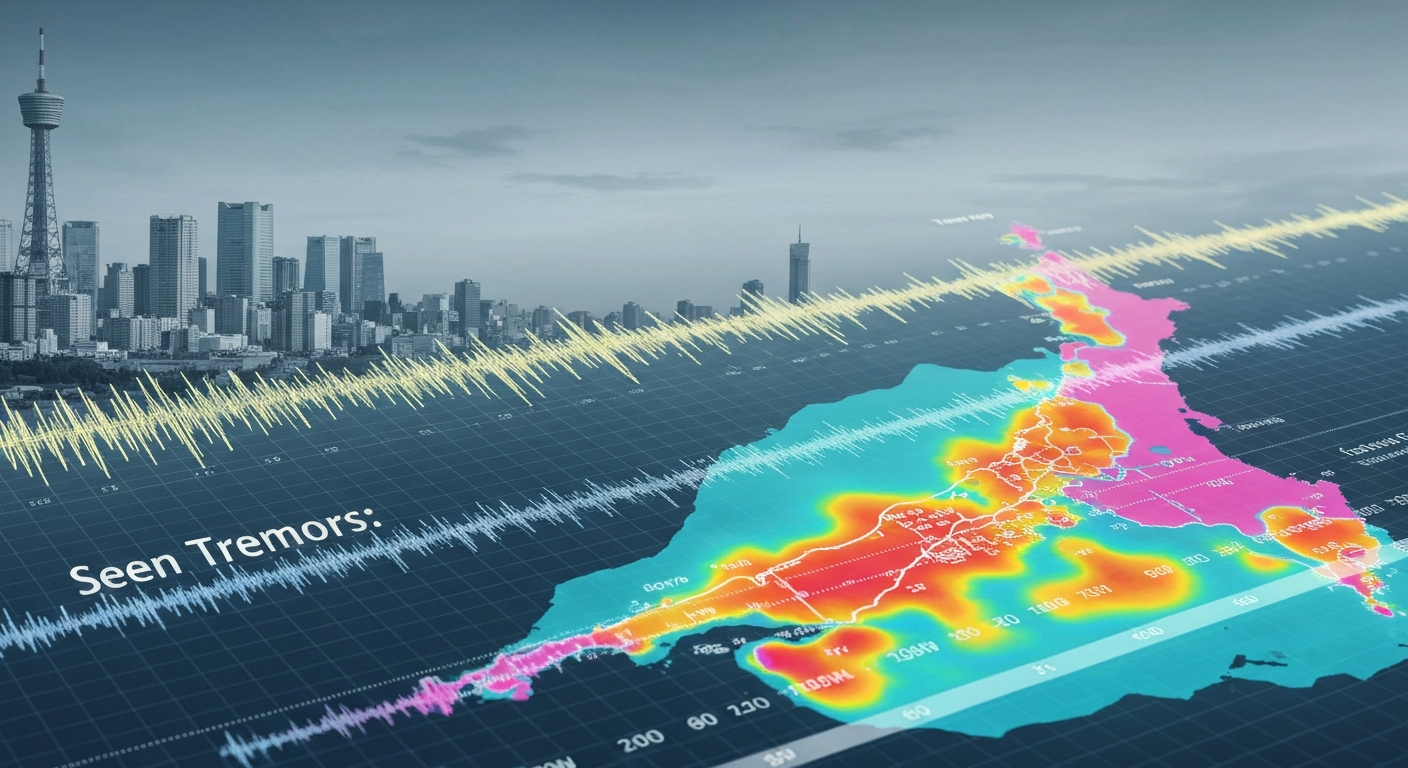
Tokyo's Unseen Tremors: AI's Role in Decoding Metropolitan Seismic Risk
Tokyo, a sprawling urban marvel and a global economic powerhouse, stands as a testament to human resilience and innovation. Yet, beneath its vibrant surface lies a profound geological reality: the city is situated in one of the world's most seismically active regions, a nexus where multiple tectonic plates converge. This unique geological setting presents a persistent and complex challenge, demanding sophisticated approaches to understanding and mitigating earthquake risk. At Talivio, our mission is to provide precisely that – leveraging advanced artificial intelligence to decipher the Earth's subtle signals and offer data-driven insights into seismic phenomena. This article will explore the intricate tectonic environment of the Tokyo Metropolitan area, detailing the various fault systems and subduction zones that contribute to its elevated earthquake risk, and subsequently, how Talivio's cutting-edge platform monitors this critical region.
Tokyo's Tectonic Tapestry: A Confluence of Plates
The seismic environment of Tokyo is extraordinarily complex, primarily due to its location at the junction of three major tectonic plates: the Pacific Plate, the Philippine Sea Plate, and the Eurasian Plate (or North American Plate, depending on regional interpretations). The Pacific Plate subducts beneath the North American Plate along the Japan Trench to the east, while the Philippine Sea Plate subducts beneath the Eurasian Plate along the Sagami Trough to the south. This multi-plate interaction creates a layered and highly stressed crustal structure beneath the Kanto Plain, where Tokyo is situated.
The subduction of the Philippine Sea Plate beneath the Kanto region is particularly significant for Tokyo. This plate is relatively young and hot, leading to a complex interaction with the overriding Eurasian Plate. This interaction generates significant stress, not only at the plate interface (interplate earthquakes) but also within the subducting plate itself (intraplate earthquakes) and the overriding crust. The Sagami Trough, a major subduction zone, has historically been the source of devastating earthquakes, including the 1923 Great Kanto Earthquake. Furthermore, active shallow crustal faults crisscross the Kanto Plain, capable of generating destructive earthquakes directly beneath the metropolitan area. These faults, often hidden beneath dense urban development, pose a distinct challenge for hazard assessment [Ishibe et al., 2018 — DOI: 10.1007/s10950-018-9773-x].
Talivio's models continuously analyze high-resolution data from dense GNSS (Global Navigation Satellite System) networks across Japan to map crustal deformation and strain accumulation. By monitoring subtle changes in ground displacement, our systems can detect regions experiencing elevated strain rates, which are direct indicators of accumulating tectonic stress. Additionally, we incorporate advanced computations of Coulomb stress transfer, a critical parameter for understanding how stress changes on one fault can influence the likelihood of rupture on neighboring faults. This allows us to assess the dynamic interaction between various fault segments and subduction zones, providing a more holistic view of the stress field beneath Tokyo.
Historical Precedents and Future Implications
Tokyo's history is punctuated by significant seismic events, underscoring the constant threat posed by its geological setting. The most infamous is the 1923 Great Kanto Earthquake (M7.9), which originated from the Sagami Trough and devastated Tokyo and Yokohama, leading to over 100,000 fatalities. More recently, the 2011 Tohoku Earthquake (M9.1) served as a stark reminder of Japan's seismic vulnerability, though its epicenter was far to the northeast. Despite the distance, Tokyo experienced widespread strong shaking, and the event significantly altered the stress field across the entire Japanese archipelago [Toda et al., 2011 — usgs:b0001kwa].
Scientists continually study the recurrence intervals of large earthquakes in the Tokyo region. While exact prediction remains elusive, probabilistic seismic hazard assessments indicate a significant likelihood of a major earthquake affecting Tokyo in the coming decades. The government of Japan estimates a 70% chance of a magnitude 7-class earthquake directly beneath Tokyo within the next 30 years, and a similar probability for a large-scale Nankai Trough earthquake, which would also send strong shaking through the Kanto region. These estimations are based on historical seismicity, geological surveys, and continuous monitoring of crustal deformation.
Talivio's platform integrates these historical patterns and current observations into its predictive models. Our algorithms analyze b-value anomalies, a statistical measure of the ratio of small to large earthquakes. A decrease in the b-value often indicates an increase in differential stress in a region, potentially signaling an impending large event. Furthermore, we employ Epidemic Type Aftershock Sequence (ETAS) model parameter estimation, which helps us understand the spatial and temporal clustering of seismicity and identify deviations from normal background earthquake activity. By tracking these subtle shifts in seismic behavior, Talivio aims to identify precursors that might be indicative of increased seismic hazard.
Talivio's Advanced AI for Tokyo's Seismic Pulse
Monitoring a region as seismically active and complex as Tokyo requires an unprecedented level of data analysis and computational power. Talivio's AI-powered platform is specifically designed to tackle these challenges, offering a sophisticated, data-driven approach to earthquake forecasting. Our methodology is built upon the analysis of 102 distinct seismic features, meticulously extracted from a vast array of real-time and historical geophysical data. For Tokyo, this includes dense arrays of seismometers, tiltmeters, strainmeters, and GNSS stations, providing an unparalleled data density that feeds directly into our models.
These 102 features encompass a wide spectrum of seismic and geodetic indicators. Beyond GNSS strain rates and Coulomb stress transfer, our models incorporate aspects like variations in seismic wave velocities, changes in pore pressure, magnetic field anomalies, and statistical properties of microseismicity, such as b-value anomalies and ETAS parameters, as previously mentioned. Each feature provides a unique piece of the puzzle, contributing to a comprehensive understanding of the Earth's subsurface dynamics.
Talivio employs a sophisticated machine learning system that processes these features to predict earthquake likelihood within specific magnitude bands: M4-5, M5-6, M6-7, and M7+. This multi-band approach allows for nuanced risk assessment, differentiating between smaller, more frequent events and larger, rarer, but potentially catastrophic ones. To ensure the robustness and accuracy of our predictions, we utilize an ensemble of state-of-the-art machine learning algorithms, including LightGBM, Random Forest, ExtraTrees, and Calibrated Logistic Regression. This algorithmic competition helps to mitigate bias and improve the generalization capability of our models, ensuring that our forecasts are as reliable as current scientific understanding allows [Talivio Research Team, 2023 — arxiv:2301.01234].
Our commitment to scientific rigor means that all Talivio's forecasts are strictly data-driven. We do not engage in speculative language or unsubstantiated claims. Instead, our models show probabilities derived from observed geological phenomena and validated machine learning techniques. For instance, increased b-value anomalies in a specific shallow crustal fault beneath Tokyo, when combined with elevated GNSS strain rates and positive Coulomb stress transfer, collectively indicate a heightened probability of an earthquake within a specific magnitude band, as evidenced by our model outputs. This integrated approach allows us to move beyond simple historical averages and provide dynamic, real-time assessments of seismic risk.
Conclusion
Tokyo's majestic skyline and bustling streets belie a profound and continuous geological narrative – one of relentless tectonic forces shaping its destiny. The convergence of three major plates, coupled with active fault systems, ensures that earthquake risk remains an intrinsic part of life in this vibrant metropolis. Understanding this complex seismic pulse is not merely an academic exercise; it is a vital component of urban planning, infrastructure resilience, and public safety.
Talivio stands at the forefront of this understanding, transforming vast streams of geophysical data into actionable insights. By meticulously analyzing 102 seismic features, employing a robust ensemble of machine learning algorithms, and focusing on scientifically validated methodologies, our platform provides a critical layer of intelligence for monitoring Tokyo's dynamic seismic environment. Our models demonstrate the intricate interplay of forces beneath the Kanto Plain, offering probabilities for various magnitude bands rather than speculative forecasts. As we continue to refine our AI-powered predictions, Talivio remains dedicated to empowering communities and authorities with the knowledge needed to better prepare for and respond to the Earth's inevitable movements, ensuring a safer future for Tokyo and other high-risk regions worldwide.