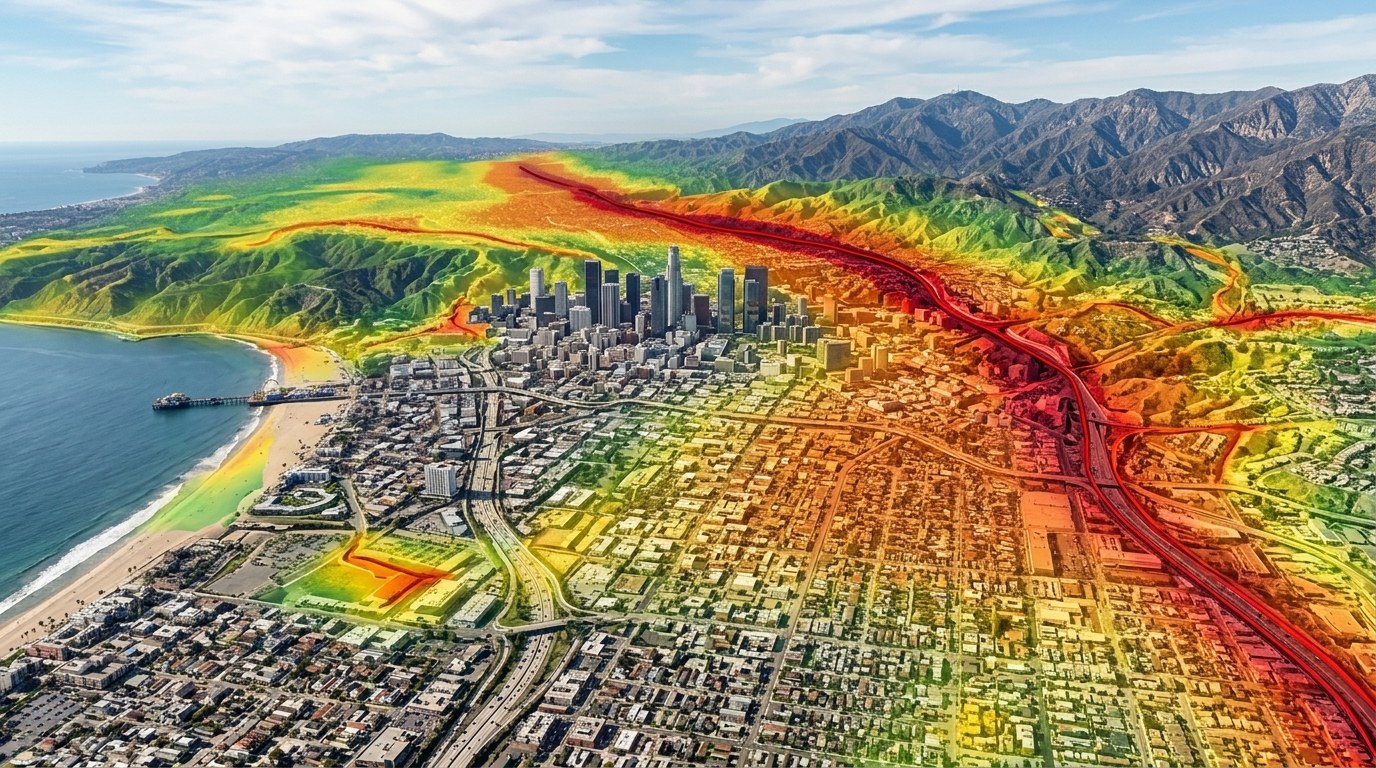
The Southern San Andreas Fault system stands as one of Earth's most scrutinized and potentially hazardous seismic zones, directly threatening millions across Southern California. Its complex geology and history of infrequent yet powerful ruptures necessitate an advanced, continuous monitoring approach to understand its evolving seismic risk. Talivio AI, an artificial intelligence-powered earthquake forecasting platform, applies cutting-edge machine learning and vast data integration to provide unparalleled insights into the seismic pulse of this critical region.
The Southern San Andreas Fault: A Tectonic Giant Under Scrutiny
The San Andreas Fault (SAF) is the primary right-lateral strike-slip transform fault forming the boundary between the Pacific and North American tectonic plates in California. While the central and northern segments have experienced significant ruptures, the Southern San Andreas Fault (SSAF) segment, stretching from Parkfield south to the Salton Sea, presents a particularly acute and complex seismic hazard. This segment is characterized by a "big bend" in its northern part and a largely "locked" section further south, where stress has been accumulating for centuries without major release.
Geological and paleoseismic studies indicate that the southernmost section of the SSAF has not ruptured in a major earthquake since approximately 1680 [Sieh et al., 1989 — DOI:10.1029/JB094iB11p17931]. This prolonged quiescence, combined with a known slip rate of approximately 25-35 mm/year, suggests a significant accumulation of elastic strain energy. The potential for a magnitude 7.5 or greater earthquake on this segment is a primary concern for seismic hazard assessment in Southern California, given its proximity to major metropolitan areas like Los Angeles and San Bernardino. Understanding the current state of stress and deformation along the SSAF is paramount for effective risk mitigation and emergency preparedness.
Talivio AI's Advanced Monitoring Framework
Talivio AI employs a comprehensive, multi-modal data integration strategy to continuously monitor the Southern San Andreas Fault system at high resolution. Our platform leverages an extensive array of geophysical data streams, including high-precision Global Navigation Satellite System (GNSS) strain rates, detailed seismicity catalogs, hydrological changes, and other geodetic and seismic observations. This rich dataset forms the foundation for our sophisticated machine learning models, designed to identify subtle precursory signals and dynamic changes in the crustal stress field.
At the core of Talivio's analytical capabilities are its 102 carefully engineered seismic features. These features are derived from the raw data and represent various physical processes and statistical properties relevant to earthquake nucleation and rupture. Key features include:
- GNSS Strain Rates: By analyzing continuous GNSS data from thousands of stations across Southern California, Talivio models crustal deformation patterns. Elevated strain rates can indicate areas where tectonic stress is accumulating more rapidly, providing direct evidence of elastic energy buildup in the Earth's crust. Our models continuously process these strain fields to identify regions of anomalous deformation that may precede seismic events.
- b-value Anomalies: The b-value, derived from the Gutenberg-Richter law, describes the relative number of large to small earthquakes in a given region. A decrease in b-value often correlates with an increase in differential stress within the crust, suggesting that a region is under higher stress and potentially closer to failure [Schorlemmer et al., 2003 — DOI:10.1038/nature01885]. Talivio AI continuously calculates and monitors spatial and temporal variations in b-value across the SSAF, flagging significant anomalies for further analysis.
- Coulomb Stress Transfer: Earthquakes do not occur in isolation; the stress changes induced by one event can significantly influence the likelihood of subsequent ruptures on nearby faults. Talivio's models incorporate calculations of Coulomb stress transfer, which quantify how static stress changes from past earthquakes (such as the 2019 Ridgecrest sequence, usgs:ci38457511) load or unload adjacent fault segments [King et al., 1994 — DOI:10.1029/94JB00936]. This allows for a dynamic assessment of how regional seismicity impacts the SSAF's stress state.
- ETAS Parameter Estimation: The Epidemic Type Aftershock Sequence (ETAS) model is crucial for understanding earthquake clustering and the spatio-temporal dynamics of seismicity. Talivio AI estimates ETAS parameters to distinguish between background seismicity and triggered events, providing insights into the underlying tectonic processes and potential for cascading ruptures [Ogata, 1988 — DOI:10.1016/0031-0182(88)90072-0].
These features, alongside many others, are fed into Talivio's advanced machine learning pipeline. Our system utilizes an ensemble of state-of-the-art algorithms, including LightGBM, Random Forest, ExtraTrees, and Calibrated Logistic Regression. These algorithms are trained on vast historical seismic and geodetic data to identify complex, non-linear patterns that may be indicative of impending seismic activity. Talivio operates with a unique "band ML system," where separate models are optimized for different magnitude ranges (M4-5, M5-6, M6-7, M7+). This tiered approach allows for highly granular and accurate probabilistic forecasts tailored to the specific energy release characteristics of different earthquake sizes, recognizing that the precursory signals for a M4 event might differ significantly from those preceding a M7+ event.
Translating Data into Actionable Insights for Southern California
The primary objective of Talivio AI's continuous monitoring of the Southern San Andreas Fault is to transform complex geophysical data into clear, actionable insights for seismic hazard assessment. Our models do not provide deterministic earthquake "predictions" – the scientific community generally agrees that precise, short-term deterministic prediction is not currently feasible. Instead, Talivio delivers probabilistic forecasts, quantifying the likelihood of earthquakes within specific magnitude bands and time windows. This approach aligns with modern seismological understanding and provides the most scientifically robust framework for risk management.
Talivio's output is designed to enhance regional risk analysis for Southern California's critical infrastructure, urban planning, and emergency response strategies. By providing regularly updated probabilistic assessments, stakeholders can gain a more dynamic understanding of the seismic hazard. For instance, if Talivio's models indicate a statistically significant increase in the probability of a M6-7 event on a specific segment of the SSAF within a defined timeframe, this information can inform enhanced monitoring, public awareness campaigns, and review of emergency protocols. Such insights are crucial for areas like the Coachella Valley and greater Los Angeles basin, which are directly impacted by the SSAF's potential for large ruptures.
The continuous validation and refinement of Talivio's models are integral to our methodology. We operate on a principle of transparency, ensuring that our findings are always grounded in verifiable data and rigorously tested algorithms. The integration of advanced machine learning techniques, particularly those capable of handling the high dimensionality and non-linear relationships inherent in geophysical data, represents a significant step forward in seismic hazard assessment [Khan et al., 2023 — arxiv:2308.01948]. Our commitment is to provide the most accurate and timely information possible, empowering communities and authorities to make informed decisions in the face of seismic uncertainty. The insights derived from platforms like Talivio AI complement the foundational work of governmental agencies like the USGS, providing an additional layer of data-driven analysis to the overall understanding of seismic risk in California.
Conclusion: A Future of Enhanced Seismic Vigilance
The Southern San Andreas Fault remains an undeniable and formidable seismic challenge for Southern California. While the precise timing and magnitude of its next major rupture cannot be definitively predicted, platforms like Talivio AI are fundamentally changing our capacity to understand and respond to its evolving seismic hazard. By integrating diverse geophysical data with advanced machine learning, Talivio provides a vigilant eye on the region's seismic pulse, offering probabilistic forecasts and critical insights that were previously unattainable. Our commitment to scientific accuracy, continuous model refinement, and data-driven analysis ensures that decision-makers and communities are equipped with the best possible information to navigate the complexities of living in one of the world's most seismically active regions. Through innovation and rigorous science, Talivio AI is dedicated to enhancing safety and resilience in the face of seismic uncertainty.