Introduction: California's Seismic Challenge
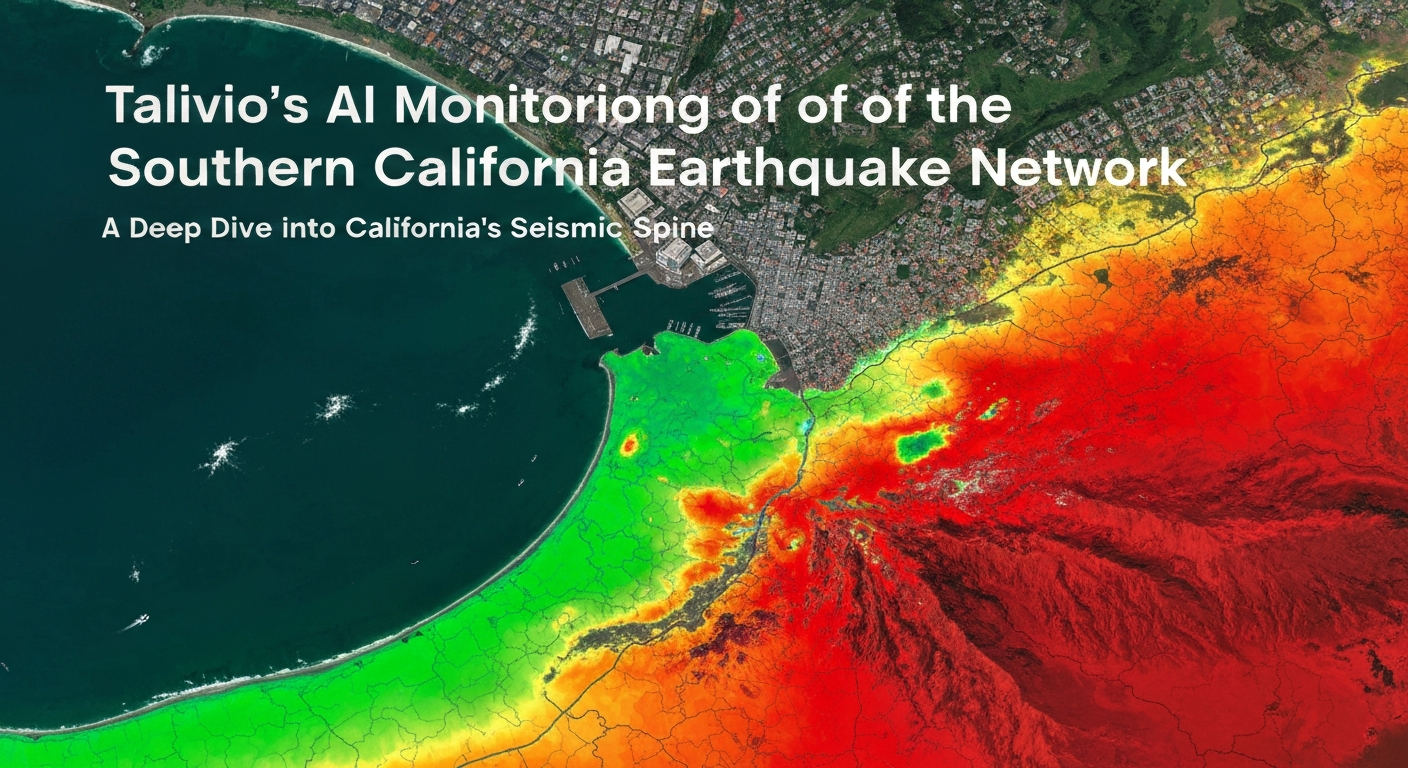
California sits atop a dynamic tectonic boundary, a reality underscored by the omnipresent threat of earthquakes. At the heart of this geological drama lies the San Andreas Fault System, a colossal right-lateral strike-slip fault that defines the interaction between the Pacific and North American plates. While the entire system demands vigilance, the southern segment of the San Andreas Fault (SAF) is of particular concern, representing a critical seismic gap with the potential for a major rupture that could profoundly impact one of the world's most populous regions. Talivio, with its advanced AI-powered platform, provides continuous, data-driven monitoring and analysis of this complex and vital segment, offering crucial insights into its ongoing seismic activity and long-term hazard.
The Southern San Andreas Fault: A Segment Under Pressure
The San Andreas Fault is not a single, continuous break but a complex system of interconnected fault segments. The southern San Andreas Fault, stretching approximately from the Salton Sea northwestward through the Coachella Valley and into the San Bernardino Mountains, is a segment characterized by long periods of seismic quiescence, leading to significant stress accumulation. Unlike segments further north that exhibit more frequent, smaller ruptures or even creep, the southernmost SAF is largely locked, meaning it accumulates elastic strain over centuries without significant release. This locking mechanism is a primary factor contributing to its high seismic hazard potential.
Geological evidence and paleoseismic studies indicate that the southern SAF has a history of generating large, infrequent earthquakes, with an estimated recurrence interval for major events in the range of 150-200 years. The last major rupture on the southernmost segment occurred over 300 years ago, suggesting that this segment is well overdue for a significant earthquake. The United States Geological Survey (USGS) consistently highlights the southern SAF as a prime candidate for a future 'Big One' due to its extended period without a major event and its high slip rate, which can reach up to 34 mm/year in some sections [USGS: The San Andreas Fault System — link]. Understanding the mechanics of this stress accumulation and its potential release is paramount for seismic hazard assessment.
Seismicity Patterns and Stress Dynamics
The southern San Andreas Fault's seismicity is characterized by a mix of infrequent large events and continuous, albeit often subtle, microseismicity. While the main fault trace itself can appear quiet, adjacent or parallel faults within the broader Southern California fault system, such as the San Jacinto and Elsinore faults, exhibit more frequent activity. These adjacent faults play a critical role in the stress dynamics of the region, as stress can be transferred between fault segments, potentially influencing the rupture potential of the main SAF. For example, a moderate earthquake on a nearby fault could, in theory, increase or decrease the stress on a segment of the SAF, a phenomenon known as Coulomb stress transfer.
Scientists utilize various metrics to monitor these complex dynamics. "b-value" analysis, which describes the ratio of small to large earthquakes, can reveal insights into the stress state of a fault. Anomalously low b-values in a region may indicate higher stress accumulation, while high b-values might suggest a more fractured crust or lower stress. Continuous Global Navigation Satellite System (GNSS) measurements provide critical data on crustal deformation, revealing the rate and direction of strain accumulation across the fault zone. These precise measurements show how the land is deforming, providing direct evidence of the tectonic forces at play. Research, such as the Uniform California Earthquake Rupture Forecast, Version 3 (UCERF3), extensively models these factors, emphasizing the significant hazard posed by the southern SAF based on accumulated strain and rupture probabilities [Field et al., 2013 — DOI: 10.3133/ofr20131165].
Even seemingly minor seismic events, like the M 2.4 earthquake near Borrego Springs, CA on May 15, 2024 [USGS Event: M 2.4 near Borrego Springs, CA (2024-05-15) — usgs:ci40798080], while not directly on the main SAF, contribute to the overall seismic signature that Talivio's AI monitors. These events, even small, provide valuable data points about the stress field and the behavior of the surrounding crust.
Talivio's AI Platform: Unveiling Hidden Patterns in Seismic Data
Talivio's strength lies in its ability to process and analyze vast quantities of diverse seismic and geophysical data in real-time, far exceeding human capacity. For the southern San Andreas Fault, our AI platform provides continuous monitoring, leveraging a sophisticated machine learning framework to identify subtle precursors and patterns that might indicate changes in seismic potential. Our models are trained on an extensive dataset of historical earthquake catalogs and geophysical measurements, enabling them to discern complex relationships often invisible to traditional analysis methods.
The core of Talivio's methodology involves the extraction and analysis of 102 distinct seismic features. These features encompass a wide range of geophysical parameters, including:
- GNSS strain rate: Quantifying crustal deformation and stress accumulation.
- b-value anomaly: Detecting deviations from typical earthquake size distributions, which can signal changes in stress.
- Coulomb stress transfer: Modeling how stress from one earthquake or creeping segment might influence adjacent fault sections.
- ETAS (Epidemic Type Aftershock Sequence) parameter estimation: Analyzing the spatiotemporal clustering of earthquakes to understand triggering mechanisms.
- Other features include seismicity rates, seismic wave velocity changes, pore pressure variations, tidal stresses, and more, providing a comprehensive view of the fault's state.
These features feed into a multi-band machine learning system, which assesses probabilities for different magnitude ranges: M4-5, M5-6, M6-7, and M7+. This tiered approach allows for granular risk assessment across various scales of potential events. Our platform employs an algorithm competition, rigorously testing models such as LightGBM, Random Forest, ExtraTrees, and Calibrated Logistic Regression. The best-performing model or an ensemble of models is then selected to generate the most robust and accurate insights. This ensures that our analysis is always at the cutting edge of machine learning for seismology [Mousavi et al., 2019 — arxiv:1905.09346].
Talivio's models do not engage in speculative predictions. Instead, they provide data-driven assessments of seismic potential. For instance, our models might show elevated probabilities for certain magnitude bands in specific segments of the southern SAF based on observed b-value anomalies, coupled with GNSS data indicating accelerated strain accumulation. This integrated analysis offers a dynamic understanding of the fault's behavior, moving beyond static hazard maps to provide real-time, evolving insights into seismic risk.
Conclusion: Enhancing Resilience Through AI-Powered Insight
The southern San Andreas Fault remains one of the most significant seismic hazards in the United States, demanding continuous and sophisticated monitoring. Talivio's AI platform stands at the forefront of this effort, transforming vast streams of geophysical data into actionable insights. By meticulously analyzing 102 seismic features and employing advanced machine learning algorithms across multiple magnitude bands, Talivio provides an unparalleled, non-speculative assessment of the southern SAF's seismic potential. Our commitment to scientific rigor and continuous model refinement ensures that stakeholders, from emergency responders to urban planners, have access to the most advanced understanding of California's seismic spine, ultimately enhancing resilience in the face of inevitable geological forces. Stay informed with Talivio's ongoing analysis as we continue to push the boundaries of AI in earthquake science.