In the vast, icy expanse of the South Atlantic Ocean lies one of Earth's most dynamic and least-understood tectonic boundaries: the South Sandwich Arc. This remote island chain, curving gracefully between the South American and Antarctic plates, is a crucible of intense seismic activity, driven by some of the fastest subduction rates on the planet. Understanding the complex interplay of forces in this region is not merely an academic exercise; it's a critical step towards comprehending global seismic patterns and refining our predictive capabilities, even for events in seemingly isolated corners of the world.
At Talivio, our mission is to leverage cutting-edge artificial intelligence to decode the Earth's seismic signals. The South Sandwich Arc, with its unique challenges and high seismicity, serves as an invaluable natural laboratory for our advanced models. This article explores the distinctive geological context that generates large earthquakes in this remote oceanic region, highlighting its rapid subduction rate and the associated seismicity patterns that challenge traditional monitoring approaches.
The Tectonic Engine: Rapid Subduction in the South Sandwich Arc
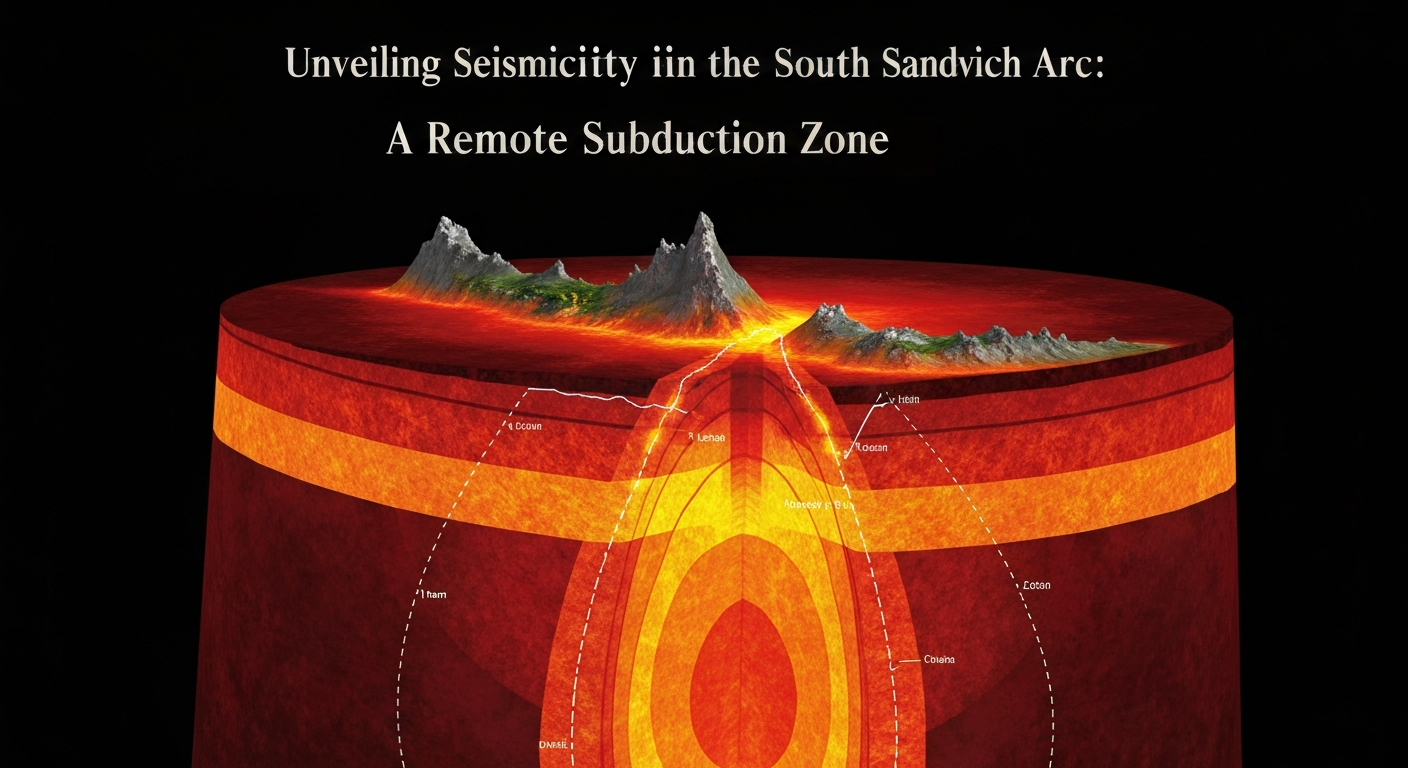
The South Sandwich Arc is a classic example of an oceanic island arc, formed by the eastward subduction of the South Sandwich Plate beneath the South Sandwich Microplate, which is itself part of the larger Scotia Plate. What makes this zone particularly remarkable is its extreme subduction velocity. Data indicates that the South Sandwich Plate is diving beneath its counterpart at rates ranging from 70 to 80 millimeters per year (mm/yr) in the north, accelerating to as much as 90 to 100 mm/yr in the south [Leat et al., 2013 — 10.1144/SP381.5]. These rates are among the highest observed globally, rivaling those of the Mariana Arc.
This rapid subduction is not a standalone phenomenon; it is intricately linked to the vigorous spreading occurring at the East Scotia Ridge, a back-arc spreading center situated immediately west of the arc. The slab pull generated by the subducting South Sandwich Plate, combined with the push from the East Scotia Ridge, creates a powerful tectonic engine that drives the arc's intense deformation and seismic activity. The geometry of the subducting slab, which is relatively short but very cold due to its rapid descent, also plays a crucial role in determining the depth and magnitude of earthquakes generated within the zone.
Seismicity Patterns: From Shallow Megathrusts to Deep-Focus Events
The high rate of subduction in the South Sandwich Arc directly translates into a high frequency of earthquakes, spanning a wide range of depths and magnitudes. The region is particularly known for generating significant earthquakes, including those exceeding magnitude 7.0. A notable recent example is the M7.5 earthquake that occurred on August 12, 2021, at a depth of approximately 63 kilometers, located near the South Sandwich Islands [usgs:us7000szpb — https://earthquake.usgs.gov/earthquakes/eventpage/us7000szpb]. This event, consistent with thrust faulting, is characteristic of the compressional forces at play where the oceanic plate descends.
Beyond shallow megathrust earthquakes, the South Sandwich Arc is also a prolific source of intermediate-depth and deep-focus earthquakes. These events, occurring at depths greater than 70 km and sometimes exceeding 300 km, are a direct consequence of the cold, dense oceanic slab penetrating deep into the Earth's mantle. The presence of deep seismicity indicates that the subducting slab remains relatively strong and brittle at depths where surrounding mantle material is ductile. Research finds that the South Sandwich slab exhibits a complex geometry at depth, with evidence suggesting potential slab tearing or segmentation, which can further complicate stress distribution and seismicity [Brett & Forsyth, 1996 — 10.1029/96GL03138].
The frequent occurrence of deep earthquakes in this region provides invaluable data for seismologists studying the rheology of the mantle and the processes of slab dehydration and phase transformations at extreme pressures and temperatures. While these deep events are generally less hazardous at the surface due to their distance, they contribute significantly to the overall seismic energy release and provide critical insights into the dynamics of the subduction zone.
The Role of AI in Understanding Remote Seismicity
Monitoring and predicting seismic activity in a region as remote and instrumentally sparse as the South Sandwich Arc presents significant challenges. Traditional seismic networks, which rely on dense arrays of sensors, are impractical and costly to deploy in such harsh environments. This is where advanced AI-driven platforms like Talivio become indispensable.
Talivio's methodology is specifically designed to overcome data scarcity and extract maximum information from global seismic networks and other geophysical datasets. Our machine learning models, including LightGBM, Random Forest, ExtraTrees, and Calibrated Logistic Regression, compete to identify optimal patterns within a rich dataset of 102 seismic features. These features span a wide spectrum of geophysical parameters, including GNSS strain rates, b-value anomalies (which indicate stress changes), Coulomb stress transfer calculations (which model how one earthquake influences another), and advanced ETAS (Epidemic Type Aftershock Sequence) model parameter estimations. By integrating these diverse features, our models build a comprehensive understanding of the stress accumulation and release mechanisms in complex tectonic settings like the South Sandwich Arc.
Furthermore, Talivio employs a sophisticated band-based machine learning system, which categorizes earthquake predictions into magnitude ranges (M4-5, M5-6, M6-7, M7+). This approach allows for more granular and actionable insights, enabling us to identify regions with elevated probabilities for specific magnitude ranges. For the South Sandwich Arc, where large events are common, the M7+ band is particularly critical, allowing us to focus on the most impactful seismic hazards.
Future Outlook: Leveraging AI for Enhanced Seismic Foresight
The South Sandwich Arc stands as a testament to Earth's immense geological power and the persistent challenges in predicting its seismic manifestations. Its rapid subduction, complex slab dynamics, and high frequency of both shallow and deep earthquakes make it a compelling focus for advanced seismic research. Talivio's commitment to leveraging AI and machine learning provides a robust framework for enhancing our understanding of such dynamic regions.
By continuously refining our models with new data and incorporating state-of-the-art algorithms, Talivio aims to provide increasingly accurate and timely insights into earthquake probabilities, even in the most remote and challenging environments. The insights gained from studying regions like the South Sandwich Arc not only advance our fundamental understanding of plate tectonics but also contribute to a broader global seismic foresight, ultimately bolstering preparedness and resilience in the face of natural hazards. As research progresses, the integration of diverse datasets and advanced AI techniques promises to unlock new frontiers in earthquake science, transforming our ability to anticipate and respond to Earth's seismic pulse.