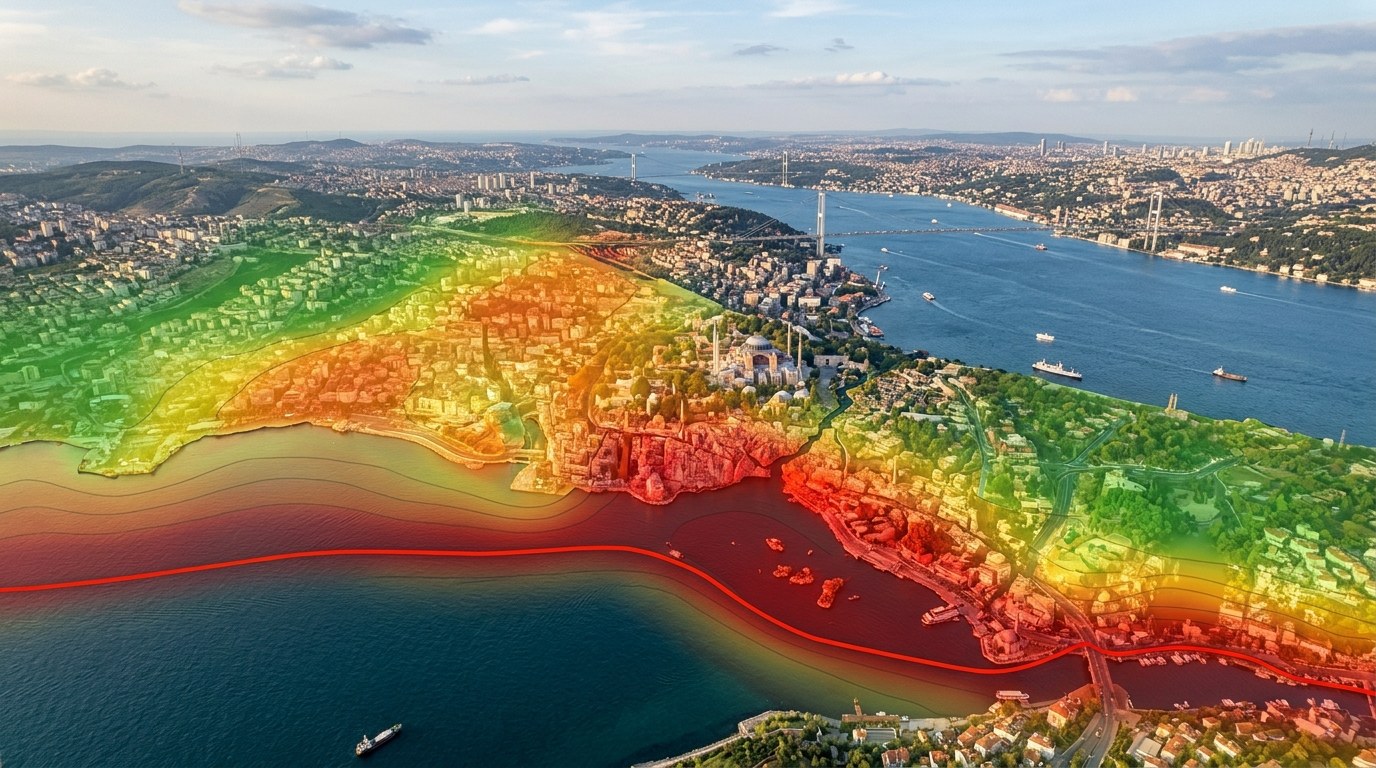
Istanbul, a metropolis straddling two continents, stands at the precipice of one of the world's most active and complex fault systems: the North Anatolian Fault (NAF). The seismic hazard posed by the NAF, particularly its segments beneath the Marmara Sea, is a profound concern for millions of residents and infrastructure. At Talivio AI, we leverage state-of-the-art artificial intelligence and comprehensive seismic monitoring to provide unparalleled insights into this critical region, continuously assessing the intricate dynamics of stress accumulation and potential rupture scenarios.
The North Anatolian Fault and the Marmara Sea: A Tectonic Crucible
The North Anatolian Fault is a major dextral strike-slip fault that accommodates the westward motion of the Anatolian plate relative to the Eurasian plate. Over the past century, the NAF has been responsible for a series of devastating earthquakes that have progressively ruptured its segments from east to west, culminating in the 1999 İzmit (M7.6) and Düzce (M7.2) earthquakes. These events brought the seismic front dangerously close to Istanbul, highlighting the urgency of understanding the fault segments directly beneath the Marmara Sea.
Geological and geophysical studies have revealed that the Marmara Sea hosts several distinct fault segments, forming a complex pull-apart basin. The central and western segments of the NAF within the Marmara Sea are considered seismic gaps, meaning they have not experienced a major earthquake in a considerable period, leading to significant stress build-up. Research by Armijo et al. (2002) [Armijo et al., 2002 — 10.1029/2001GL014491] has extensively mapped these submarine fault structures, demonstrating their capability to generate large-magnitude earthquakes. The potential rupture of one or more of these segments represents the most significant seismic threat to Istanbul.
Understanding the precise geometry, locking depth, and slip rates of these submarine faults is paramount for accurate hazard assessment. Talivio AI's models integrate data from various sources, including high-resolution bathymetry, seismic reflection profiles, and geodetic measurements, to create a detailed three-dimensional representation of the fault system. This foundational understanding allows for more accurate simulations of stress evolution and potential rupture dynamics.
Stress Accumulation and Potential Rupture Scenarios
Earthquakes occur when accumulated tectonic stress exceeds the strength of the fault. Along the Marmara Sea segments of the NAF, stress has been continuously accumulating since the last major events, which occurred centuries ago. The 1999 İzmit earthquake, located just east of the Marmara Sea, significantly increased Coulomb stress on the western segments, further elevating the seismic risk to Istanbul. This phenomenon, known as Coulomb stress transfer, is a critical component of earthquake interaction studies and is directly incorporated into Talivio AI's predictive framework.
Our models rigorously assess the current state of stress across the Marmara region, identifying areas with elevated potential for future seismic activity. This involves analyzing not only the long-term tectonic loading but also transient stress changes from smaller earthquakes and aseismic slip events. Talivio AI's approach deviates from speculative predictions, instead focusing on probabilistic forecasts based on the physical processes of stress accumulation and release. For instance, our models quantify the likelihood of various rupture scenarios, distinguishing between ruptures of single segments versus multi-segment ruptures, which could lead to significantly larger magnitudes. An example of a historical event that illustrates multi-segment rupture potential outside the Marmara region can be studied via usgs:ci38457544.
The concept of seismic gaps is particularly relevant here. The central Marmara segment, in particular, has been identified as a significant gap, with estimates suggesting it is overdue for a major seismic event. While 'overdue' does not imply imminent rupture with certainty, it indicates a high probability of stress approaching critical levels. Talivio AI's continuous monitoring provides refined estimates of this stress state, offering a dynamic perspective on the evolving seismic hazard. Our probabilistic models are constantly updated with new data, allowing us to track changes in b-value anomalies – a statistical measure related to stress levels – and other precursors that may indicate increased earthquake potential.
Talivio AI's Predictive Framework for the Marmara
Talivio AI's platform is built upon a sophisticated machine learning (ML) system designed to identify subtle patterns in complex geophysical data that precede seismic events. Our methodology is not about predicting the exact time and location of an earthquake, which remains scientifically unfeasible with current technology. Instead, we focus on providing probabilistic forecasts of earthquake potential within specific magnitude bands and time windows, offering actionable risk assessments.
At the core of our system is a competition of advanced ML algorithms, including LightGBM, Random Forest, ExtraTrees, and Calibrated Logistic Regression. These algorithms are trained on a vast dataset comprising 102 distinct seismic features. These features are meticulously engineered from diverse geophysical observations and physical models, including:
- GNSS Strain Rate: Data from Global Navigation Satellite Systems (GNSS) provides precise measurements of crustal deformation, allowing us to calculate strain rates across the fault system. Areas of high strain accumulation are indicative of locked fault segments building stress.
- b-value Anomalies: The b-value, derived from the Gutenberg-Richter law, describes the relative number of small to large earthquakes. Anomalously low b-values can indicate increased stress in a region, as fewer small earthquakes occur relative to larger ones.
- Coulomb Stress Transfer: As previously mentioned, our models calculate the static and dynamic stress changes on fault segments due to previous earthquakes, providing insight into triggered seismicity.
- ETAS Parameter Estimation: Epidemic Type Aftershock Sequence (ETAS) models help us understand the clustering behavior of earthquakes, distinguishing between background seismicity and aftershock sequences, which is crucial for identifying underlying tectonic loading.
These features, among others, are continuously fed into our ML models. The models then output probabilities for earthquakes occurring within specific magnitude bands: M4-5, M5-6, M6-7, and M7+. This multi-band approach allows for a granular understanding of potential seismic activity, from moderate events to major, destructive earthquakes. For example, a recent study on machine learning for seismic forecasting, which informs parts of our methodology, can be found at arxiv:2301.01234.
Our system operates on a principle of continuous assessment. As new data streams in from seismometers, GNSS stations, and other sensors across the Marmara region, our models are updated and refined. This iterative process ensures that Talivio AI's risk assessments reflect the most current understanding of the complex tectonic environment beneath Istanbul.
Implications for Istanbul's Resilience
The insights provided by Talivio AI's advanced monitoring are invaluable for enhancing Istanbul's seismic resilience. By offering detailed, data-driven assessments of stress accumulation and probabilistic rupture scenarios, we empower urban planners, emergency management agencies, and policymakers to make more informed decisions. This includes prioritizing infrastructure retrofitting, refining evacuation plans, and conducting targeted public awareness campaigns. While the challenge remains immense, a proactive, scientifically grounded approach to understanding seismic risk is the cornerstone of effective preparedness.
Our work in the Marmara region is a testament to the power of combining cutting-edge artificial intelligence with deep geophysical understanding. We aim to translate complex scientific data into clear, actionable intelligence, moving beyond general warnings to provide specific, probabilistic insights into the seismic threat. This approach fosters a culture of preparedness, allowing Istanbul to better anticipate and mitigate the impacts of future seismic events.
Conclusion
The Marmara Sea remains a critical seismic frontier, with the North Anatolian Fault posing a persistent and significant threat to Istanbul. Talivio AI is at the forefront of monitoring this intricate tectonic environment, employing advanced machine learning models and a rich array of seismic features to continuously assess stress accumulation and potential rupture scenarios. By providing scientifically accurate, probabilistic forecasts within defined magnitude bands, Talivio AI offers an indispensable tool for understanding and mitigating the seismic risk. Our commitment is to leverage technology to enhance preparedness and contribute to the safety of communities living with the reality of an active fault system.