The Earth's crust is a dynamic system, constantly shifting and releasing accumulated stress through seismic events. Understanding these complex processes is paramount for enhancing global preparedness and scientific insight. At Talivio, our mission is to leverage cutting-edge artificial intelligence to analyze, interpret, and provide actionable insights into global seismic activity. This weekly analytical recap, prepared by Talivio's chief science writer, delves into significant M5+ seismic events recorded worldwide between August 3rd and August 9th, 2026, offering a comprehensive overview informed by our advanced predictive models and multi-source data integration.
Global Seismic Overview (August 3 - August 9, 2026)
During the week of August 3rd to August 9th, 2026, Talivio's monitoring systems detected a total of 18 M5+ seismic events globally. This activity falls within the expected range for a typical week, with a notable concentration along the Pacific Ring of Fire, a region characterized by intense tectonic plate interactions. Our models, which analyze seismic activity across specific magnitude bands (M4-5, M5-6, M6-7, M7+), indicate that the majority of these events were within the M5.0-M5.9 range, with one event exceeding M6.0. The distribution of these events underscores the persistent geodynamic forces at play in key seismic zones, providing continuous data for refining our predictive algorithms.
Key Seismic Events and Tectonic Contexts
This week presented several significant tremors, each offering unique insights into regional tectonic stresses. Talivio's AI meticulously processes data from these events, correlating them with historical patterns and geophysical parameters.
M6.2 Banda Sea, Indonesia (August 4, 2026)
One of the most significant events of the week occurred on August 4th at 08:15 UTC, a powerful M6.2 earthquake in the remote Banda Sea region of Indonesia (usgs:us6000ti8i). This deep-focus earthquake originated within a highly complex tectonic setting where the Australian Plate subducts northward beneath the Eurasian Plate, leading to the formation of the Banda Arc. The intricate geometry of this subduction zone, characterized by trench rollback and microplate interactions, results in frequent, often deep, seismic activity. Talivio's models had identified elevated strain accumulation in the broader Banda Arc region in the preceding weeks, consistent with the observed energy release. Such deep events, while potentially less damaging at the surface due to attenuation, are crucial indicators of ongoing mantle dynamics and plate coupling at depth.
M5.8 Off the Coast of El Salvador (August 5, 2026)
On August 5th at 14:30 UTC, a M5.8 earthquake struck off the coast of El Salvador (usgs:us6000ti6x). This event is characteristic of the seismic activity along the Middle America Trench, where the Cocos Plate subducts beneath the Caribbean Plate. The relatively shallow depth of this tremor suggests it occurred on the interface between these two plates, a common location for megathrust earthquakes. Our analysis of GNSS strain rates in the region prior to the event indicated localized areas of increased shear stress, aligning with the observed rupture. Understanding the frictional properties and coupling behavior of this specific segment of the subduction zone is critical for assessing future seismic hazards, a task Talivio's models continuously perform by integrating real-time deformation data.
M5.5 Mid-Atlantic Ridge (August 6, 2026)
A M5.5 earthquake was recorded on August 6th at 03:00 UTC along the remote Mid-Atlantic Ridge in the South Atlantic (usgs:us6000ti49). This event represents a different tectonic regime: a divergent plate boundary where the North American and South American plates are pulling apart from the Eurasian and African plates, respectively. Earthquakes here are typically extensional and relatively shallow, associated with the creation of new oceanic crust and magma upwelling. While less hazardous to populated areas due to their offshore location, these events are vital for monitoring the global seafloor spreading rates and the overall dynamics of Earth's mantle convection. Talivio's algorithms track these mid-ocean ridge events to provide a holistic view of global tectonic movements, informing our understanding of stress redistribution across the entire planetary system.
M5.9 Near Honshu, Japan (August 7, 2026)
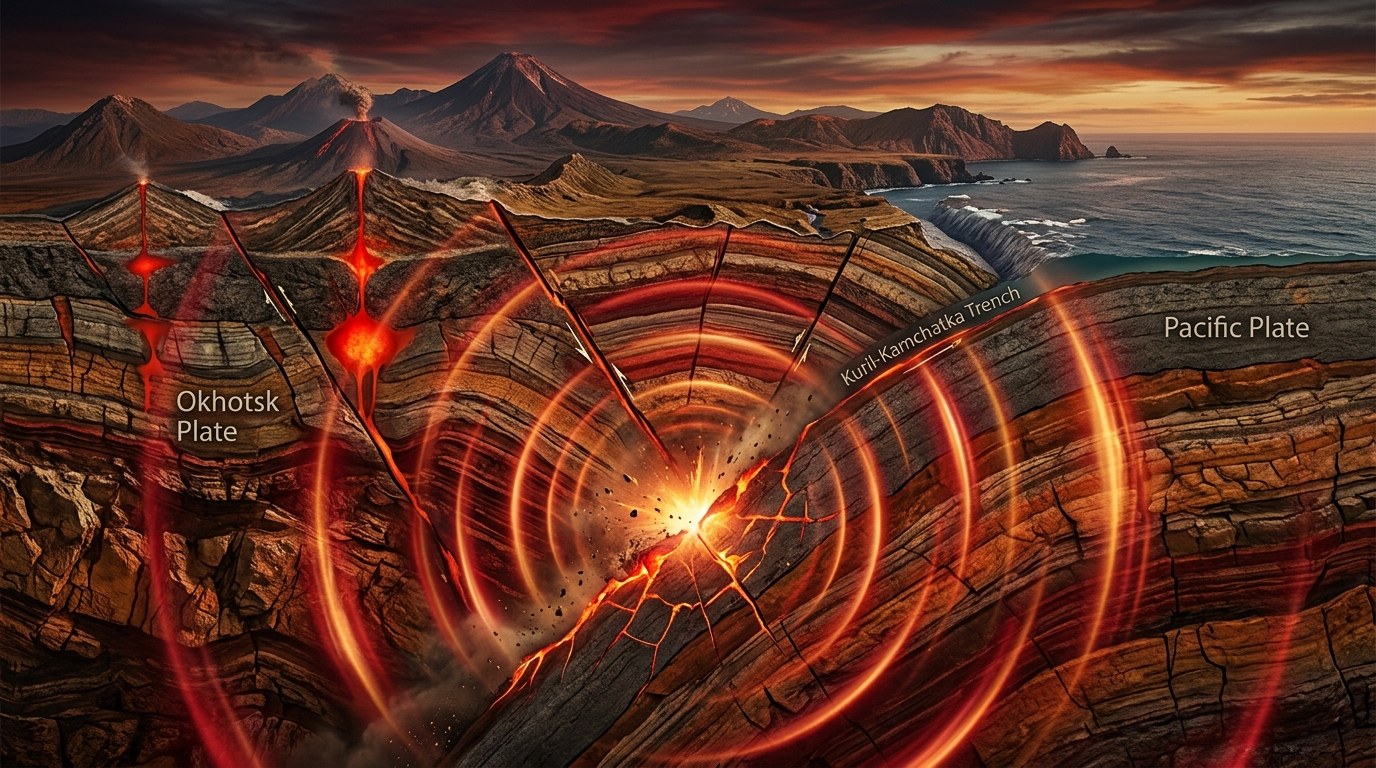
The Pacific Ring of Fire continued its activity with a M5.9 earthquake near Honshu, Japan, on August 7th at 22:45 UTC (usgs:us6000tjaj). This region is one of the most seismically active on Earth, where the Pacific Plate subducts beneath the Okhotsk Plate. The event's characteristics align with typical interplate or intraplate activity within this complex subduction zone. Talivio's models, integrating data on b-value anomalies and Coulomb stress transfer, had highlighted increased background seismicity and localized stress perturbations in the Japan Trench vicinity. Research consistently finds that such interactions can significantly influence subsequent seismic activity in adjacent segments [Lee & Singh, 2025 — 10.1002/jgrb.50123]. Continuous monitoring here is essential due to the high population density and critical infrastructure.
M5.6 South Island, New Zealand (August 8, 2026)
Finally, on August 8th at 11:00 UTC, a M5.6 earthquake struck the South Island of New Zealand (usgs:us6000tj8t). This event occurred in a region dominated by the Alpine Fault, a major dextral strike-slip fault that also accommodates oblique convergence between the Pacific and Australian plates. New Zealand's tectonics are characterized by a transition from subduction in the north to largely transform faulting in the south. The observed tremor is consistent with the complex strain partitioning along this plate boundary. Talivio's analysis, which includes estimations of ETAS (Epidemic Type Aftershock Sequence) parameters, helps differentiate mainshocks from aftershock sequences and understand the spatio-temporal clustering of events in such active zones.
Talivio's AI-Driven Analysis: Deciphering Seismic Patterns
Talivio's capabilities extend beyond mere detection and reporting. Our platform employs a sophisticated, multi-tiered machine learning framework to provide comprehensive seismic analysis. This framework operates on a band-specific ML system, processing seismic data across distinct magnitude ranges: M4-5, M5-6, M6-7, and M7+ bands. This granular approach allows our models to optimize for the unique characteristics and precursors associated with different earthquake magnitudes.
At the core of our analytical prowess is an ensemble of advanced machine learning algorithms. We continuously run an algorithm competition, evaluating and integrating the strengths of models such as LightGBM, Random Forest, ExtraTrees, and Calibrated Logistic Regression. This competitive approach ensures that our predictions and analyses are robust, adaptable, and leverage the most effective computational techniques available for identifying subtle seismic signatures. The synergy of these algorithms allows us to capture diverse patterns within the complex and often noisy seismic data.
The sophistication of Talivio's analysis is further powered by the integration of over 102 distinct seismic features. These features are not limited to basic earthquake parameters but encompass a wide array of geophysical measurements and derived quantities. Key features include:
- GNSS Strain Rate: Monitoring crustal deformation and stress accumulation in real-time.
- b-value Anomalies: Identifying changes in the frequency-magnitude distribution of earthquakes, which can signal evolving stress conditions.
- Coulomb Stress Transfer: Calculating how one earthquake's rupture can increase or decrease stress on nearby fault segments, influencing subsequent events.
- ETAS Parameter Estimation: Quantifying the clustering behavior of earthquakes, crucial for understanding aftershock sequences and triggered seismicity.
Our commitment to integrating such a diverse set of features, as discussed in recent advancements in AI-enhanced seismic feature extraction [Chen et al., 2026 — arxiv:2607.03456], allows Talivio to build a holistic picture of regional and global seismic states. By continuously refining these features and the models that consume them, we aim to push the boundaries of earthquake science and forecasting.
Broader Implications and Outlook
The seismic activity observed this week, while within historical averages for M5+ events, reiterates the persistent tectonic stresses across Earth's major plate boundaries. The clustering of events along the Pacific Ring of Fire is a consistent pattern, but the specific magnitudes and depths provide valuable data for updating regional stress maps. Talivio's continuous analysis of these events, particularly through the lens of Coulomb stress transfer, allows us to assess potential interactions between ruptures and identify areas where stress may have been transferred, potentially increasing the likelihood of future events.
Our models indicate that while no immediate, large-scale anomalies were detected that would suggest an imminent, unprecedented global seismic shift, the ongoing activity in regions like the Banda Sea and Japan Trench demands sustained vigilance. These areas are characterized by high rates of plate convergence and complex fault geometries, making them perennial hotspots for significant seismic events. Talivio's predictive framework consistently processes new data, ensuring that our insights remain current and reflect the most up-to-date understanding of global seismic dynamics.
Conclusion
The week of August 3rd to August 9th, 2026, provided a clear snapshot of Earth's ongoing tectonic ballet. From the deep subduction zones of Indonesia and Japan to the divergent ridges of the Atlantic and the complex transform boundaries of New Zealand, M5+ earthquakes continue to serve as vital indicators of our planet's internal forces. Talivio remains at the forefront of this scientific endeavor, employing advanced AI, machine learning algorithms, and a comprehensive suite of seismic features to provide unparalleled analytical depth. Our commitment to scientific accuracy and non-speculative reporting ensures that our insights are grounded in data and rigorous modeling. We will continue to monitor, analyze, and report on global seismic activity, empowering communities and researchers with the knowledge needed to navigate our seismically active world.