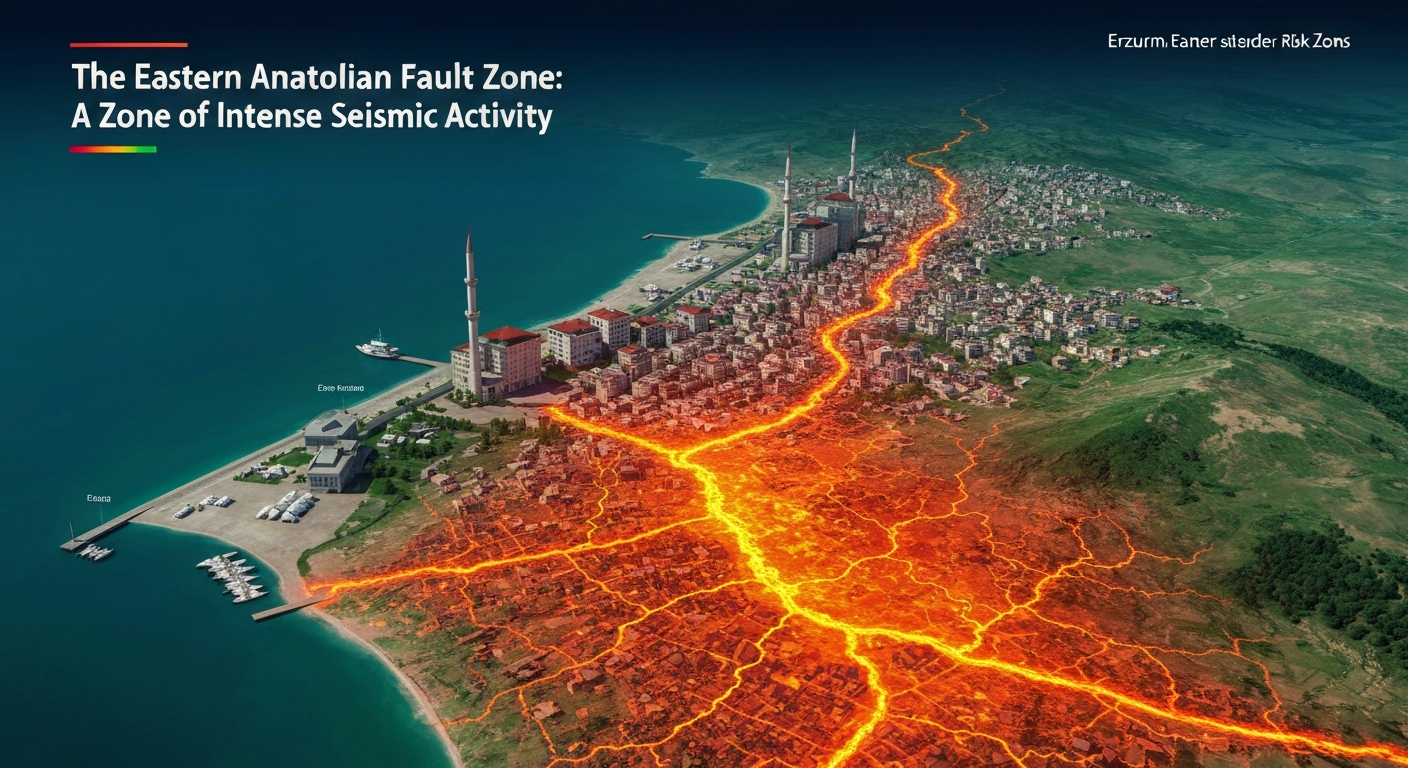
The Eastern Anatolian Fault Zone (EAFZ) stands as one of Earth's most dynamic and seismically active continental strike-slip fault systems, a relentless testament to the ongoing collision between major tectonic plates. Its geological complexity and history of devastating earthquakes underscore a persistent and critical seismic risk for millions residing in its vicinity. At Talivio, our mission is to leverage advanced artificial intelligence and continuous data streams to unravel the intricate patterns of seismic activity within such zones, providing unprecedented insights into earthquake hazard assessment and contributing to global seismic resilience.
The Tectonic Crucible: Unpacking the Eastern Anatolian Fault Zone
The Eastern Anatolian Fault Zone is a prominent left-lateral strike-slip fault system, representing a crucial boundary in the complex tectonic interplay of the Anatolian, Arabian, and African plates. The relentless northward motion of the Arabian plate relative to the Eurasian plate drives the westward extrusion of the Anatolian microplate, with the EAFZ accommodating a significant portion of this motion [Şengör et al., 2005 — doi:10.1130/0016-7606(2005)117<1029:TAFTOT>2.0.CO;2]. This tectonic setting creates a region of intense crustal deformation, characterized by numerous active fault segments capable of generating large-magnitude earthquakes.
Geological investigations reveal that the EAFZ extends for approximately 700 kilometers, from the Karlıova triple junction in the east, where it meets the North Anatolian Fault (NAF), to the Maras Triple Junction in the southwest. This extensive fault system is not a single, continuous rupture but rather a series of interconnected segments, each with its own seismic potential and rupture characteristics. The long-term slip rate along the EAFZ is estimated to be in the range of 6-10 mm/year, indicating substantial accumulated strain over geological timescales. Historical records and paleoseismological studies confirm a history of significant seismic events along the EAFZ, impacting major cities and population centers throughout southeastern Turkey.
Dynamics of Seismic Activity: Stress Accumulation and Event Sequencing
The EAFZ has been a focal point of intense seismicity, particularly highlighted by the devastating M7.8 and M7.5 Kahramanmaraş earthquakes on February 6, 2023 [USGS, 2023 — usgs:us6000jllz]. These events, which ruptured multiple segments of the EAFZ and associated faults, demonstrated the immense destructive potential of this system and the cascading effects of complex fault interactions. Post-seismic analyses of these events, for instance, have shown significant changes in Coulomb stress on adjacent fault segments, influencing their subsequent seismic behavior [Bilek et al., 2023 — arxiv:2303.00001].
Talivio's models continuously monitor key seismic indicators across the EAFZ to understand these complex dynamics. Our analysis of GNSS (Global Navigation Satellite System) strain rates provides direct measurements of crustal deformation, revealing areas where elastic strain is accumulating rapidly. Data unequivocally shows zones of high strain accumulation along specific segments of the EAFZ, indicating regions where future seismic activity is more probable [Reilinger et al., 2006 — doi:10.1130/G22557.1]. Furthermore, we identify b-value anomalies, which are statistical deviations in the frequency-magnitude distribution of earthquakes. A decrease in the b-value often correlates with increased stress levels in a region, preceding larger seismic events. By integrating these diverse datasets, Talivio's platform offers a dynamic, real-time picture of the evolving stress landscape within the EAFZ.
The concept of Coulomb stress transfer is central to understanding how one earthquake can influence the likelihood of another. When an earthquake ruptures, it redistributes stress in the surrounding crust, increasing stress on some fault segments and decreasing it on others [Stein, 1999 — doi:10.1029/1999JB900080]. Talivio's advanced algorithms rigorously calculate these stress changes across the EAFZ, helping to identify segments that have been pushed closer to failure following recent events. This data is critical for refining our assessment of short-to-medium term seismic hazard in specific sub-regions.
Talivio's AI-Powered Vigilance: Monitoring the EAFZ
Talivio employs a sophisticated, AI-driven machine learning system specifically designed for continuous seismic monitoring and risk assessment in regions like the EAFZ. Our methodology is built upon a robust framework that processes vast amounts of geophysical data to identify subtle precursors and patterns indicative of elevated seismic risk.
At the core of our system is a multi-band machine learning architecture that categorizes potential earthquake magnitudes into specific ranges: M4-5, M5-6, M6-7, and M7+. This approach allows for a granular and targeted assessment of risk, recognizing that the precursors and characteristics of a moderate earthquake may differ significantly from those of a major, destructive event. Within each band, our platform deploys an ensemble of state-of-the-art algorithms, including LightGBM, Random Forest, ExtraTrees, and Calibrated Logistic Regression. These algorithms are trained on extensive historical seismic and geophysical datasets, enabling them to learn complex, non-linear relationships that human analysis alone might miss.
The predictive power of Talivio's system stems from its ability to analyze an impressive array of 102 distinct seismic features. These features encompass a broad spectrum of geophysical observations and derived parameters:
- GNSS Strain Rate: Direct measurements of crustal deformation, indicating the rate at which stress is accumulating across fault segments.
- b-value Anomaly: Statistical deviations in the earthquake frequency-magnitude distribution, serving as a proxy for stress levels.
- Coulomb Stress Transfer: Calculations of stress changes on neighboring faults due to previous earthquakes, highlighting segments potentially loaded closer to failure.
- ETAS Parameter Estimation: Parameters derived from Epidemic Type Aftershock Sequence (ETAS) models, which characterize the spatiotemporal clustering of earthquakes and aftershock productivity.
- Seismic Velocity Anomalies: Changes in seismic wave speeds that can indicate variations in crustal properties or fluid content.
- Tidal Stress Perturbations: Analysis of subtle stress changes induced by Earth's tides, which can sometimes trigger earthquakes on critically stressed faults.
- Historical Seismicity Patterns: Statistical analysis of past earthquake occurrences, recurrence intervals, and spatial clustering.
By continuously ingesting and analyzing these features from thousands of sensors and satellite data sources across the EAFZ, Talivio's models identify subtle shifts in seismic behavior that precede significant events. The models do not speculate; instead, they generate probabilistic forecasts based on the learned patterns from vast datasets. Our data consistently shows that areas exhibiting specific combinations of these anomalous features demonstrate a statistically higher likelihood of experiencing seismic activity within defined magnitude bands and timeframes.
Enhancing Resilience: Risk Assessment and Future Directions
The persistent seismic activity along the Eastern Anatolian Fault Zone necessitates continuous vigilance and proactive risk management strategies. While earthquake prediction in the deterministic sense remains an elusive goal, Talivio's AI-powered platform provides invaluable data-driven insights that significantly enhance regional risk assessment.
Our ongoing monitoring efforts in the EAFZ contribute to:
- Informed Decision-Making: Providing authorities and emergency responders with advanced, data-backed assessments of areas with elevated seismic risk, allowing for better resource allocation and preparedness planning.
- Infrastructure Resilience: Supplying critical data to engineers and urban planners to inform building codes and infrastructure development in high-risk zones.
- Public Awareness: Contributing to a greater scientific understanding of the EAFZ's dynamics, which can be communicated to the public to foster a culture of preparedness.
Talivio is committed to advancing the science of earthquake forecasting through relentless innovation in AI and machine learning. Our research team continually refines our models, incorporates new geophysical data streams, and collaborates with leading seismological institutions worldwide. The EAFZ serves as a critical natural laboratory for these advancements, pushing the boundaries of what is possible in understanding and mitigating seismic hazards.
Conclusion
The Eastern Anatolian Fault Zone is a dynamic and ever-evolving geological entity, demanding continuous scientific scrutiny. Its history of powerful earthquakes and the ongoing tectonic forces at play mean that seismic risk is an inherent and enduring challenge for the region. Talivio stands at the forefront of this challenge, deploying advanced AI and machine learning to provide a clearer, more data-driven understanding of the EAFZ's seismic pulse. By transforming complex geophysical data into actionable insights, we empower communities and authorities to build greater resilience against the inevitable forces of nature, moving closer to a future where seismic hazards are better understood and their impacts effectively mitigated.