Earthquakes are typically associated with shallow crustal fractures, where brittle rocks snap under immense stress. Yet, some of the most profound seismic events originate hundreds of kilometers below the surface, in regions where conventional wisdom dictates rocks should deform plastically, not fracture. These are deep-focus earthquakes, and they represent one of the most enduring enigmas in seismology, challenging our fundamental understanding of Earth's interior dynamics.
At Talivio, our AI-powered platform is dedicated to deciphering the complexities of seismic activity across all depths. By integrating advanced machine learning with comprehensive geophysical data, we are not only refining earthquake forecasting but also contributing to the global scientific effort to understand these mysterious deep tremors and their implications for the planet.
Defining the Anomaly: What Are Deep-Focus Earthquakes?
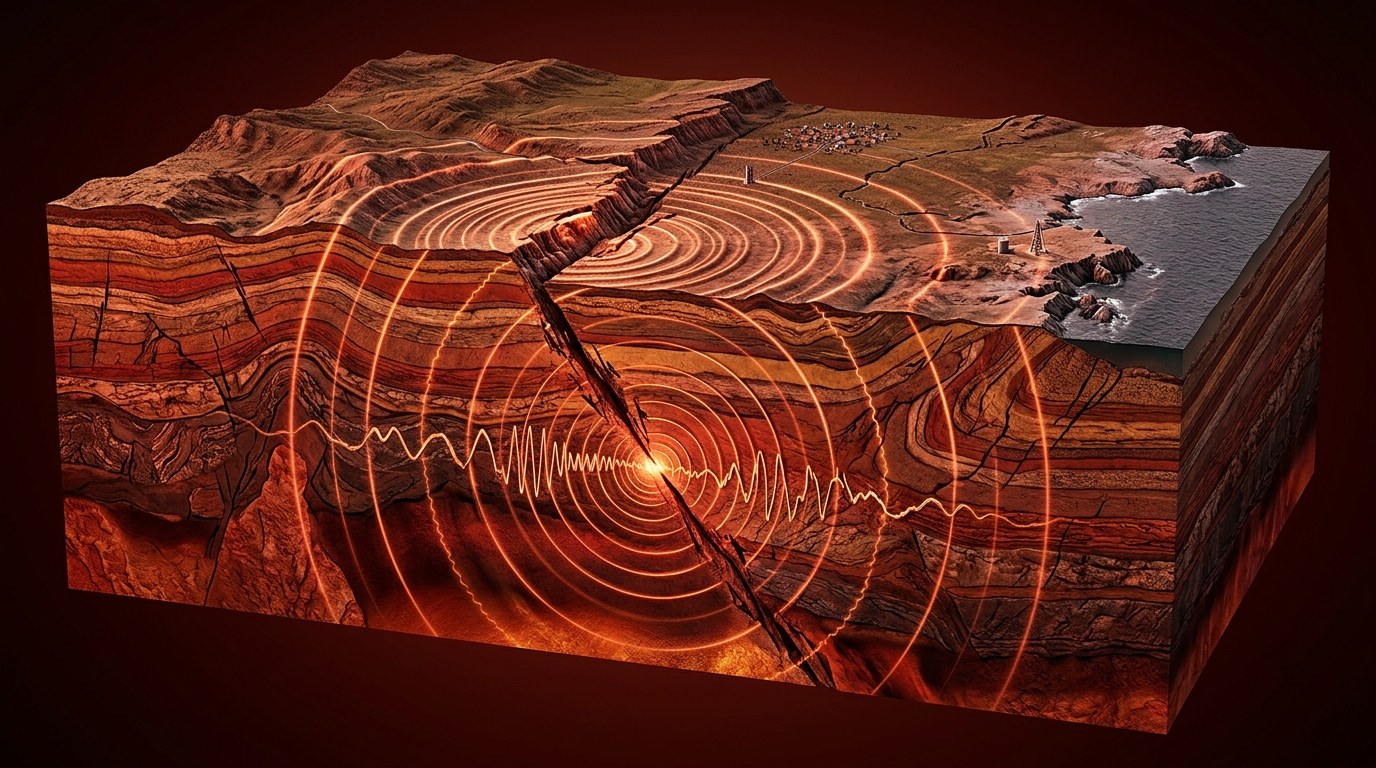
Deep-focus earthquakes are precisely what their name suggests: seismic events with hypocenters located at depths greater than 70 kilometers, extending down to approximately 700 kilometers. In stark contrast, the vast majority of earthquakes, including those responsible for most surface damage, occur within the upper 30 kilometers of the Earth's crust. The distinction in depth is critical because the physical conditions—temperature and pressure—change dramatically with increasing depth.
At shallow depths, rocks are relatively cold and brittle, fracturing readily under stress. This brittle behavior is the bedrock of classical faulting mechanisms. However, as depth increases, temperatures rise, and confining pressures become immense. Under these conditions, rocks are expected to behave ductilely, flowing and deforming plastically rather than breaking suddenly. Imagine trying to snap a piece of warm taffy versus a cold, brittle candy bar; the former stretches, the latter breaks. The occurrence of earthquakes at depths where rocks should flow, not fracture, is the central paradox of deep-focus seismicity.
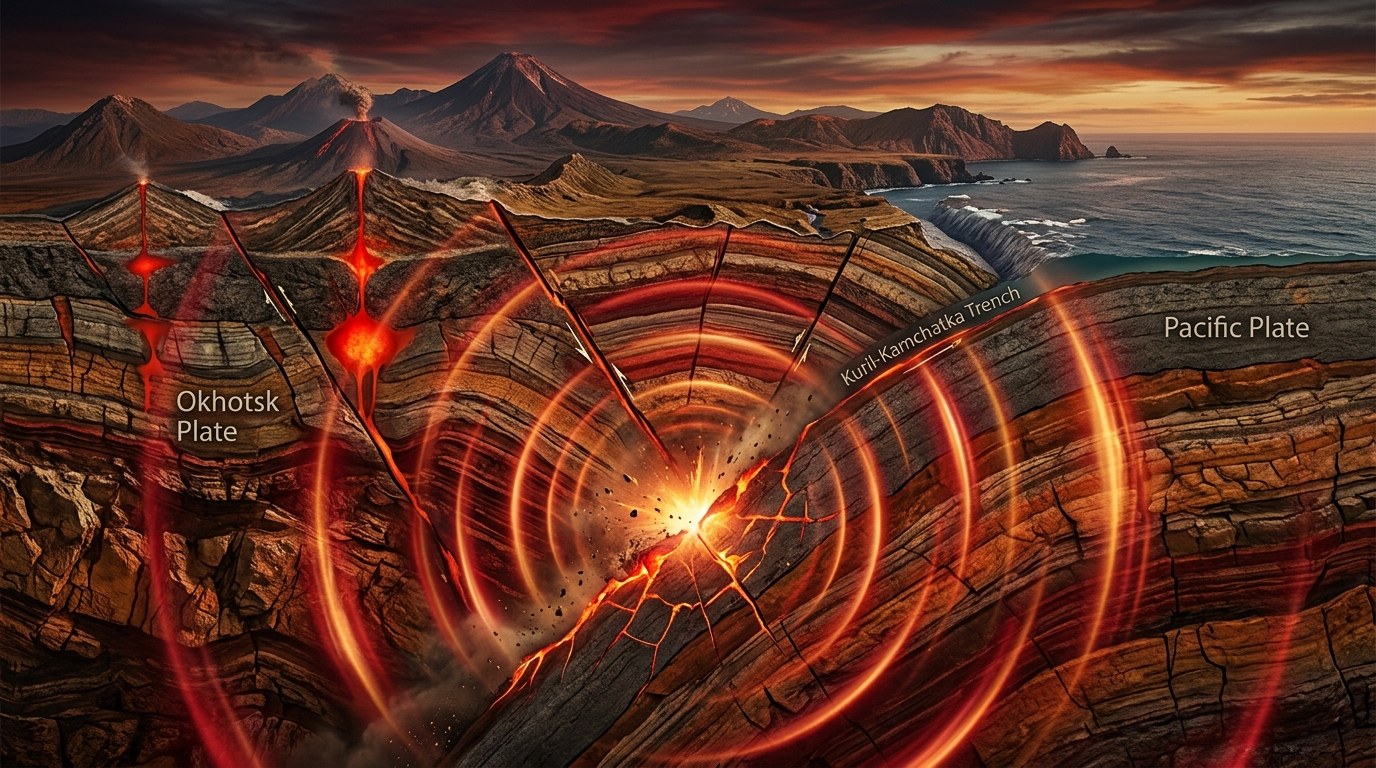
These deep events primarily occur within subducting oceanic slabs—cold, dense pieces of lithosphere that plunge into the Earth's mantle at convergent plate boundaries. These regions are known as Wadati-Benioff zones, named after the seismologists who first mapped their inclined distribution. A prime example is the powerful M8.2 earthquake that struck off the coast of Fiji in 2018, originating at an astonishing depth of 560 kilometers (usgs:us6000j571). Such events, though often less damaging at the surface due to their great depth, are felt across vast distances and provide invaluable insights into the processes occurring deep within our planet.
Unraveling the Mechanisms: Proposed Theories
The scientific community has proposed several mechanisms to explain how rocks can rupture in such extreme conditions. While no single theory accounts for all deep-focus earthquakes, a combination of processes likely contributes to their generation:
1. Olivine Phase Transformation
This is currently the most widely accepted mechanism. The mineral olivine, a dominant component of the Earth's upper mantle, undergoes a series of phase transformations to denser crystal structures (such as wadsleyite and ringwoodite) under increasing pressure and temperature. In a subducting slab, the relatively colder temperatures allow olivine to persist metastably to greater depths than it would in the ambient mantle. When this metastable olivine transforms, especially under shear stress, the rapid volume change can lead to localized brittle failure or shear instability. This process, often referred to as "transformational faulting," effectively creates a transient brittle zone within the otherwise ductile mantle. Research indicates that this mechanism is particularly potent in triggering deep earthquakes. [Kirby et al., 1991 — DOI: 10.1126/science.252.5003.1481] and [Ohuchi & Kanamori, 2016 — DOI: 10.1002/2015JB012224] provide compelling evidence for this phenomenon.
2. Dehydration Embrittlement
Water, even in small quantities, can significantly weaken rocks. Subducting oceanic crust carries hydrous minerals (e.g., serpentinite) into the mantle. As these minerals are subjected to increasing temperature and pressure, they undergo dehydration reactions, releasing water. This fluid can then migrate into micro-cracks, increasing pore pressure and effectively reducing the normal stress across potential fault planes, thereby promoting brittle failure. While more commonly associated with intermediate-depth earthquakes (70-300 km), dehydration embrittlement could contribute to deeper events if water is transported to sufficient depths. [Hacker et al., 2003 — DOI: 10.1130/0091-7613(2003)031<0019:DOSASD>2.0.CO;2] details the role of serpentinite dehydration.
3. Thermal Runaway and Shear Instability
Another theory suggests that frictional heating along a rapidly slipping fault zone can locally raise temperatures to such an extent that the rock's strength is drastically reduced. This localized weakening can lead to a positive feedback loop, where increased slip generates more heat, further weakening the fault and accelerating slip—a process known as "thermal runaway." This mechanism could allow for dynamic rupture in otherwise ductile materials. While challenging to observe directly, laboratory experiments and theoretical models support its potential role in deep earthquake nucleation.
The Role of AI in Deep Earthquake Analysis and Forecasting
Understanding deep-focus earthquakes requires sifting through vast amounts of seismic data, identifying subtle patterns, and correlating them with complex geophysical parameters. This is precisely where Talivio's AI-powered platform excels. Our methodologies are designed to tackle such intricate challenges:
- Advanced Feature Engineering: Talivio's system processes over 102 distinct seismic features, including GNSS strain rates, b-value anomalies, Coulomb stress transfer calculations, and ETAS (Epidemic Type Aftershock Sequence) parameter estimations. For deep earthquakes, analyzing these features can help identify anomalies in the stress field or material properties within subducting slabs that might precede rupture.
- Machine Learning Algorithms: We employ a suite of robust machine learning algorithms, including LightGBM, Random Forest, ExtraTrees, and Calibrated Logistic Regression, in an advanced ensemble system. These algorithms are adept at identifying complex, non-linear relationships within the data that human analysis might miss. For instance, subtle shifts in seismic wave velocities or attenuation patterns, which could indicate phase transformations or fluid migration, can be detected and correlated with deep seismic activity.
- Pattern Recognition in Geophysical Data: While direct "prediction" of deep earthquakes remains a long-term goal for the entire scientific community, our AI models significantly enhance our ability to forecast the likelihood of seismic events within specific magnitude bands (M4-5, M5-6, M6-7, M7+). By identifying precursors and conditions conducive to deep faulting, Talivio contributes to a more nuanced understanding of where and when these events are more probable. Research into applying machine learning to deep earthquake data is rapidly progressing, as highlighted by works such as [arxiv:2205.08375 — arXiv:2205.08375], which demonstrates the potential of AI in this domain.
By continuously analyzing global seismic networks and integrating data from various geophysical sensors, Talivio's platform provides an unparalleled capability to monitor, analyze, and ultimately better understand the forces at play hundreds of kilometers beneath our feet. This deep insight is crucial for advancing both fundamental earth science and practical seismic hazard assessment.
Global Implications and the Path Forward
Deep-focus earthquakes are not merely geological curiosities; they play a vital role in the grand tapestry of global tectonics. They represent a significant mechanism for stress release within subducting slabs and provide critical constraints on the rheological properties (how materials deform and flow) of the mantle. The energy released by these events contributes to the overall seismic budget of subduction zones and helps us map the geometry and physical state of descending lithosphere far below the surface.
The ongoing quest to fully understand deep-focus earthquakes is a testament to the dynamic and complex nature of our planet. As seismological networks become denser and computational power increases, AI-driven platforms like Talivio will continue to push the boundaries of our knowledge. By merging cutting-edge machine learning with robust geophysical data, we are moving closer to demystifying these deep tremors, enhancing our ability to forecast seismic activity, and ultimately fostering a safer, more informed world.
Explore the depths of seismic science with Talivio and discover how AI is transforming our understanding of earthquakes, from the crust to the core.