Cascadia's Silent Power: An Introduction to the Threat
Beneath the verdant landscapes and bustling cities of the Pacific Northwest lies a geologic leviathan: the Cascadia Subduction Zone. This 1,000-kilometer-long convergent plate boundary, stretching from northern California to British Columbia, represents one of Earth's most significant seismic hazards. Unlike many active fault systems that frequently release stress through smaller quakes, Cascadia is characterized by long periods of seismic quiescence, accumulating immense strain that can culminate in devastating megathrust earthquakes.
The potential for such an event, often dubbed the "Big One," necessitates rigorous and continuous monitoring. At Talivio, our advanced AI-powered platform is dedicated to providing unparalleled insights into these complex tectonic processes. We leverage cutting-edge machine learning to analyze vast datasets, enhancing our understanding of seismic hazard in regions like Cascadia and empowering communities with data-driven risk assessments.
The Cascadia Subduction Zone: A Tectonic Overview
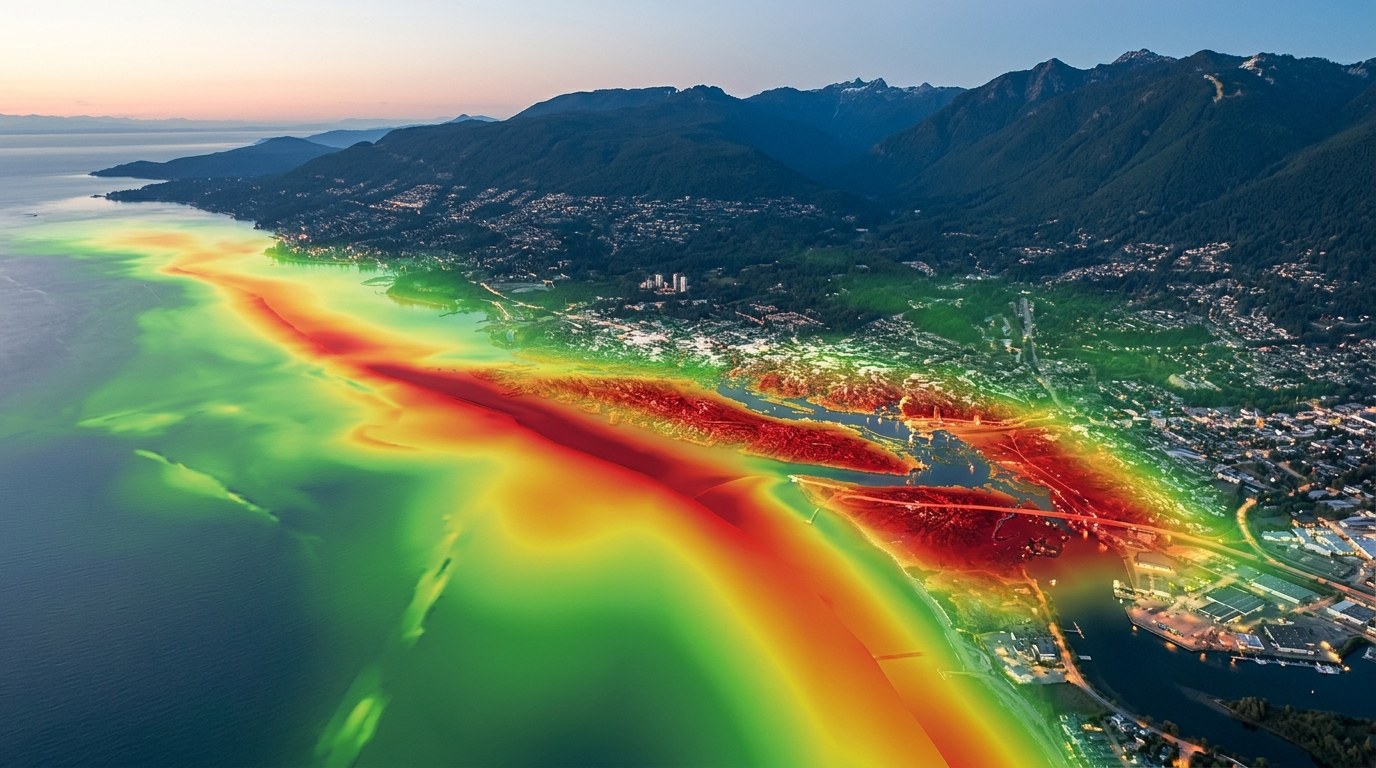
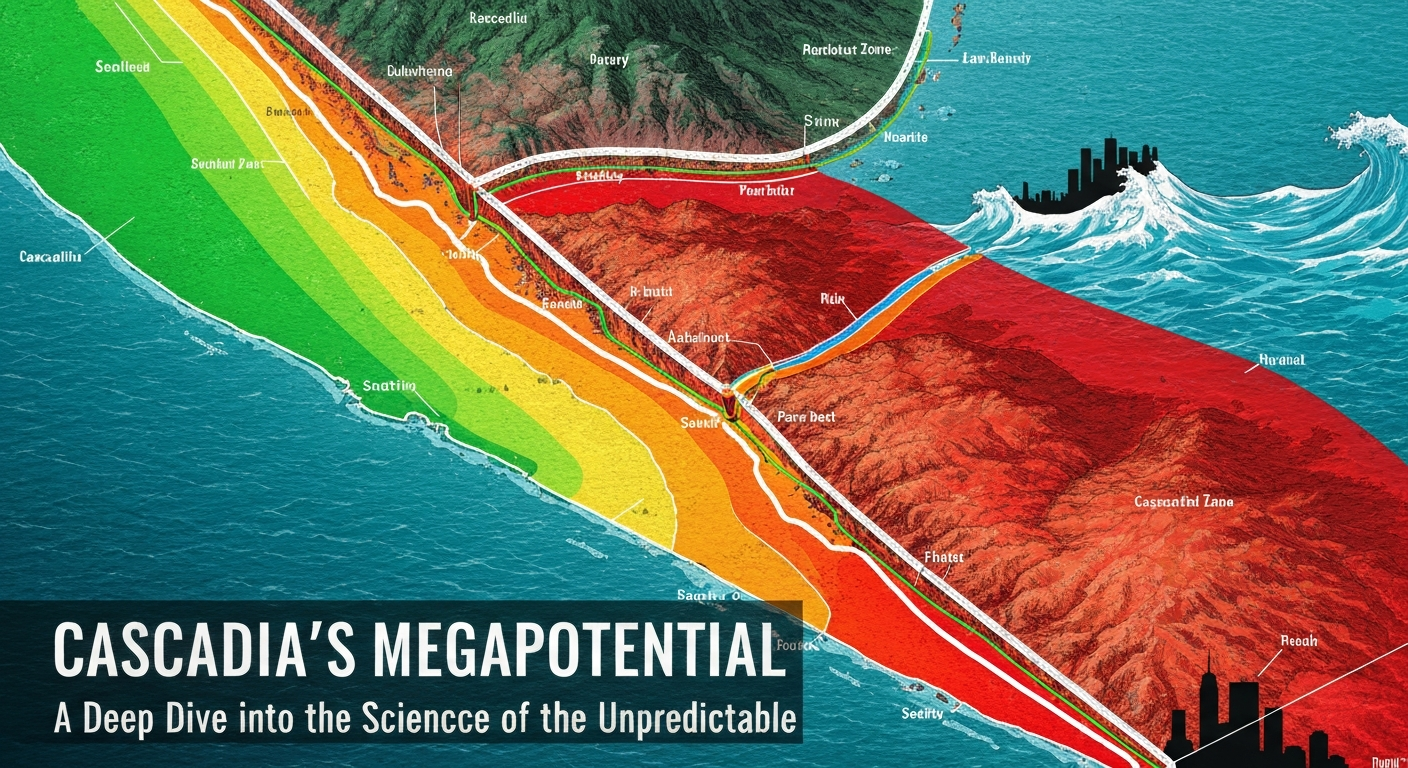
The Cascadia Subduction Zone is formed where the oceanic Juan de Fuca, Gorda, and Explorer plates are forced beneath the continental North American Plate. This process, known as subduction, is not always smooth. For much of its length, the interface between these plates is currently "locked," meaning the plates are stuck together, accumulating elastic strain rather than sliding past each other. This accumulated strain is the fundamental driver of megathrust earthquakes.
Geological evidence, including tsunami deposits and submerged coastal forests, unequivocally demonstrates that Cascadia has generated numerous megathrust earthquakes in the past. The most recent major event occurred on January 26, 1700 AD, a magnitude ~9 earthquake that generated a massive tsunami impacting not only the Pacific Northwest coast but also reaching Japan [Atwater et al., 1992 — doi:10.1029/JB095iB12p21449]. The recurrence interval for these great earthquakes is estimated to be between 200 and 500 years, with some segments showing shorter or longer periods. The locking mechanism and potential for rupture are critical factors in assessing the region's seismic hazard [Hyndman & Wang, 1996 — doi:10.1130/0016-7606(1996)108<0001:CTOACA>2.3.CO;2].
Understanding the state of stress and strain accumulation along the Cascadia interface is paramount. Traditional seismic monitoring, while essential, is often insufficient to fully characterize the complex, slow-moving processes occurring deep within the Earth. This is where Talivio's AI-driven approach provides a significant advantage, integrating a broader spectrum of geophysical data.
Talivio's AI-Powered Monitoring: Unpacking Cascadia's Data Streams
Effective seismic hazard assessment in a region like Cascadia demands a multidisciplinary approach. Talivio's AI models are specifically designed to ingest and interpret a diverse array of geophysical data streams, creating a comprehensive picture of the subduction zone's behavior. Our methodology goes beyond merely cataloging past events; it seeks to identify subtle precursors and patterns indicative of evolving seismic potential.
- GNSS Strain Rate: Global Navigation Satellite System (GNSS) data provides precise measurements of ground deformation. By tracking the movement of thousands of GPS stations across the Pacific Northwest, we can infer the rate at which strain is accumulating along the locked fault interface. Anomalies in these strain rates can signal changes in tectonic loading.
- b-value Anomaly: The b-value, a parameter in the Gutenberg-Richter law, describes the relative number of small earthquakes to large earthquakes. A decrease in the b-value in a specific region can indicate increased stress and a higher likelihood of larger events. Talivio's models continuously calculate and monitor b-value anomalies across the Cascadia region.
- Coulomb Stress Transfer: Earthquakes can trigger subsequent events by redistributing stress on nearby faults. Coulomb stress transfer models quantify these changes, identifying segments of the fault system that may have experienced an increase in stress following previous seismic activity, even distant ones (e.g., usgs:ci37207433).
- ETAS Parameter Estimation: The Epidemic Type Aftershock Sequence (ETAS) model helps characterize the spatio-temporal clustering of earthquakes. By estimating ETAS parameters, Talivio can identify deviations from expected aftershock sequences or background seismicity, which might suggest changes in the underlying stress regime.
These are just a few examples among the 102 distinct seismic features that Talivio's AI platform utilizes. Each feature provides a unique window into the dynamic processes of the Cascadia Subduction Zone, and their synergistic analysis by our machine learning models yields a more robust assessment of seismic hazard.
Talivio's AI in Action: Advanced Algorithms for Hazard Assessment
Talivio's core strength lies in its sophisticated machine learning architecture. Our platform employs a banded ML system, where specialized models are trained to assess the probability of earthquakes within specific magnitude ranges: M4-5, M5-6, M6-7, and M7+. This granular approach allows for more precise hazard characterization tailored to the potential impact of different earthquake sizes.
To ensure the most accurate and reliable predictions, Talivio utilizes an algorithm competition framework. This means that multiple state-of-the-art machine learning algorithms, including LightGBM, Random Forest, ExtraTrees, and Calibrated Logistic Regression, are simultaneously trained and evaluated. This ensemble approach helps mitigate the biases inherent in any single model and enhances the overall robustness of our hazard assessments. The models are continuously retrained and validated against new data, ensuring their adaptability to evolving tectonic conditions.
It is crucial to emphasize that Talivio's AI provides probabilistic hazard assessments, not deterministic predictions of exact earthquake timing. Our models show regions where the likelihood of seismic activity within specific magnitude bands has increased based on the observed data patterns. For instance, an increase in GNSS strain rates combined with a localized b-value anomaly might lead our models to indicate an elevated probability of an M6+ event in a particular segment of the Cascadia Subduction Zone over a defined timeframe. This allows for proactive risk management and preparedness strategies, rather than waiting for an event to occur.
For example, recent research on slow slip events along Cascadia (e.g., arxiv:2007.00999) provides another type of data stream that our models can integrate, as these events are known to load stress onto the locked zone, potentially influencing the timing of future megathrust earthquakes.
Conclusion: Empowering Resilience in the Pacific Northwest
The Cascadia Subduction Zone remains a formidable, yet thoroughly studied, seismic threat. While we cannot prevent the inevitable tectonic forces at play, we can significantly enhance our understanding and preparedness. Talivio's AI-powered platform stands at the forefront of this effort, transforming complex geophysical data into actionable insights for regional risk analysis.
By continuously monitoring the subtle shifts in strain, seismicity patterns, and stress transfer across the Cascadia interface, Talivio provides a dynamic, data-driven assessment of seismic hazard. Our commitment to scientific accuracy, combined with advanced machine learning, aims to empower communities, emergency responders, and policymakers in the Pacific Northwest to build greater resilience against the silent, powerful threat that lies beneath their feet. Continuous, informed vigilance is our strongest defense.