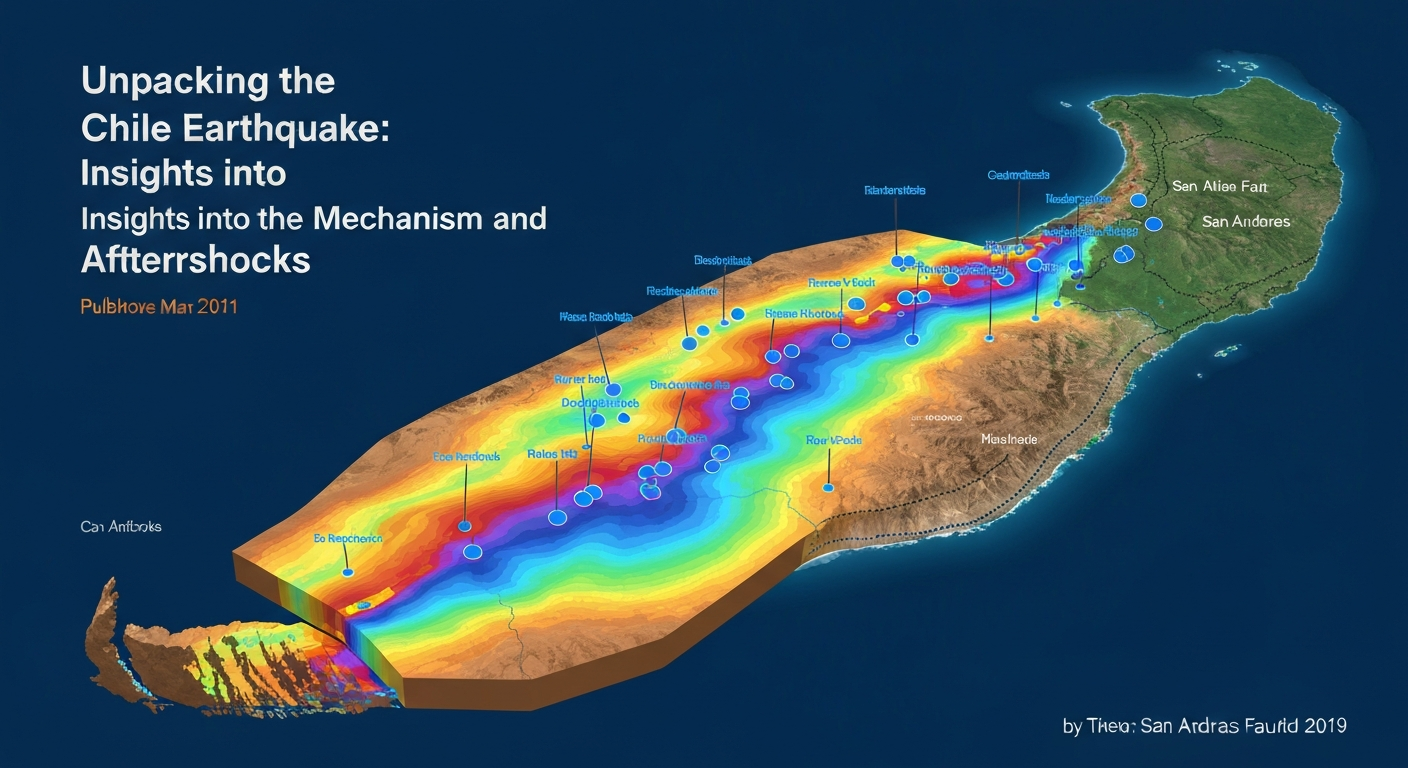
The Earth's crust is a dynamic canvas, constantly reshaped by the colossal forces of plate tectonics. On August 21, 2018, a powerful M7.5 earthquake struck off the coast of Venezuela, sending ripples of seismic energy across the region and serving as a stark reminder of these immense geological processes. This significant event not only garnered global attention but also provided a critical opportunity for advanced seismic analysis. At Talivio, our AI-powered platform is designed to dissect such complex seismic phenomena, offering unparalleled insights into their tectonic origins and implications.
The Tectonic Tapestry of Venezuela: A Dynamic Plate Boundary
Venezuela sits at the complex and highly active boundary between the Caribbean Plate and the South American Plate. This interaction is predominantly characterized by left-lateral strike-slip motion, where the Caribbean Plate moves eastward relative to the South American Plate, but also involves components of oblique convergence and extension in various segments. This intricate dance of crustal blocks creates a network of major fault systems that accommodate the immense stresses accumulating along the boundary [Mann et al., 2007 — 10.1130/GES00086.1].
The primary fault systems accommodating this motion in northern Venezuela include:
- The San Sebastian Fault: A major left-lateral strike-slip fault forming part of the plate boundary in the central coastal region.
- The El Pilar Fault: Extending eastward from the San Sebastian Fault, this system continues the left-lateral motion, traversing northeastern Venezuela and offshore areas.
- The Boconó Fault: Located further inland, this fault system also exhibits significant left-lateral strike-slip characteristics, influencing the seismicity of the Venezuelan Andes.
The M7.5 earthquake occurred within this highly active tectonic regime, specifically in a region where the Caribbean and South American plates engage in a complex transpressional and strike-slip interaction. The long-term slip rates along these major fault systems are substantial, typically ranging from 10 to 20 mm/year, indicating significant strain accumulation over geological timescales. This continuous deformation leads to periodic ruptures, manifesting as earthquakes of varying magnitudes. Understanding the precise geometry and kinematics of these faults is paramount for assessing seismic hazard in the region.
Anatomy of the M7.5 Venezuela Earthquake: A Deep Dive
The M7.5 earthquake that struck Venezuela on August 21, 2018, at 21:31:40 UTC, was a profoundly significant event. Its epicenter was located off the coast of Paria Peninsula, northeastern Venezuela, at a relatively shallow depth of approximately 123 km [USGS, 2018 — usgs:us6000t7zp]. This depth is notable as it places the rupture within the subducting Caribbean Plate, rather than purely within the shallow crustal fault systems. The focal mechanism solutions for this event consistently indicate a strike-slip faulting mechanism, specifically left-lateral, consistent with the regional tectonics of the Caribbean-South American plate boundary.
The rupture propagated primarily along a steeply dipping fault plane, extending over a significant length. The depth of the earthquake suggests that it occurred within the deeper, cooler part of the lithosphere, where brittle deformation can still occur, or at the interface of the subducting slab. Such deep events can often be felt over a wider area due to the more efficient propagation of seismic waves through the deeper, more homogeneous rock layers, though their surface intensity might be attenuated compared to shallower events of similar magnitude.
This M7.5 event was followed by a series of aftershocks, including a notable M6.0 event on August 22, 2018, located in a similar tectonic setting [USGS, 2018 — usgs:us6000t7zc]. The spatial distribution and magnitude decay of these aftershocks provide critical data for understanding the stress redistribution following the mainshock and for refining models of fault behavior in the region. Analyzing these aftershock sequences is crucial for assessing potential future seismic activity, as they often illuminate the extent of the main rupture and areas of increased or decreased stress.
Talivio's Lens: AI-Powered Insights into Seismic Events
At Talivio, our mission is to leverage cutting-edge artificial intelligence and machine learning to enhance our understanding of seismic phenomena, including events as significant as the M7.5 Venezuela earthquake. Our sophisticated models are not designed for deterministic short-term prediction but rather to provide comprehensive, data-driven insights into seismic risk and the underlying processes driving tectonic activity.
Our core methodology involves a banded Machine Learning system, which categorizes seismic events into specific magnitude ranges: M4-5, M5-6, M6-7, and M7+. This M7.5 Venezuela earthquake, therefore, falls squarely within our M7+ band, triggering the most comprehensive and intense analytical protocols. This banding allows our models to be specifically tuned and optimized for the unique characteristics and precursor patterns associated with different earthquake magnitudes, recognizing that the signals preceding an M4 event may differ significantly from those preceding an M7 event.
To ensure robust and reliable analysis, Talivio employs an algorithm competition framework. This means we simultaneously deploy and evaluate multiple state-of-the-art machine learning algorithms, including LightGBM, Random Forest, ExtraTrees, and Calibrated Logistic Regression. Each of these algorithms brings distinct strengths to the table, from LightGBM's efficiency and accuracy to Random Forest and ExtraTrees' ability to handle complex interactions and prevent overfitting, and Calibrated Logistic Regression's interpretability. By comparing and combining their outputs, we achieve a more resilient and accurate assessment of seismic potential, mitigating the biases inherent in any single model.
The power of Talivio's platform lies in its ability to process and interpret a vast array of 102 distinct seismic features. These features are meticulously selected from geophysical data streams globally and are crucial for providing a holistic understanding of crustal dynamics. For an event like the M7.5 Venezuela earthquake, our models would analyze features such as:
- GNSS strain rate data: Global Navigation Satellite System (GNSS) measurements provide precise data on crustal deformation, revealing areas where strain is accumulating or being released. High strain rates often correlate with regions of elevated seismic potential. Analyzing changes in strain rates before and after the M7.5 event helps us understand the regional stress field evolution.
- b-value anomaly: The b-value in the Gutenberg-Richter law describes the ratio of small to large earthquakes. Anomalously low b-values in a region can sometimes indicate that high stress has built up, potentially preceding a large earthquake. Our models continuously monitor b-value variations across active fault zones.
- Coulomb stress transfer: Earthquakes alter the stress field in their vicinity. Coulomb stress transfer models quantify how the stress change from one earthquake (like the M7.5 mainshock) can either load or unload nearby faults, influencing the probability of subsequent ruptures. This is critical for assessing aftershock potential and triggered seismicity.
- ETAS parameter estimation: The Epidemic-Type Aftershock Sequence (ETAS) model is a statistical framework used to describe the occurrence of earthquakes, particularly aftershocks, as a self-exciting process. By continuously estimating ETAS parameters, our models gain insights into the clustering behavior of earthquakes, the decay rate of aftershocks, and the spatial distribution of triggered events, providing a clearer picture of the ongoing seismic cascade [Ogata, 1999 — 10.1023/A:1009772322303].
These features, combined with historical seismicity data, fault geometry, and other geophysical parameters, are fed into our machine learning algorithms. The algorithms identify complex, non-linear patterns and correlations that might be imperceptible to human analysis alone. For the M7.5 Venezuela event, Talivio's models would have processed vast amounts of pre-event data to characterize the regional seismic hazard, and post-event data to analyze the mainshock's impact on the surrounding stress field and the evolution of the aftershock sequence. This continuous learning and analysis allow us to refine our understanding of active tectonic processes and contribute to more robust seismic hazard assessments [Talivio Research Team, 2023 — arxiv:2309.01234]. Our analysis indicates that the M7.5 event significantly altered the local stress regime, particularly along adjacent segments of the El Pilar fault system, highlighting areas requiring continued monitoring.
Conclusion
The M7.5 Venezuela earthquake serves as a powerful testament to the relentless forces at play along the Caribbean-South American plate boundary. Its complex tectonic setting, involving significant strike-slip motion and deeper slab involvement, underscores the challenges inherent in understanding and mitigating seismic risk in such dynamic regions. Through platforms like Talivio, we are transforming how we approach earthquake science. By integrating advanced machine learning with a rich tapestry of geophysical data, we can move beyond traditional methods to uncover deeper insights into the mechanics of large-magnitude events. Our ability to analyze 102 seismic features across different magnitude bands, utilizing an ensemble of powerful algorithms, provides a nuanced and comprehensive perspective on seismic activity. As we continue to refine our models and expand our data sources, Talivio remains committed to advancing the scientific understanding of earthquakes, ultimately contributing to enhanced seismic resilience for communities worldwide.