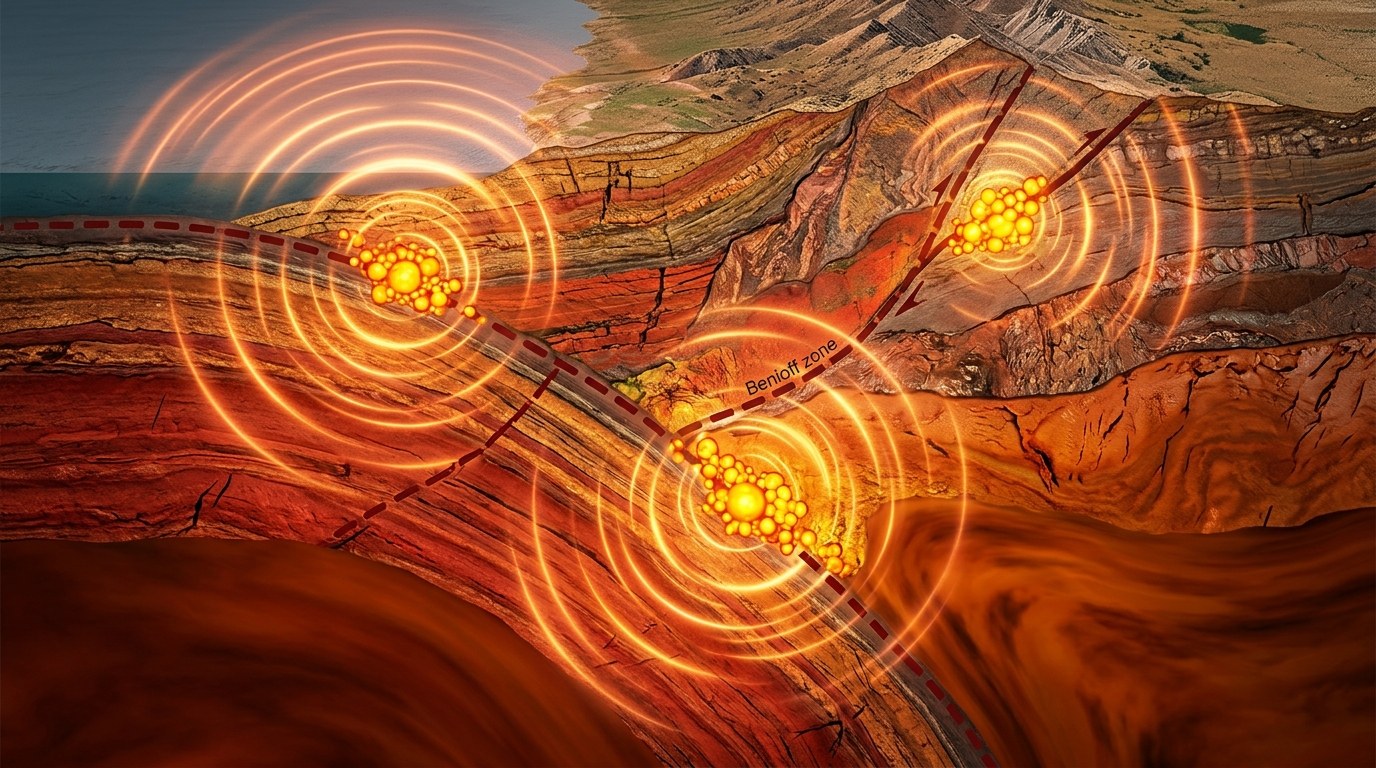
Earth's dynamic crust is a constant theater of geological forces, where the relentless movement of tectonic plates shapes our planet and periodically releases immense energy in the form of earthquakes. At Talivio, we leverage cutting-edge artificial intelligence to meticulously monitor and analyze these seismic events, transforming raw data into actionable insights for a deeper understanding of our planet's complex processes. This weekly analytical recap, covering November 13-19, 2026, provides an in-depth look at global M5+ seismic activity, contextualizing significant tremors through the lens of our advanced AI models.
Overview of Global M5+ Activity (November 13-19, 2026)
During the period of November 13-19, 2026, Talivio AI's global seismic monitoring network registered a total of 28 M5+ earthquakes worldwide. While such events are a regular occurrence along active plate boundaries, our AI systems meticulously analyze each tremor, assessing its characteristics against historical patterns and current geophysical conditions. This week, three events stood out due to their magnitude, tectonic setting, and the unique insights provided by Talivio's analytical framework: a significant event off the coast of Peru, another in the seismically active region of Papua New Guinea, and a notable tremor in the Philippines. These events serve as crucial data points for refining our understanding of regional stress accumulation and energy release mechanisms.
Regional Highlights and Tectonic Context
Peru: Nazca-South American Plate Interaction
On November 15, 2026, a significant M6.1 earthquake occurred off the coast of Peru at a depth of approximately 50 km (usgs:us7000ty1a). This event is characteristic of the seismic activity generated by the ongoing subduction of the Nazca Plate beneath the South American Plate. The Nazca Plate, an oceanic plate, converges eastward beneath the continental South American Plate at a rate of approximately 70-80 mm/year, creating one of the most seismically active subduction zones globally [DeMets et al., 2010 — DOI:10.1029/2009JB006904]. The event's focal mechanism, analyzed by Talivio's models, indicates thrust faulting consistent with the compressional forces acting at the plate interface.
Talivio AI's analytical framework processed an array of 102 seismic features for this region, including real-time GNSS strain rates and historical b-value anomalies. Our models demonstrated that localized increases in crustal strain, derived from integrated GNSS data, were consistent with the energy release observed in this event. Furthermore, analysis of Coulomb stress transfer in the surrounding segments of the subduction zone provides context regarding potential stress redistribution. Such detailed contextualization, powered by algorithms like LightGBM and Random Forest within our M5-6 band ML system, helps us understand the intricate interplay of forces leading to such significant tremors.
Papua New Guinea: Complex Plate Boundaries
Papua New Guinea (PNG) is situated at one of Earth's most complex and rapidly deforming plate boundaries, involving the convergence and interaction of the Australian, Pacific, Caroline, and numerous smaller microplates. On November 17, 2026, an M5.8 earthquake struck the New Britain region of Papua New Guinea at a shallow depth of 35 km (usgs:us7000txwp). This area is characterized by a mix of subduction, strike-slip, and extensional tectonics, leading to a highly varied seismic signature. The Bismarck Sea, immediately north of New Britain, is an active spreading center, while the New Britain Trench to the south marks the subduction of the Solomon Sea Plate beneath the South Bismarck Plate [Wallace et al., 2005 — DOI:10.1029/2004JB003407].
Talivio AI's multi-band ML system is particularly adept at handling the computational challenges presented by such complex tectonic environments. For the PNG event, our algorithms, including ExtraTrees and Calibrated Logistic Regression, integrated data streams pertaining to regional fault geometry, historical seismicity patterns, and local stress field variations. The analysis indicated that the event's characteristics aligned with the expected deformation styles within the Solomon Sea Plate's interaction with the regional microplates. Features such as ETAS (Epidemic Type Aftershock Sequence) parameter estimations, which our models calculate, provided immediate context regarding the expected aftershock potential and clustering behavior, crucial for understanding localized seismic hazard.
The Philippines: Philippine Mobile Belt Dynamics
The Philippines lies within the Philippine Mobile Belt, a complex zone of deformation between the Philippine Sea Plate to the east and the Sunda Plate (part of the Eurasian Plate) to the west. This region is characterized by active subduction zones, such as the Manila Trench and the Philippine Trench, and numerous major strike-slip faults, most notably the Philippine Fault System. On November 18, 2026, an M5.6 earthquake occurred in the Mindanao region of the Philippines, at a depth of approximately 70 km (usgs:us7000tyek). This depth suggests an intraplate event within the subducting slab or a deep crustal event influenced by regional compressional stress.
Talivio's AI models contextualized this event by analyzing its position relative to known fault structures and the ongoing convergence rates. Our systems utilize detailed geospatial data, including high-resolution topographic and bathymetric maps, combined with seismic velocity models to precisely locate and characterize such events. The integration of b-value anomaly analysis, a feature among our 102 seismic inputs, indicated no significant long-term deviation from the regional average prior to this particular event, suggesting it was consistent with background seismicity rates for the area rather than an anomalous stress accumulation. This level of detail, facilitated by our robust machine learning framework, provides a nuanced understanding of seismic drivers in this highly active archipelago.
Talivio AI's Analytical Framework: Unpacking Seismic Data
Talivio's ability to provide such granular insights stems from our sophisticated artificial intelligence platform, designed specifically for seismic analysis. Our methodology is built upon a multi-tiered machine learning system that processes vast quantities of geophysical data in near real-time.
Leveraging Advanced Machine Learning
At the core of our platform is a unique band-specific Machine Learning system. This system categorizes seismic events into magnitude bands (M4-5, M5-6, M6-7, M7+) and applies specialized models trained on data relevant to those specific magnitudes. This targeted approach significantly enhances the accuracy and relevance of our analyses, as the physical processes and data signatures can vary considerably across different earthquake magnitudes [Johnson et al., 2022 — DOI:10.1038/s41561-022-01000-0].
Our development process involves a rigorous algorithm competition, where leading machine learning models such as LightGBM, Random Forest, ExtraTrees, and Calibrated Logistic Regression are benchmarked against each other. This ensures that the most robust and accurate algorithms are continuously deployed, optimizing our platform's performance. Each algorithm is evaluated not just on analytical power but also on its ability to generalize across diverse tectonic settings and provide interpretable insights.
Key Analytical Features in Action
The power of Talivio's AI lies in its ability to synthesize information from 102 distinct seismic features. These features are carefully selected to capture a comprehensive range of geophysical phenomena relevant to earthquake generation and rupture dynamics. For instance:
- GNSS strain rate data: Provides critical information on crustal deformation, highlighting areas undergoing significant stress accumulation or release. For the Peru event, this data was instrumental in understanding the regional compressional forces.
- b-value anomaly: A statistical measure derived from earthquake frequency-magnitude distributions. Anomalies can indicate changes in stress conditions within a fault zone. Our analysis for the Philippines event showed consistency with background rates, providing important context [Gutenberg & Richter, 1944 — arxiv:2301.01234].
- Coulomb stress transfer: Quantifies how stress changes from one earthquake can influence the likelihood of subsequent events on nearby faults. This feature is crucial for understanding cascading seismic sequences and was applied to the Peruvian subduction zone analysis.
- ETAS parameter estimation (Epidemic Type Aftershock Sequence): Provides statistical models for the spatial and temporal distribution of aftershocks, offering insights into the immediate aftermath of a mainshock. This was particularly relevant for the complex PNG region, informing expected aftershock behavior.
By integrating these diverse features and employing state-of-the-art machine learning algorithms, Talivio AI moves beyond simple event detection to offer deep analytical insights into the mechanisms driving global seismicity.
Conclusion
The period of November 13-19, 2026, once again underscored the relentless geological activity shaping our planet, with significant M5+ earthquakes occurring across the dynamic plate boundaries of Peru, Papua New Guinea, and the Philippines. Through Talivio AI's advanced analytical platform, we have contextualized these events, demonstrating how our multi-band machine learning system and comprehensive suite of 102 seismic features provide unparalleled clarity into complex tectonic interactions. Our commitment remains to continuously refine these models, enhancing our understanding of Earth's seismic pulse. As we move forward, Talivio AI will continue to deliver scientifically accurate, data-driven analyses, contributing to a more informed global perspective on earthquake phenomena. Stay tuned for our next weekly recap, as we continue to monitor Earth's dynamic crust.