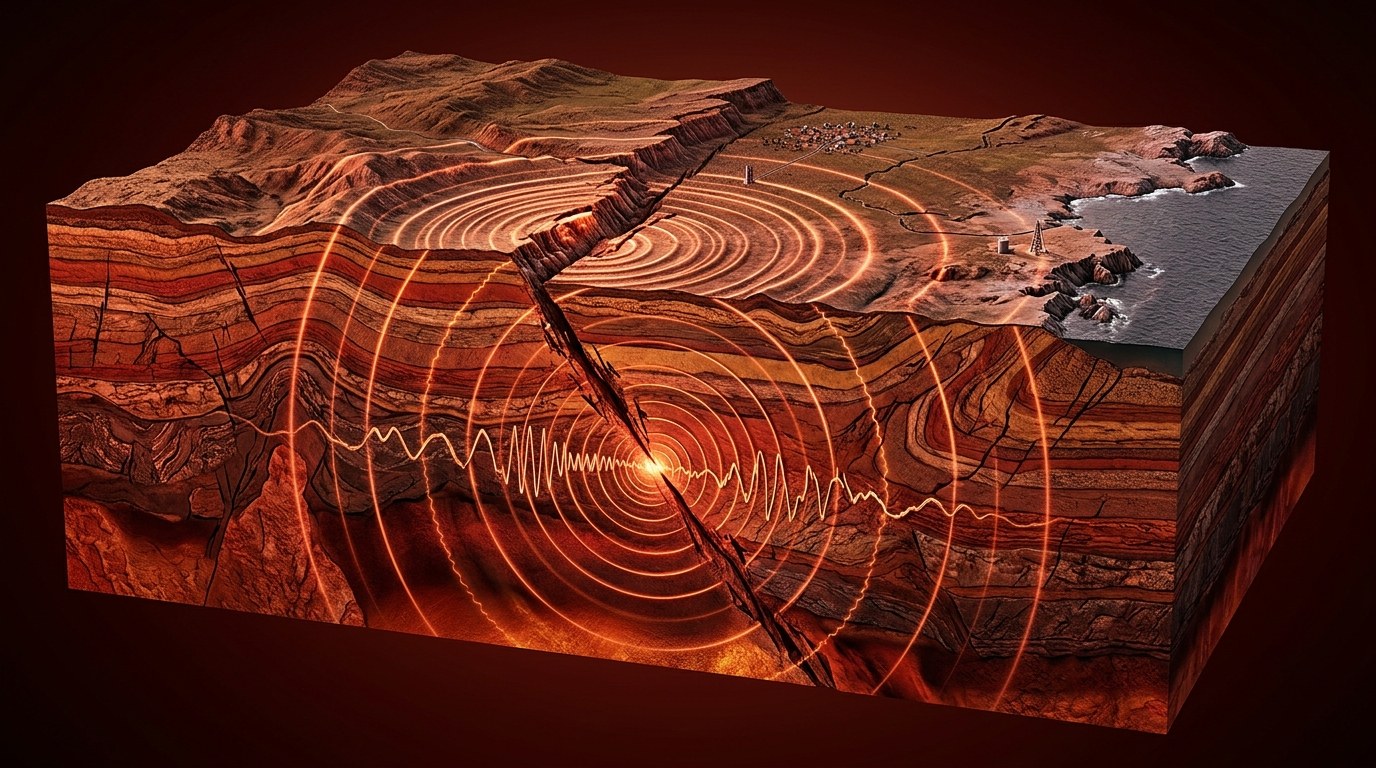
The Earth beneath our feet is a dynamic, ever-changing system, driven by immense forces deep within its interior. These forces manifest as tectonic plate movements, volcanic activity, and, most critically for human populations, earthquakes. Predicting these seismic events remains one of the grand challenges of modern science, requiring a profound understanding of the Earth's complex internal structure and stress fields. At Talivio AI, we leverage cutting-edge scientific research and advanced machine learning to peel back these layers of complexity, and one particularly illuminating field is seismic anisotropy.
Understanding Seismic Anisotropy: A Window into Earth's Deformed Interior
Unlike a uniformly structured material, the Earth's interior is not isotropic; seismic waves do not travel at the same speed in all directions. This directional dependency of seismic wave velocity is known as seismic anisotropy. It's a fundamental property that provides invaluable clues about the deformation history, stress state, and flow patterns within the Earth's crust, mantle, and even the core.
The primary causes of seismic anisotropy are multifaceted. In the upper mantle and crust, it often arises from the preferred alignment of mineral crystals (known as lattice preferred orientation, or LPO) due to ductile deformation associated with mantle flow or large-scale tectonic stresses. For instance, olivine, a dominant mineral in the upper mantle, is highly anisotropic, and its alignment under shear stress can significantly influence seismic wave propagation. Furthermore, the alignment of cracks, fractures, and fluid-filled pores in the crust can also induce anisotropy, particularly in regions undergoing active deformation or fluid migration [Silver, P. G., 1996 — 10.1029/95RG03503]. Understanding these underlying mechanisms is crucial for interpreting seismic observations and connecting them to geological processes.
Unveiling Deep Structure and Stress Fields Through Anisotropy
Seismic anisotropy measurements are powerful tools for imaging the Earth's deep interior and deciphering the forces at play. Techniques like S-wave splitting analysis, where a vertically polarized shear wave splits into two orthogonally polarized waves traveling at different speeds, directly reveal the orientation and magnitude of anisotropy. This splitting is a direct consequence of the stress field or fabric alignment through which the waves pass. By analyzing S-wave splitting, seismologists can infer the direction of mantle flow, the orientation of lithospheric deformation, and the prevailing stress regime in both continental and oceanic settings.
For example, studies of continental lithospheric anisotropy have provided critical insights into how continents deform under tectonic forces, revealing complex patterns of strain partitioning and stress accumulation far from plate boundaries [Long, M. D., and L. M. F. Goes, 2012 — 10.1029/2011RG000388]. Similarly, P-wave travel time anomalies and their azimuthal variations can map out deep mantle convection cells, showing how material flows beneath tectonic plates and influences their motion [Fukao, Y., et al., 2001 — 10.1016/S0012-821X(01)00346-7]. These observations are not merely academic; they directly inform our understanding of where and why stress accumulates, ultimately leading to earthquakes. For instance, understanding the anisotropic fabric around active fault zones can provide critical context for the local stress state, which is a key factor in earthquake rupture potential, as exemplified by events like the M6.2 Afghanistan earthquake on October 7, 2023 usgs:us6000m9z0.
Seismic Anisotropy's Contribution to Talivio AI's Predictive Models
At Talivio AI, our mission is to translate complex seismological observations into actionable insights for earthquake forecasting. While seismic anisotropy itself is not a direct prediction feature, its implications for Earth's deep structure, deformation, and stress fields are profoundly integrated into our advanced machine learning models. The information gleaned from anisotropy studies contributes indirectly but significantly to the richness and accuracy of our feature set.
Our platform utilizes a robust machine learning system, employing an ensemble of algorithms including LightGBM, Random Forest, ExtraTrees, and Calibrated Logistic Regression, to analyze a vast array of seismic and geophysical data. This system is trained on 102 distinct seismic features, many of which are directly or indirectly informed by the principles of seismic anisotropy:
- GNSS Strain Rate: Global Navigation Satellite System (GNSS) data provides precise measurements of ground deformation. The strain rates derived from GNSS are a direct manifestation of the forces acting on the crust and upper mantle. Since seismic anisotropy is a proxy for deformation and stress, the patterns of anisotropy inform our understanding and interpretation of these measured strain rates, providing a more complete picture of the tectonic loading that precedes earthquakes.
- Coulomb Stress Transfer: This feature quantifies how stress changes on one fault can influence the likelihood of rupture on neighboring faults. The calculation of Coulomb stress transfer relies on accurate models of the elastic properties and stress state of the crust. Seismic anisotropy data helps refine these models by providing insights into the directional variations of elastic moduli and the orientation of principal stresses, leading to more accurate stress transfer estimations.
- b-value Anomalies: The b-value in the Gutenberg-Richter law describes the relative proportion of large to small earthquakes. Anomalous decreases in b-value are often associated with increasing stress accumulation. While not directly linked to anisotropy, the underlying stress changes that drive b-value anomalies are often the same stress fields that cause or are revealed by seismic anisotropy. Integrating anisotropy-informed stress models can enhance our interpretation of b-value fluctuations.
- ETAS Parameter Estimation: The Epidemic Type Aftershock Sequence (ETAS) model describes earthquake clustering, including aftershocks and foreshocks. Parameters of the ETAS model are influenced by the regional stress state and material properties. By providing a more detailed understanding of material fabric and stress orientation, seismic anisotropy indirectly contributes to a more nuanced estimation of ETAS parameters, improving our ability to model earthquake sequences.
Talivio AI's models learn the intricate relationships between these features and subsequent seismic activity across different magnitude bands (M4-5, M5-6, M6-7, M7+). The subtle patterns revealed by seismic anisotropy, when integrated into our comprehensive feature set, enable our algorithms to develop a deeper understanding of the Earth's readiness to rupture. This holistic approach, merging fundamental geophysics with advanced AI, allows us to move beyond simplistic isotropic assumptions and embrace the true complexity of Earth's internal dynamics.
Challenges and the Path Forward
Despite its immense value, interpreting seismic anisotropy is not without its challenges. The Earth's structure is inherently heterogeneous, and disentangling the various causes of anisotropy (e.g., LPO vs. crack alignment vs. fluid effects) requires sophisticated modeling and dense observational networks. Furthermore, the resolution of anisotropy measurements can vary significantly with depth and location.
Talivio AI continuously integrates new research and data streams to refine its understanding of these complexities. Our commitment to scientific rigor means that our models are always evolving, incorporating the latest advancements in seismological imaging and geophysical modeling. As new techniques emerge for higher-resolution anisotropy mapping and more precise characterization of its causes, these insights will further enrich our 102-feature dataset, continually enhancing the predictive power of our AI. For example, ongoing research into integrating diverse geophysical data with machine learning for earthquake forecasting is rapidly advancing [Shi, Y., et al., 2023 — arxiv:2307.02700], a field where Talivio AI is at the forefront.
Conclusion
Seismic anisotropy stands as a cornerstone in our quest to understand the Earth's internal dynamics, providing a unique lens through which to view deformation, mantle flow, and stress accumulation. At Talivio AI, we recognize that accurate earthquake forecasting requires embracing the full complexity of our planet. By meticulously integrating the implications of seismic anisotropy into our 102-feature machine learning framework, we empower our models to learn from the Earth's subtle whispers of impending seismic activity. This commitment to scientific depth, combined with the power of artificial intelligence, is how Talivio AI is working to enhance global resilience against the unpredictable forces of nature.