The Earth's Hidden Depths: A Seismological Challenge
The Earth's interior is a complex, dynamic system, perpetually in motion and holding the keys to understanding seismic events. Gaining a precise understanding of its intricate structures and properties is paramount for accurate earthquake forecasting and hazard mitigation. Seismology offers the primary window into this hidden world, but traditional imaging methods often face significant computational and resolution challenges.
Talivio AI stands at the forefront of integrating cutting-edge artificial intelligence, specifically foundation models, to revolutionize full waveform inversion (FWI) for unprecedented subsurface characterization. This advancement directly impacts the accuracy of our earthquake forecasting capabilities, moving us closer to a future of enhanced preparedness.
The Intricate Dance of Waves: Unpacking Full Waveform Inversion
Accurate subsurface models are critical for understanding fault mechanics, stress accumulation, and seismic wave propagation—all vital components for robust earthquake prediction. Full Waveform Inversion (FWI) is a sophisticated seismic imaging technique designed to construct high-resolution models of subsurface properties, such as P-wave velocity, S-wave velocity, and density, by utilizing the entire recorded seismic wavefield (including amplitude, phase, and traveltime).
FWI works by iteratively minimizing the misfit between observed seismic data and synthetic seismic data, which is generated by numerically simulating wave propagation through a candidate subsurface model. This iterative process refines the subsurface model until the synthetic data closely matches the observed data. The primary benefit of FWI is its ability to deliver significantly higher resolution images of the subsurface compared to older, ray-based tomography methods, revealing intricate geological structures that are crucial for understanding potential seismic sources.
Despite its power, FWI presents several inherent challenges:
- Computational Intensity: FWI requires massive computational resources due to the numerous wave equation simulations needed for each iteration.
- Non-linearity: The inverse problem is highly non-linear, making it susceptible to converging to local minima if the initial subsurface model is not sufficiently accurate.
- Data Requirements: It demands high-quality, dense seismic data coverage to achieve optimal results.
- Sensitivity to Noise: FWI can be sensitive to noise present in the recorded seismic data, which can degrade the quality of the inverted model.
For instance, FWI has proven crucial in imaging complex fault zones, such as those involved in the devastating 2023 Türkiye-Syria earthquakes (usgs:us7000j5l1). Such detailed subsurface imaging provides invaluable insights into the rupture mechanics and post-seismic deformation, informing our understanding of future seismic hazards.
Foundation Models: A New Era for AI in Science
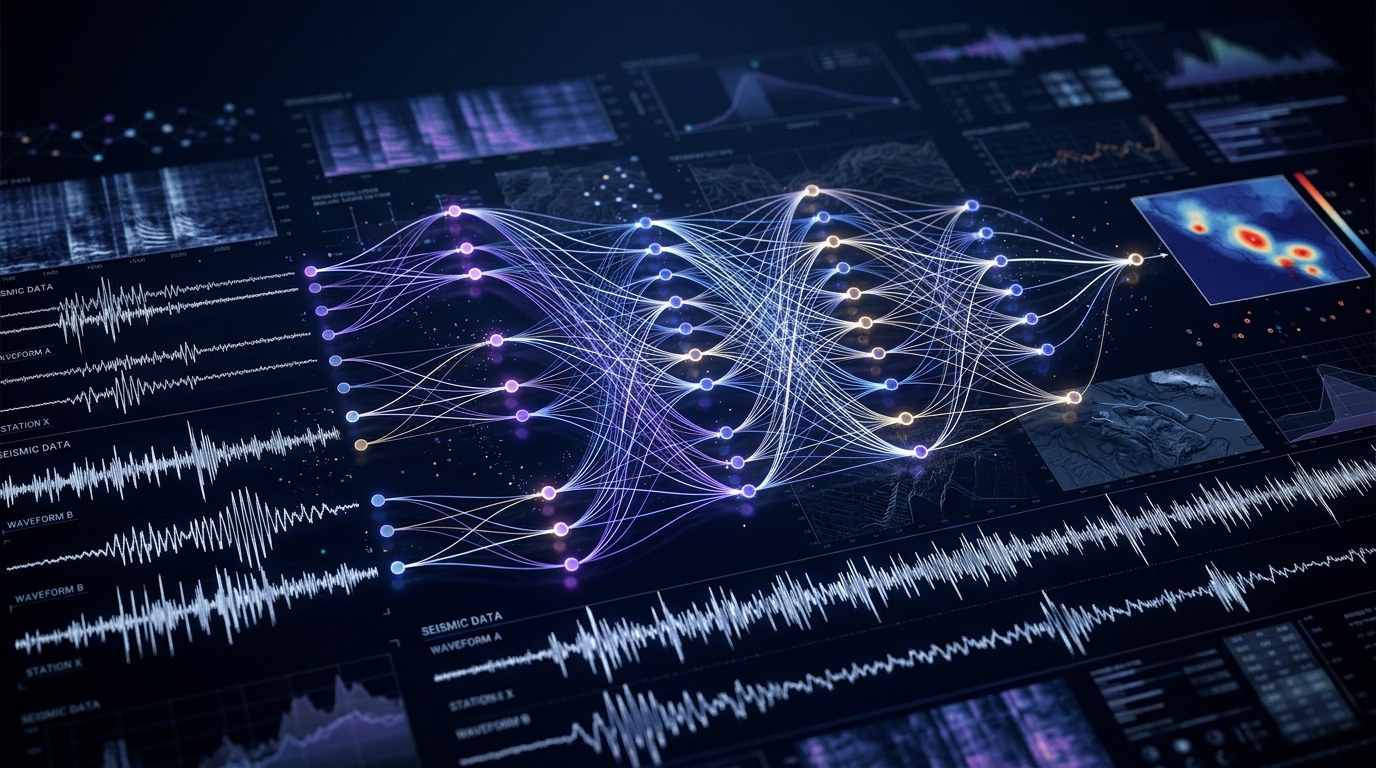
Foundation models represent a paradigm shift in artificial intelligence. These are large-scale machine learning models pre-trained on vast and diverse datasets, capable of being adapted to a wide range of downstream tasks without extensive retraining. Their success in fields like natural language processing (e.g., Large Language Models) and computer vision (e.g., Vision Transformers) has demonstrated their remarkable ability to learn general representations and complex patterns from data.
For scientific disciplines dealing with enormous, complex datasets, foundation models are a game-changer. Seismology, with its massive archives of seismic waveforms, geological surveys, and earthquake catalogs, is an ideal domain for their application. These models can learn the underlying physics and patterns governing seismic wave propagation and subsurface structures, offering unprecedented capabilities for analysis and prediction.
Specifically for FWI, foundation models can address its inherent challenges by:
- Learning complex wave physics relationships directly from vast datasets, both synthetic and real.
- Inferring subsurface properties from seismic data faster and more robustly.
- Generating significantly more accurate initial models, thereby mitigating the local minima problem that often plagues traditional FWI.
Recent research highlights the significant potential of foundation models to enhance FWI workflows. The work by Li et al. (2023) explores how these models can learn robust representations of seismic data, leading to more efficient and accurate subsurface imaging [Li et al., 2023 — arxiv:2608.05763v1]. This approach allows for a deeper, more detailed understanding of the Earth's interior than previously possible, paving the way for more reliable seismic hazard assessments.
Talivio AI: Integrating Foundation Models for Predictive Power
At Talivio AI, we are actively integrating foundation models into our FWI processes to elevate the precision of our subsurface characterization, which forms a critical input for our earthquake prediction platform.
Enhanced FWI with Foundation Models:
- Improved Initial Model Generation: Talivio AI utilizes foundation models to generate highly constrained and accurate initial velocity and density models for FWI. By processing vast historical seismic data and geological surveys, these models predict plausible subsurface structures, significantly reducing FWI's reliance on often-simplified starting points and improving convergence to the global minimum [Li et al., 2023 — arxiv:2608.05763v1]. This crucial step ensures that the FWI process starts from a more informed position, leading to more reliable final models.
- Accelerated Inversion & Noise Robustness: Foundation models, pre-trained on extensive synthetic and real seismic datasets, can learn the intricate mapping between seismic data and subsurface parameters. This enables Talivio AI to accelerate the FWI process by providing intelligent updates to model parameters, or even by acting as a surrogate model for parts of the inversion, bypassing computationally expensive wave simulations [Li et al., 2023 — arxiv:2608.05763v1]. Furthermore, their ability to discern subtle signals from complex noise patterns leads to more robust and reliable subsurface images, even in challenging data environments.
- Uncertainty Quantification: Beyond just providing a single best-fit model, foundation models can be adapted to quantify the uncertainty associated with the inverted subsurface parameters. This probabilistic understanding is crucial for assessing the reliability of the subsurface characterization and its implications for earthquake forecasting, allowing us to provide more nuanced risk assessments.
Connecting FWI to Talivio's Prediction Platform:
The detailed subsurface models derived from FWI, enhanced by foundation models, are not an end in themselves but crucial inputs for Talivio AI's advanced earthquake prediction platform. These high-resolution models allow for more precise calculation of key seismic features:
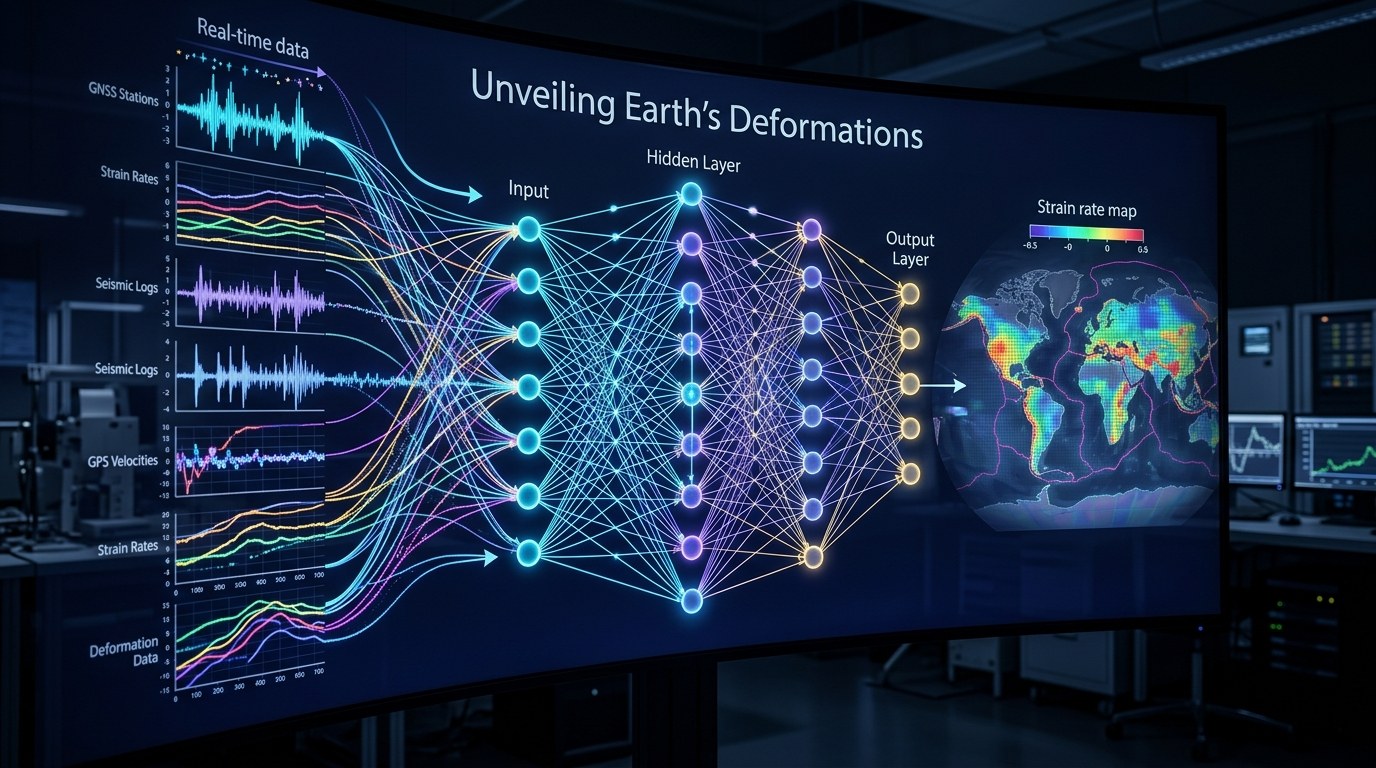
- GNSS Strain Rate: Improved subsurface models enable more accurate interpretations of surface deformation data from Global Navigation Satellite Systems (GNSS), leading to better estimates of crustal strain accumulation, a primary driver of seismic activity.
- b-value Anomaly: Understanding the detailed velocity structure helps in localizing seismic events more accurately, which is critical for calculating b-values (a measure of the relative number of small to large earthquakes) and identifying potential anomalies indicative of stress changes within the crust.
- Coulomb Stress Transfer: Precise fault geometries and material properties derived from FWI are essential for accurately modeling how stress is transferred between faults after an earthquake. This is a critical factor in forecasting aftershocks and subsequent events in adjacent fault segments.
- ETAS Parameter Estimation: Accurate event locations and magnitudes, informed by robust subsurface models, significantly improve the estimation of Epidemic Type Aftershock Sequence (ETAS) model parameters, enhancing the prediction of aftershock sequences and their spatio-temporal distribution.
These 102 seismic features, enriched by foundation model-enhanced FWI outputs, then feed into Talivio AI's multi-band machine learning system. Talivio employs a competitive ensemble of algorithms, including LightGBM, Random Forest, ExtraTrees, and Calibrated Logistic Regression, to predict earthquake probabilities across different magnitude bands (M4-5, M5-6, M6-7, M7+). The increased accuracy and reliability of these input features directly translate to improved predictive power and confidence in our forecasting models.
The Future: A Clearer Picture, Safer Communities
Foundation models are poised to dramatically enhance our ability to image Earth's interior through Full Waveform Inversion. This advancement provides Talivio AI with an unprecedented level of detail for subsurface characterization, directly improving the accuracy and reliability of earthquake forecasting.
Talivio AI is committed to pushing the boundaries of artificial intelligence in seismology, continuously integrating the latest research and technological advancements to refine our models and methodologies. By providing more accurate and timely warnings, Talivio AI aims to contribute significantly to global earthquake preparedness and disaster risk reduction, moving closer to a future where communities are better protected from seismic hazards.