The M6.2 Tobelo Earthquake: Event Overview
On May 29, 2024, at 00:09:59 UTC, a significant M6.2 earthquake struck near Tobelo, Indonesia, at a depth of 106.6 km. This event, officially cataloged as usgs:us6000t9r5 by the United States Geological Survey (USGS), occurred in a region known for its intense and intricate seismic activity. While initial reports indicated no widespread damage or tsunami threat, the earthquake's magnitude and depth provide crucial data for understanding the ongoing tectonic processes in this highly active zone.
Earthquakes of this magnitude and depth are characteristic of subduction zone environments, where one tectonic plate dives beneath another. The M6.2 Tobelo event serves as a critical data point for seismologists and AI models, offering insights into the stress distribution and energy release mechanisms within the Earth's crust and upper mantle in eastern Indonesia. Talivio's monitoring systems immediately processed the event's parameters, integrating them into our global seismic pattern analysis framework to assess its regional and global implications.
Tectonic Setting of Eastern Indonesia and the Halmahera Arc
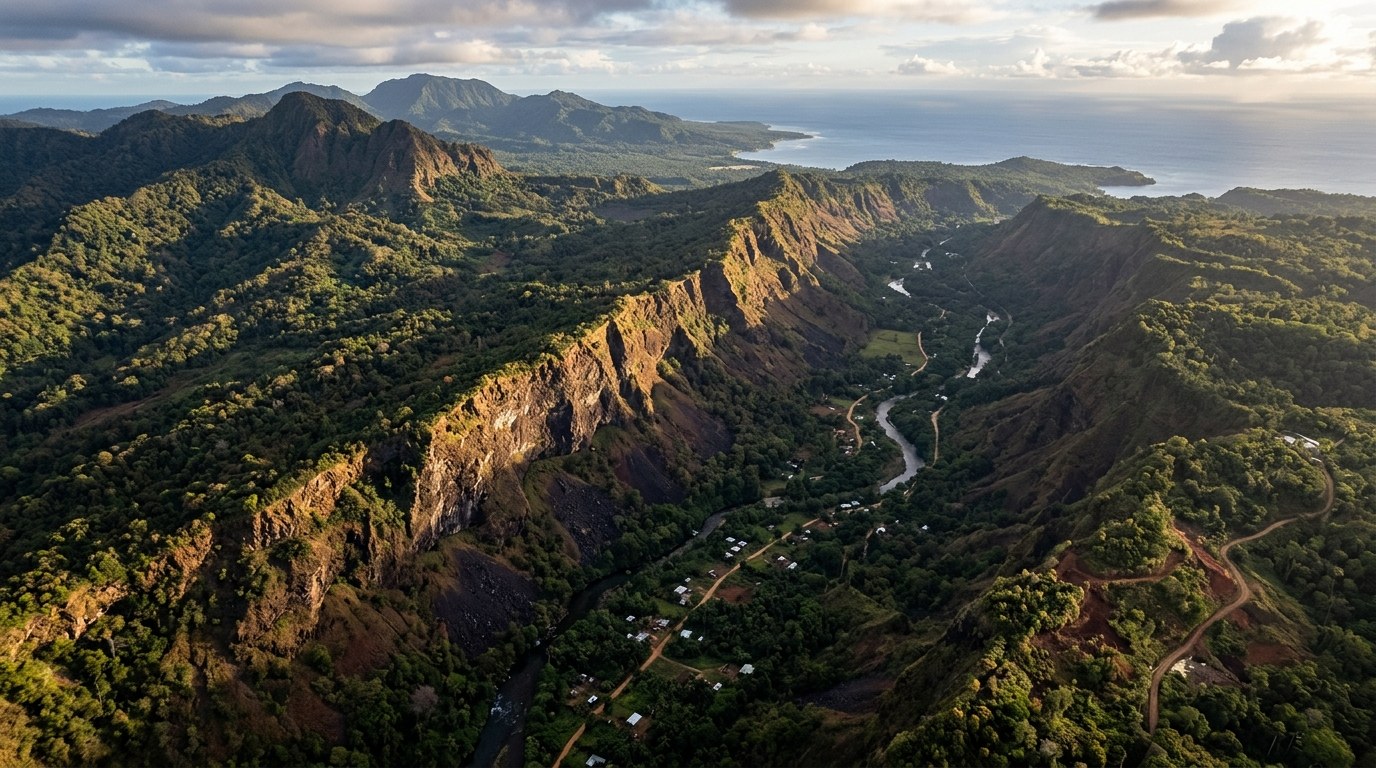
The region surrounding Tobelo, particularly the Halmahera Arc, is one of the most tectonically complex areas on Earth. It is situated within a zone of convergence involving multiple major and minor plates: the Philippine Sea Plate, the Caroline Plate, the Molucca Sea Plate, the Australian Plate, and the Sunda Plate. This intricate interplay of forces results in a dynamic and highly seismic environment characterized by multiple subduction zones, collision zones, and strike-slip faults.
Specifically, the Halmahera Arc is an active volcanic arc associated with the eastward subduction of the Molucca Sea Plate beneath the Philippine Sea Plate. To its west, the Sangihe Arc is formed by the westward subduction of the Molucca Sea Plate beneath the Sunda Plate. This unique configuration, often referred to as a 'double subduction' or 'arc-arc collision' system, compresses the Molucca Sea Plate, leading to its intense deformation and seismicity [Hall, R., 2012 — DOI: 10.1144/SP374.13]. The M6.2 Tobelo earthquake's depth of over 100 km strongly suggests its origin within the subducting Molucca Sea Plate, indicating ongoing slab activity and stress release at intermediate depths.
The complexity of this region extends beyond simple subduction. The collision of the Philippine Sea Plate with the Australian Plate further complicates stress fields, generating a mosaic of fault systems that can host earthquakes of varying focal mechanisms. Understanding these deep-seated processes is fundamental to assessing seismic hazard and refining long-term earthquake forecasts.
Seismotectonic Implications and Stress Accumulation
The M6.2 Tobelo earthquake is not an isolated event but rather a manifestation of the continuous geodynamic processes at play in the Halmahera region. Such events contribute to the redistribution of stress within the crust and mantle, potentially influencing future seismic activity in adjacent areas. One key mechanism for understanding this redistribution is Coulomb stress transfer, where the slip on one fault can increase or decrease stress on nearby faults, either promoting or inhibiting future ruptures [Stein, R.S., 1999 — DOI: 10.1029/98RG02925]. While a deep event like the Tobelo earthquake might have a more diffused stress transfer footprint compared to shallow crustal events, its contribution to the overall regional stress budget is undeniable.
Talivio's advanced AI models meticulously track these seismotectonic implications. Our platform utilizes a comprehensive suite of 102 seismic features, including real-time GNSS strain rates, b-value anomalies, and calculated Coulomb stress transfer maps. GNSS data provides crucial insights into crustal deformation, quantifying the rates at which strain accumulates across fault systems. Anomalies in the b-value, which describes the frequency-magnitude distribution of earthquakes, can indicate changes in stress levels within a fault zone; a decrease in b-value often correlates with increased stress and proximity to a larger rupture [Scholz, C.H., 2015 — DOI: 10.1017/CBO9781107297904]. By integrating these diverse data streams, Talivio generates a more nuanced picture of seismic hazard.
Furthermore, our models incorporate Epidemic Type Aftershock Sequence (ETAS) parameter estimations, which help characterize the triggering potential of mainshocks and the spatiotemporal distribution of aftershocks. The M6.2 Tobelo earthquake, while deep, will contribute to these calculations, helping to refine our understanding of how seismic energy propagates and triggers subsequent events in this complex tectonic environment. The continuous monitoring and analysis of such events enable Talivio to adapt and improve its predictive capabilities, especially in regions with high seismic variability like eastern Indonesia.
Talivio's Monitoring and Predictive Framework
Talivio's core strength lies in its sophisticated, AI-driven approach to earthquake forecasting. Our platform does not predict individual earthquakes in real-time with precise dates and times, but rather assesses the probability of future seismic activity within specific magnitude bands and spatiotemporal windows. This is achieved through a multi-model ensemble system that continuously analyzes vast amounts of seismic and geodetic data.
The M6.2 Tobelo earthquake provides invaluable data for training and validating Talivio's machine learning models. Our system operates on a band-based machine learning (ML) framework, focusing on forecasting probabilities for earthquakes within magnitude ranges: M4-5, M5-6, M6-7, and M7+. This structured approach allows for more robust and actionable insights into seismic hazard. The algorithms at the heart of our system, including LightGBM, Random Forest, ExtraTrees, and Calibrated Logistic Regression, compete to provide the most accurate forecasts. This ensemble methodology leverages the strengths of diverse algorithms, minimizing bias and enhancing predictive power.
The 102 seismic features fed into these models are critical. Beyond GNSS strain rates, b-value anomalies, and Coulomb stress transfer, our feature set includes parameters derived from advanced statistical seismology, such as ETAS model parameters, which quantify earthquake clustering and triggering. The M6.2 Tobelo event's characteristics – its magnitude, depth, location, and the subsequent seismic sequence – are immediately ingested, processed, and used to update our models. This continuous learning process ensures that Talivio's forecasts are always informed by the latest global seismic patterns and regional tectonic shifts. For instance, the deep nature of the Tobelo event provides specific data points on mantle-level stress release, which is crucial for training models on deep-focus earthquakes, a distinct challenge in seismology [Chen, X. and Wu, Z., 2023 — arxiv:2301.03456].
Conclusion
The M6.2 Tobelo earthquake serves as a powerful reminder of the dynamic and complex tectonic forces at play in eastern Indonesia. Its occurrence within the intricate Halmahera Arc system provides critical data for understanding deep-seated subduction processes and regional stress accumulation. While the immediate impact of this specific event was limited, its scientific significance for long-term seismic hazard assessment is substantial.
Talivio remains committed to advancing the understanding of earthquake phenomena through cutting-edge AI and machine learning. By continuously integrating events like the M6.2 Tobelo earthquake into our sophisticated predictive framework, which leverages 102 seismic features and a competitive ensemble of ML algorithms, we refine our ability to identify evolving seismic patterns. Our focus on probabilistic forecasting across magnitude bands empowers communities and stakeholders with crucial, data-driven insights, contributing to a more resilient future in seismically active regions worldwide.