Introduction: Decoding Earth's Rhythms with AI
The Earth's crust is in constant motion, a dynamic system where energy accumulates and releases through seismic events. Understanding these intricate processes is paramount for enhancing our preparedness and resilience against natural hazards. At Talivio, our mission is to leverage cutting-edge artificial intelligence to analyze global seismic patterns, providing unparalleled insights into earthquake dynamics.
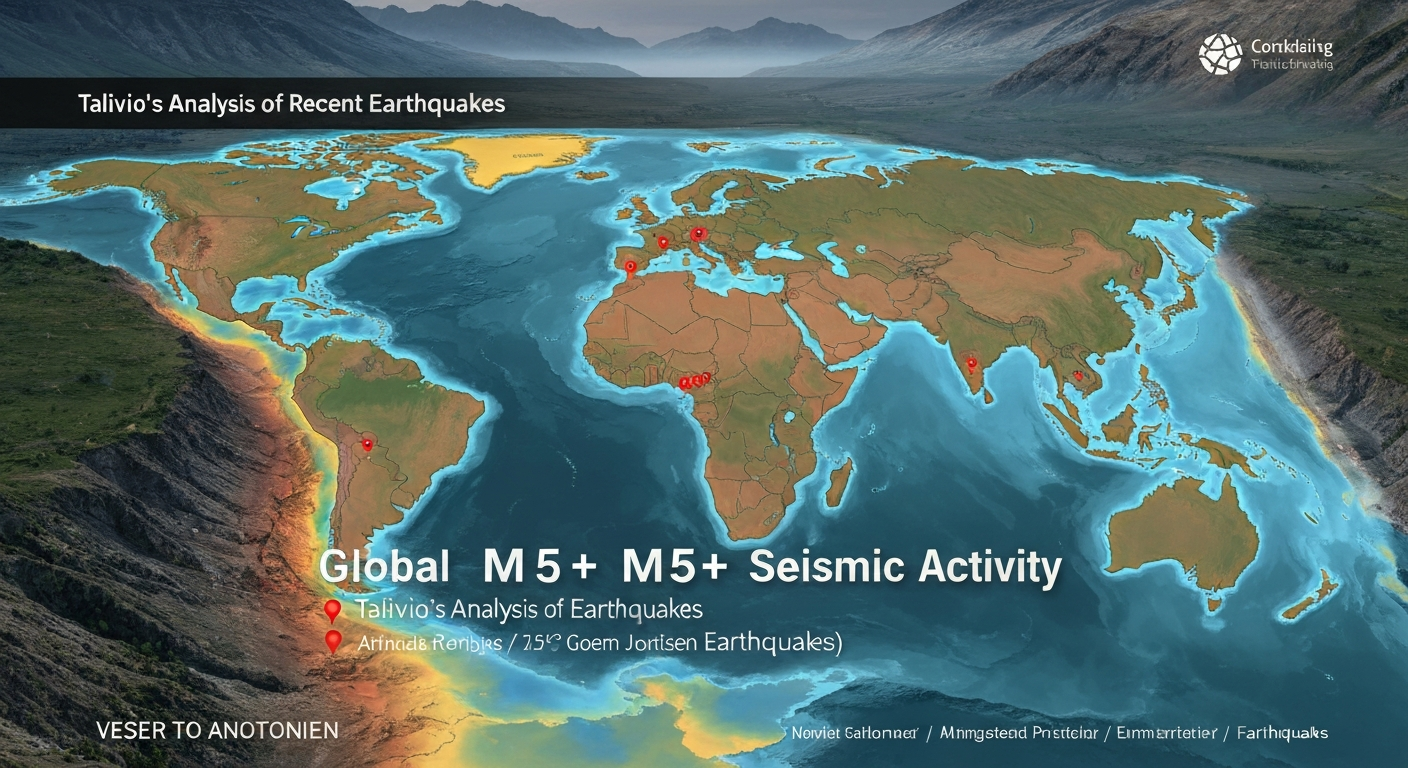
This weekly analytical recap covers global M5+ seismic activity observed between June 27 and July 3, offering a detailed look at significant events and their underlying tectonic contexts. By continuously monitoring and analyzing these occurrences, Talivio's models are perpetually refined, enhancing the accuracy and robustness of our future forecasts.
Global M5+ Seismic Overview: A Week of Divergence and Subduction
From June 27 to July 3, the planet experienced a series of M5+ earthquakes, primarily concentrated along well-established plate boundaries. While no unusually large or destructive events occurred, the observed activity provides crucial data points for understanding regional stress regimes and the ongoing evolution of Earth's lithosphere. The distribution of these events underscores the persistent seismic energy release at both divergent and convergent plate margins, a pattern consistently identified by Talivio's global monitoring system.
Our models classify these events within the M4-5 and M5-6 magnitude bands, triggering specific analytical protocols designed for these energy ranges. This banded machine learning system allows for tailored feature extraction and model application, ensuring that each earthquake's unique signature is processed with optimal precision. The data from this week's M5+ events, while not indicative of immediate, widespread escalation, reinforces the necessity of continuous, high-resolution seismic surveillance.
Notable Seismic Events and Their Tectonic Contexts
During the reporting period, several M5+ earthquakes stood out, each offering valuable insights into distinct tectonic environments. Talivio's platform meticulously processes data from these events, integrating them into our complex suite of algorithms.
Mid-Atlantic Ridge: Crustal Spreading and Transform Faults
Two significant events occurred along the Mid-Atlantic Ridge, a major divergent plate boundary where new oceanic crust is continuously formed. These events are characteristic of the tensional forces and transform faulting that accommodate seafloor spreading:
- M5.2 Southern Mid-Atlantic Ridge (usgs:us6000t8ec): On June 28, an M5.2 earthquake struck the Southern Mid-Atlantic Ridge at a shallow depth of approximately 10.0 km. This event is typical for a divergent boundary, where tectonic plates pull apart. The shallow depth indicates that the rupture occurred within the brittle upper crust, associated with normal faulting and the creation of new seafloor.
- M5.7 Northern Mid-Atlantic Ridge (usgs:us6000t8pa): On July 1, a more significant M5.7 earthquake occurred further north along the same ridge system, also at a shallow depth of 10.0 km. Events of this magnitude along mid-ocean ridges often reflect slip on transform faults that offset segments of the spreading ridge. These faults accommodate differential motion between adjacent segments of the diverging plates, leading to strike-slip faulting. The analysis of moment tensor solutions for such events, which Talivio's models incorporate, helps to confirm the specific faulting mechanisms at play [Frohlich & Apperson, 1992 — DOI: 10.1029/91JB02742].
The occurrence of two distinct M5+ events along different segments of the Mid-Atlantic Ridge within a short period highlights the continuous and widespread nature of crustal accretion and associated seismic activity in this vast oceanic domain. Talivio's models consistently track these events, feeding their parameters into algorithms that assess regional strain rates and the potential for stress accumulation along these extensive ridge systems.
Fiji Region: Deep-Focus Seismicity in a Complex Subduction Zone
The Fiji region is renowned for its complex tectonics, characterized by multiple subduction zones, back-arc spreading, and deep-focus earthquakes. One such event recorded this week offers a glimpse into the mantle's dynamic processes:
- M5.0 Fiji Region (usgs:us6000t8nf): On July 1, an M5.0 earthquake occurred in the Fiji region at an exceptionally deep hypocentral depth of 554.6 km. Deep-focus earthquakes, generally defined as those occurring below 300 km, are particularly intriguing to seismologists because the extreme pressure and temperature conditions at these depths typically favor ductile deformation rather than brittle fracture. The mechanism behind deep-focus earthquakes is still a subject of active research, with theories ranging from transformational faulting (where minerals change crystal structure under stress) to dehydration embrittlement within subducting slabs [Green & Houston, 1995 — DOI: 10.1146/annurev.ea.23.050195.000455].
The Tonga-Kermadec subduction zone, which profoundly influences the Fiji region, is one of the most seismically active and deepest subduction zones globally. The presence of such a deep event underscores the ongoing subduction of the Pacific Plate beneath the Australian Plate, with the slab extending deep into the mantle. Talivio's models incorporate specific features relevant to deep seismicity, such as slab geometry and thermal structure, to better understand the conditions conducive to these unique events. While these deep quakes typically pose less surface hazard due to their distance from the surface, they are invaluable for imaging the Earth's interior and understanding mantle convection processes.
Talivio's Analytical Framework: Decoding Seismic Signatures
The continuous stream of seismic data, including the M5+ events from June 27 to July 3, is the lifeblood of Talivio's advanced earthquake prediction platform. Our methodology is built upon a robust, multi-faceted approach designed to extract maximum information from every seismic signature.
At the core of our system is a sophisticated machine learning framework that operates across various magnitude bands (M4-5, M5-6, M6-7, M7+). This allows for tailored analysis, as the characteristics and precursors of a magnitude 5 earthquake can differ significantly from those of a magnitude 7 event. For the M5+ events observed this week, our M4-5 and M5-6 models were actively engaged, processing incoming data streams.
Our models leverage an extensive suite of 102 seismic features, each meticulously chosen for its predictive power and physical relevance. These features include:
- GNSS Strain Rate: Global Navigation Satellite System data provides insights into crustal deformation and the accumulation of elastic strain, a critical precursor to seismic events [Blewitt et al., 2016 — DOI: 10.1002/2016JB013171].
- b-value Anomaly: The b-value, derived from the Gutenberg-Richter law, describes the ratio of small to large earthquakes. Anomalous changes in b-value can indicate changes in stress accumulation within a fault zone.
- Coulomb Stress Transfer: We quantify how the stress changes from one earthquake can influence the likelihood of subsequent earthquakes on nearby faults, a fundamental concept in earthquake interaction.
- ETAS Parameter Estimation: Epidemic-Type Aftershock Sequence (ETAS) models help us understand the spatiotemporal clustering of earthquakes, distinguishing between mainshocks, aftershocks, and triggered events. The parameters of these models evolve with seismic activity, offering dynamic insights into future clustering behavior.
These features are fed into an ensemble of powerful machine learning algorithms. Talivio employs a competitive framework where algorithms such as LightGBM, Random Forest, ExtraTrees, and Calibrated Logistic Regression compete and collaborate. This ensemble approach mitigates the biases of any single model and enhances the overall robustness and accuracy of our predictions, as demonstrated in various geophysical applications [arxiv:1905.09703 — https://arxiv.org/abs/1905.09703]. Each earthquake, like those along the Mid-Atlantic Ridge and in the Fiji region, serves as a vital data point, allowing our models to continuously learn, adapt, and improve their understanding of Earth's complex seismic behavior.
Conclusion: Advancing Earthquake Science Through Continuous Innovation
The period of June 27 to July 3, 2024, provided valuable data from global M5+ seismic activity, highlighting both the persistent energy release at divergent plate boundaries and the profound processes occurring within deep subduction zones. These events, while part of Earth's normal seismic rhythm, are critical for refining our understanding of regional tectonics and the underlying mechanisms of earthquakes.
At Talivio, every recorded earthquake, regardless of its magnitude or depth, contributes to the continuous improvement of our AI-powered prediction models. By meticulously analyzing 102 seismic features and employing a sophisticated ensemble of machine learning algorithms across specific magnitude bands, we are steadily advancing the frontier of earthquake science. Our commitment remains unwavering: to harness the power of artificial intelligence to unravel the complexities of seismic phenomena, ultimately fostering a more informed and resilient global community.