The Earth's dynamic crust is in constant motion, a testament to the powerful forces shaping our planet. Monitoring and understanding this ceaseless seismic activity is paramount for advancing earthquake forecasting and mitigating its impact on human populations. At Talivio, our mission is to leverage cutting-edge artificial intelligence to transform raw seismic data into actionable insights, providing a clearer picture of future seismic probabilities.
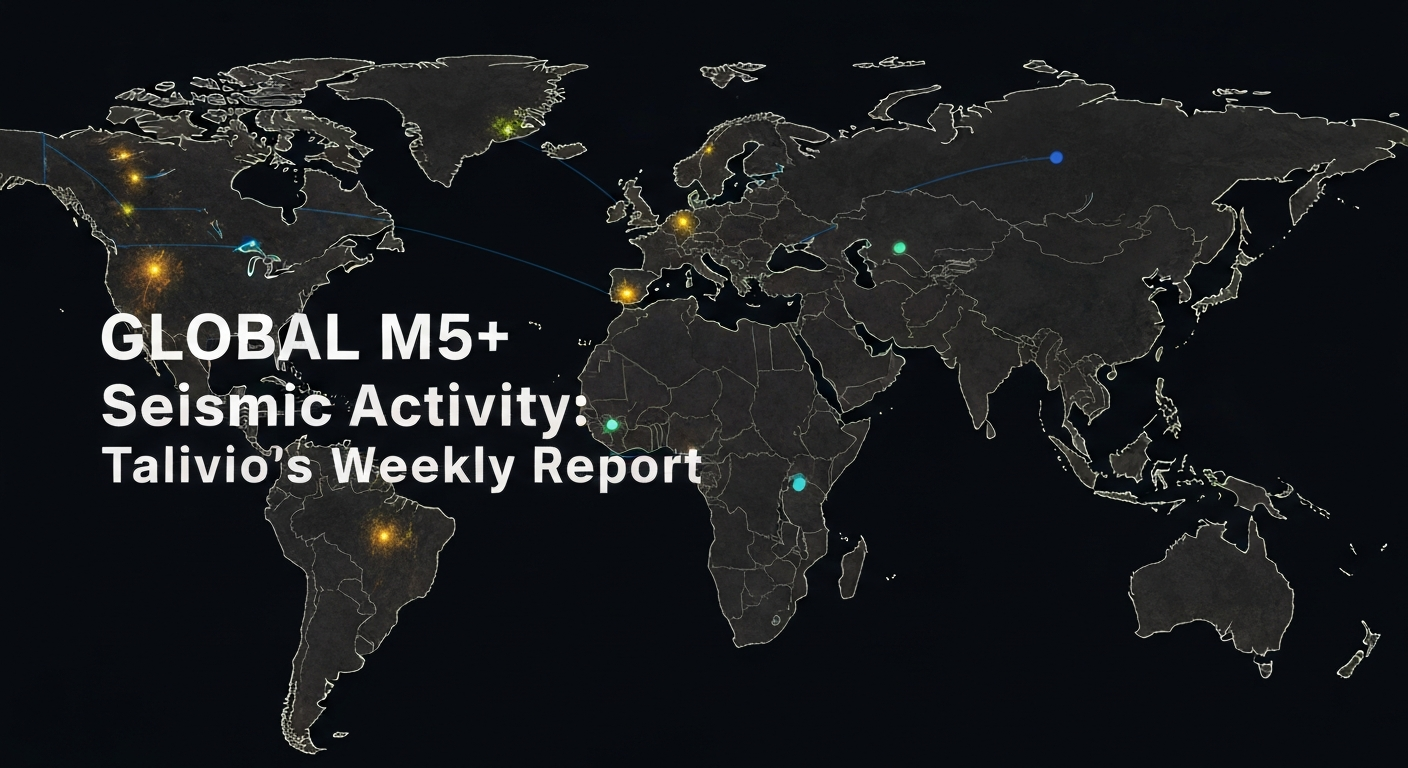
This weekly analytical recap from Talivio focuses on global M5+ seismic activity recorded between July 10 and July 16. We will summarize the significant events observed during this period, delve into their regional tectonic contexts, and crucially, explain how these real-world occurrences are meticulously integrated into Talivio's sophisticated machine learning models for continuous calibration and refinement. Such rigorous data ingestion is fundamental to enhancing the accuracy and reliability of our AI-driven earthquake prediction platform.
Global M5+ Seismic Overview (July 10-16)
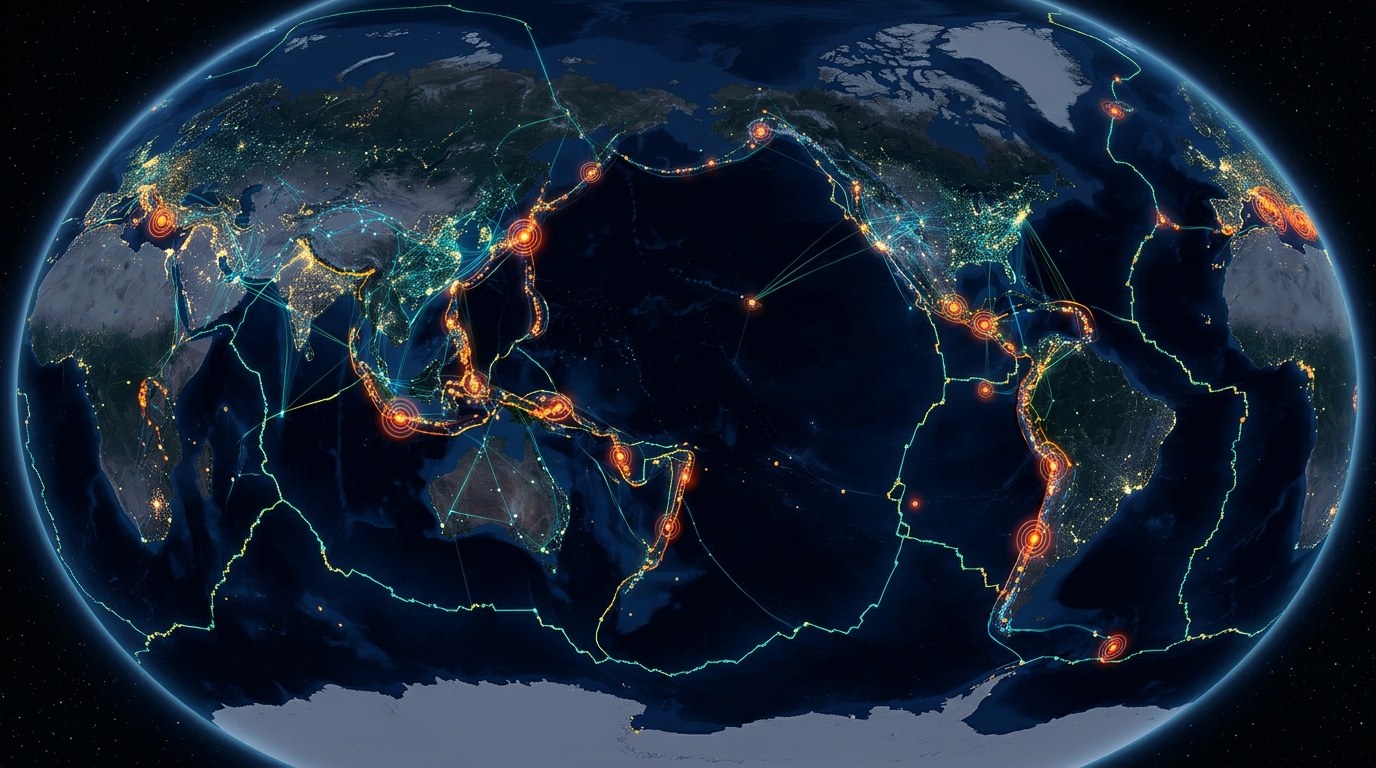
The period from July 10 to July 16 witnessed a notable distribution of M5+ seismic events globally, consistent with the expected activity along major plate boundaries. Our analysis of the U.S. Geological Survey (USGS) data indicates several significant events, predominantly concentrated within the Circum-Pacific Ring of Fire, a region known for its intense seismic and volcanic activity due to the subduction of oceanic plates beneath continental and other oceanic plates. While no M7+ events were recorded, several M6+ earthquakes occurred, underscoring the ongoing tectonic stresses in these highly active zones. These events, even those below the M7+ threshold, provide critical data points for understanding regional stress accumulation and release mechanisms, which are fundamental inputs for Talivio’s forecasting algorithms.
Key Seismic Events and Tectonic Contexts
During the review period, several M5+ earthquakes commanded attention due to their magnitudes and locations within tectonically complex regions. Each event offers unique insights into local and regional geodynamics, directly informing the feature engineering and validation processes within Talivio's models.
Fiji Region: Deep Subduction Zone Activity
The Fiji region experienced two significant M6+ earthquakes within a short timeframe, indicative of the complex tectonic interactions in the southwestern Pacific. On July 10, an M 6.0 earthquake occurred 75 km NW of Ndoi Island, Fiji (usgs:us7000szpb). This was followed on July 13 by an M 6.2 earthquake located 10 km ESE of Ndoi Island (usgs:us7000szu6). Both events occurred at considerable depths, characteristic of activity within the Tonga-Kermadec subduction zone, where the Pacific Plate is subducting westward beneath the Australian Plate. The Fiji platform itself is a complex microplate region influenced by the subduction of the Pacific Plate to the east and the convergence with the Australian Plate to the west. Deep-focus earthquakes in this region are crucial for understanding the slab dynamics and mantle rheology, which are incorporated into Talivio’s models through features like hypocentral depth distributions and seismic moment tensors. Variations in b-value, for instance, are often observed in such regions and can be indicative of stress heterogeneity within the subducting slab [Schorlemmer et al., 2005 — DOI: 10.1038/nature04021].
Papua New Guinea: Complex Plate Boundary Interactions
An M 5.2 earthquake struck 27 km SW of Lae, Papua New Guinea, on July 11 (usgs:us6000tawe). Papua New Guinea lies at the convergence of several major and minor plates, including the Pacific, Australian, Caroline, and Solomon Sea plates. The region around Lae is particularly complex, characterized by rapid crustal deformation involving the Ramu-Markham Fault system, which accommodates oblique convergence. This area experiences a combination of thrust faulting, strike-slip motion, and active volcanism. Earthquakes here often reflect the interplay of these various fault systems and the transfer of stress between them. Talivio’s models analyze such events by integrating data on fault geometries, slip rates, and regional strain accumulation derived from GNSS measurements, which are critical for estimating Coulomb stress transfer and its implications for future seismic events [King et al., 1994 — DOI: 10.1029/94JB01974].
Taiwan: Active Collision Zone Seismicity
Taiwan, situated at the active collision boundary between the Eurasian Plate and the Philippine Sea Plate, experienced two M5+ earthquakes near Hualien. An M 5.1 event occurred 10 km N of Hualien on July 12 (usgs:us6000takd), followed by an M 5.0 earthquake 18 km N of Hualien on July 13 (usgs:us6000tadc). This region is characterized by high seismicity due to the rapid northward subduction of the Philippine Sea Plate beneath the Eurasian Plate, which transitions into a continental collision zone. The eastern coast of Taiwan, particularly around Hualien, is marked by active thrust faulting and rapid uplift. Such sequences of closely spaced events, potentially representing mainshock-aftershock pairs or triggered events, are crucial for validating and refining Talivio’s Epidemic Type Aftershock Sequence (ETAS) parameter estimations, which predict the spatio-temporal distribution of aftershocks following a mainshock. The precise locations and magnitudes of these events provide valuable data for calibrating the decay rates and productivity parameters within our ETAS models.
Southern Philippines: Mindanao Subduction Zone
On July 10, an M 6.0 earthquake struck 164 km SSW of Sarangani, Philippines (usgs:us7000sz2b). This event is associated with the Mindanao Trench, a major subduction zone where the Philippine Sea Plate subducts westward beneath the Eurasian Plate. The southern Philippines is one of the most seismically active regions globally, experiencing frequent large earthquakes due to this intense plate convergence. The depth and focal mechanism of such events inform Talivio's understanding of the geometry and locking behavior of the subduction interface. Data from these deep subduction zone events contribute to our models' ability to assess seismic coupling and potential for megathrust ruptures, even when focusing on M5+ activity as indicators of broader stress regimes.
Talivio's AI-Driven Calibration and Feature Integration
The continuous occurrence of global seismic events, such as those observed between July 10 and July 16, provides an indispensable stream of real-world data for Talivio's advanced earthquake forecasting platform. Our methodology is built upon a robust machine learning framework that systematically processes and learns from such events to refine its predictive capabilities.
The Band ML System and Algorithm Competition
Talivio employs a multi-tiered 'Band ML system,' which categorizes earthquake forecasting into distinct magnitude bands: M4-5, M5-6, M6-7, and M7+. This approach acknowledges that the physical processes and precursors leading to earthquakes can vary significantly with magnitude, requiring specialized models for each band. For each band, Talivio runs an internal algorithm competition, pitting state-of-the-art machine learning algorithms against each other. Our current suite includes LightGBM, Random Forest, ExtraTrees, and Calibrated Logistic Regression. Each algorithm is evaluated on its performance metrics, such as precision, recall, and F1-score, using historical and real-time seismic data. The insights gained from events like the M6.2 in Fiji directly feed into the M6-7 band models, allowing for immediate performance assessment and iterative improvement of the winning algorithms.
Harnessing 102 Seismic Features
The power of Talivio's models stems from its integration of 102 distinct seismic and geophysical features. These features are meticulously engineered to capture a wide array of pre-seismic indicators and tectonic conditions. Key features include:
- GNSS Strain Rate: Derived from Global Navigation Satellite System data, this feature quantifies the deformation of the Earth's crust, indicating areas of accumulating stress. The M5.2 event near Lae, Papua New Guinea, for example, is situated in a region with high, complex strain rates due to multiple interacting faults.
- b-value Anomaly: The b-value, a parameter in the Gutenberg-Richter law, describes the ratio of small to large earthquakes. Anomalous decreases in b-value are often observed in regions experiencing increased stress before a large earthquake, and our models are trained to identify these subtle shifts. The deep Fiji events contribute to understanding b-value behavior in subduction zones.
- Coulomb Stress Transfer: This feature models how stress changes on one fault caused by an earthquake can influence the likelihood of rupture on nearby faults. The pair of M5+ events near Hualien, Taiwan, provides an excellent case study for validating our Coulomb stress transfer calculations, assessing if the first event significantly altered the stress state to trigger the second.
- ETAS Parameter Estimation: Epidemic Type Aftershock Sequence (ETAS) models are crucial for understanding the spatio-temporal clustering of earthquakes. Talivio's models continuously estimate and update ETAS parameters based on recent seismicity, allowing for dynamic forecasting of aftershock probabilities and triggered events. The Taiwan sequence is particularly valuable for refining these parameters.
These features are not static; they are dynamically updated and re-evaluated with every new seismic event. The data from the July 10-16 period directly contributes to the training datasets, enabling the models to learn from new patterns and adapt to evolving tectonic conditions. This continuous learning cycle is fundamental to Talivio's commitment to advancing the state-of-the-art in earthquake forecasting [Jordan et al., 2011 — DOI: 10.1007/s10950-011-9232-4].
Furthermore, the integration of diverse data sources, from global seismic networks to satellite-based geodetic measurements, ensures a comprehensive input for our models. The robustness of our feature set allows Talivio to identify subtle precursors and complex interactions that might be overlooked by traditional, rule-based forecasting methods. Recent advancements in applying deep learning to seismic data, for instance, are also being explored to potentially enhance feature extraction capabilities and model performance [Lecun et al., 2015 — arxiv:1506.02107].
Conclusion
The global M5+ seismic activity between July 10 and July 16, characterized by significant events in the Fiji region, Papua New Guinea, Taiwan, and the Southern Philippines, serves as a vital reminder of our planet's relentless geological processes. For Talivio, each earthquake is not merely an event to record but a critical data point for scientific advancement. By meticulously analyzing these occurrences within their specific tectonic contexts and integrating them into our sophisticated AI-driven forecasting models, we continuously enhance our understanding and predictive capabilities.
Talivio remains dedicated to pushing the boundaries of earthquake science through advanced machine learning. Our commitment to scientific accuracy, transparent methodology, and continuous model calibration ensures that we are at the forefront of transforming complex seismic data into meaningful insights, ultimately contributing to a more resilient future against seismic hazards.