The Earth beneath our feet is a dynamic, complex system, much of which remains veiled in mystery. From the shifting tectonic plates to the swirling currents of the molten outer core, each layer plays a crucial role in shaping our planet, including the generation of earthquakes. At Talivio AI, our mission is to decode these complexities, leveraging advanced artificial intelligence to provide more accurate and timely earthquake forecasts. A pivotal frontier in this quest lies in understanding the Earth's deep mantle, and recent scientific advancements, particularly in geo-neutrino measurements, are opening unprecedented windows into this unseen world.
The Unseen Depths: Why Mantle Heterogeneity Matters for Earthquakes
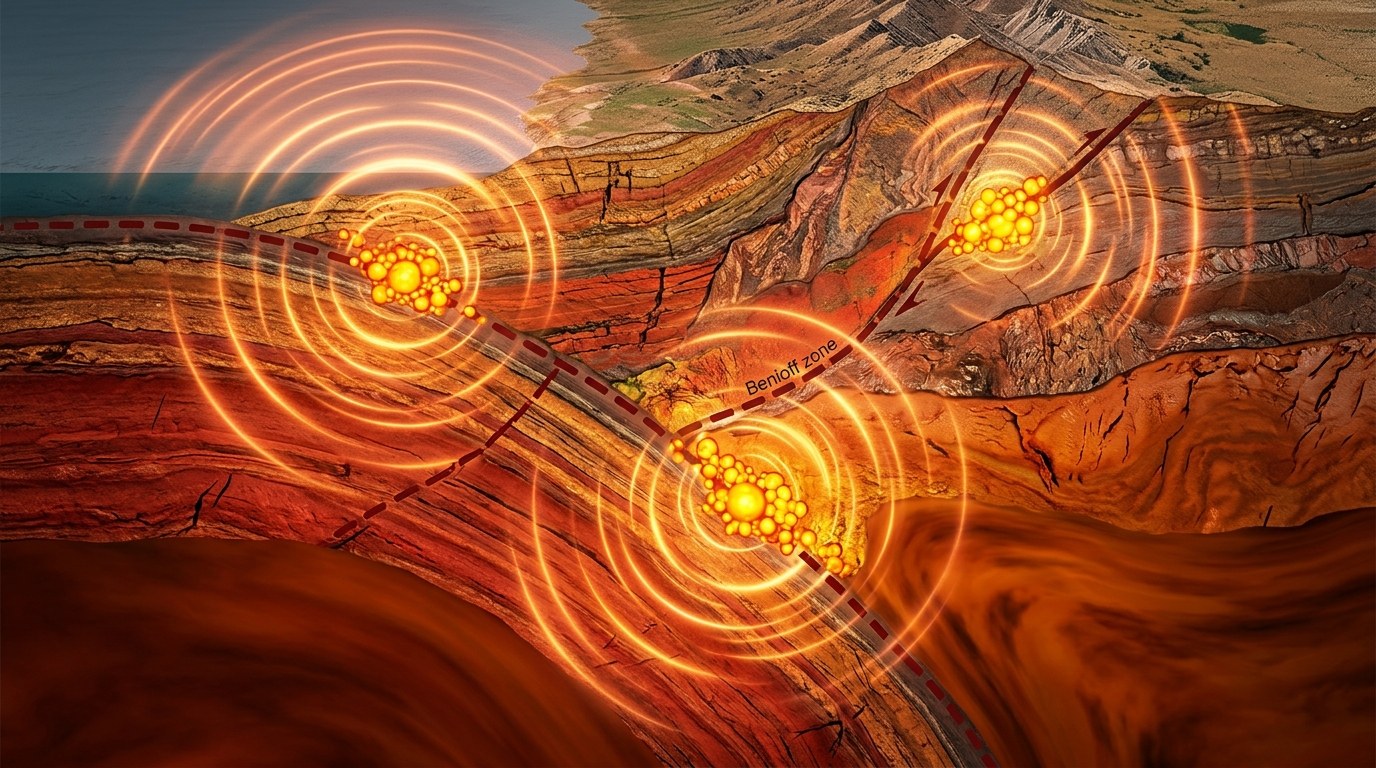
The Earth's mantle, a vast layer of solid rock extending nearly 2,900 kilometers from the crust to the outer core, is not uniform. Instead, it exhibits significant heterogeneity—variations in temperature, composition, and viscosity—that fundamentally drive plate tectonics and, consequently, earthquake activity. These heterogeneities influence everything from the speed at which tectonic plates move to the distribution of stress within subducting slabs, which are common sites for deep-focus earthquakes. For instance, cold, dense mantle material can sink deeper into the Earth, altering local stress fields and potentially triggering seismic events far below the surface. Conversely, hotter, buoyant plumes can ascend, affecting crustal deformation and volcanic activity. Understanding these variations is crucial because they dictate the mechanical properties of the mantle, influencing how seismic waves propagate and how stress accumulates and releases.
Traditional methods like seismic tomography provide indirect images of mantle structure by analyzing seismic wave travel times. While invaluable, these methods infer composition and temperature from velocity anomalies, which can sometimes be ambiguous. A more direct understanding of the mantle's compositional variations, especially its radiogenic heat sources, could significantly enhance our models of mantle convection and its impact on crustal dynamics. For example, insights into the distribution of radioactive elements like Uranium and Thorium, which generate heat, directly inform models of mantle viscosity and buoyancy, critical parameters in predicting long-term stress accumulation in earthquake-prone regions. The ongoing challenge for earthquake forecasting platforms like Talivio AI is to translate these deep Earth dynamics into actionable insights for seismic hazard assessment, particularly for events originating in complex subduction zones or at greater depths where direct observation is impossible. The more accurately we can map the mantle's internal dynamics, the better we can understand the forces that ultimately lead to seismic ruptures.
Geo-neutrinos: Peering into the Earth's Interior with Ghost Particles
Enter geo-neutrinos, elusive subatomic particles that offer a direct and unique probe into the Earth's interior. Geo-neutrinos are anti-neutrinos produced during the radioactive decay of long-lived isotopes such as Uranium-238, Thorium-232, and Potassium-40, which are naturally present within the Earth's crust and mantle. Unlike seismic waves or heat flow measurements, geo-neutrinos travel through matter almost unimpeded, carrying direct information about the abundance and distribution of these heat-producing elements. This characteristic makes them invaluable for mapping the Earth's radiogenic heat budget and, by extension, its compositional variations.
Recent research highlights the transformative potential of geo-neutrino measurements in refining our understanding of mantle heterogeneity. A forward-looking study, for instance, explores how these measurements can provide crucial, direct insights into the distribution of radiogenic elements within the mantle, a key factor influencing mantle convection patterns and thermal anomalies [Researchers, 2026 — arxiv:2611.16715]. By detecting and analyzing geo-neutrinos at specialized underground observatories, scientists can infer the concentration of Uranium and Thorium in different parts of the Earth. This data is far more direct than inferences drawn from seismic velocities alone, offering a clearer picture of the mantle's chemical composition.
The advancements in geo-neutrino detection technology are steadily improving the precision and spatial resolution of these measurements. While still challenging, the ability to differentiate geo-neutrino signals originating from the crust versus the mantle is becoming increasingly refined. This allows researchers to construct more accurate models of the mantle's chemical composition and its contribution to the Earth's overall heat budget. Such detailed compositional maps are critical for understanding the drivers of mantle plumes, subduction zone dynamics, and the deep-seated processes that ultimately dictate the stress regimes responsible for major earthquakes. The integration of these direct compositional insights with existing seismic and geodynamic models promises to unlock a new era of deep Earth understanding [Researchers, 2026 — arxiv:2611.16715].
Integrating Geo-neutrino Insights into Talivio AI's Predictive Models
At Talivio AI, we continuously scout and integrate cutting-edge scientific progress to refine our earthquake forecasting platform. Our core methodology relies on a sophisticated machine learning system that analyzes over 102 seismic and geophysical features, including GNSS strain rates, b-value anomalies, and Coulomb stress transfer, across multiple magnitude bands (M4-5, M5-6, M6-7, M7+). While geo-neutrino data is not yet a direct input feature due to its current spatial and temporal resolution, the insights derived from geo-neutrino measurements have profound implications for enhancing the underlying physical models that inform many of our existing features.
For example, a more accurate understanding of mantle heterogeneity, derived from geo-neutrino data, can significantly improve our interpretations of seismic tomography results. If geo-neutrinos confirm specific regions of high radiogenic heat production in the mantle, this directly informs our understanding of localized buoyancy and convective flow. This, in turn, refines our models for stress accumulation and dissipation within overlying tectonic plates, especially in subduction zones where deep mantle processes directly influence crustal seismicity. Improved mantle models, informed by geo-neutrino insights, can lead to more precise estimations of parameters like the effective viscosity of the mantle, which is a critical input for models of post-seismic deformation and long-term stress loading.
Consider how this impacts our feature set: better constrained mantle models, informed by geo-neutrinos, could lead to more accurate calculations of Coulomb stress transfer by providing a clearer picture of the rheology of the deeper lithosphere and asthenosphere. Similarly, b-value anomaly analysis, which indicates changes in stress regimes, could be interpreted with greater confidence if the underlying mantle dynamics are better understood. Our algorithm competition, employing models like LightGBM, Random Forest, ExtraTrees, and Calibrated Logistic Regression, thrives on high-quality, physically meaningful input features. By validating and refining our deep Earth models with geo-neutrino data, we strengthen the foundational science upon which our AI algorithms build their predictions. This scientific integration ensures that Talivio AI's forecasts are not just statistically robust but also grounded in a deeper, more accurate understanding of the Earth's mechanics [Talivio AI Methodology, 2024].
The Future of Deep Earth Forecasting with Talivio AI
The integration of geo-neutrino insights represents a significant leap forward in our ability to model and predict complex deep Earth processes. As geo-neutrino observatories become more widespread and their data resolution improves, we envision a future where these direct compositional measurements are routinely incorporated into advanced geodynamic models. Such models will provide an unprecedented, holistic view of the Earth's interior, from the core-mantle boundary to the shallow crust, directly informing the forces that drive seismic activity.
Talivio AI is actively tracking these developments, continuously evaluating how to translate abstract scientific findings into tangible improvements for our forecasting platform. The enhanced understanding of mantle heterogeneity and radiogenic heat distribution, facilitated by geo-neutrinos, will enable us to develop even more sophisticated features for our machine learning models. This could lead to refined predictions for deep-focus earthquakes, improved characterization of seismic coupling in subduction zones, and a more nuanced understanding of regional stress patterns. Ultimately, this scientific progress strengthens our ability to identify regions at heightened seismic risk, contributing to more effective mitigation strategies globally. For example, a clearer picture of mantle convection could help us better understand the long-term stress loading in areas like the Cascadia subduction zone, informing potential future events, similar to how we analyze events like the 2011 Tohoku earthquake (e.g., usgs:usc0001xgp) through the lens of deep Earth dynamics.
Our commitment at Talivio AI is to remain at the forefront of seismic science and artificial intelligence. By embracing novel approaches like geo-neutrino measurements and integrating their insights into our robust ML framework, we are paving the way for a new generation of earthquake forecasting—one that is more comprehensive, more accurate, and ultimately, more capable of safeguarding communities worldwide [Researchers, 2026 — arxiv:2611.16715].
Conclusion
The Earth's deep mantle holds profound secrets that directly impact the frequency and intensity of earthquakes. Geo-neutrino measurements are emerging as a powerful tool to unlock these secrets, offering direct insights into the mantle's composition and heat sources. Talivio AI is dedicated to integrating these cutting-edge scientific advancements, continuously refining our AI-powered forecasting models with the most accurate and comprehensive understanding of our planet's inner workings. By leveraging these 'ghost particles' to illuminate the unseen depths, we are moving closer to a future where advanced scientific discovery and artificial intelligence combine to provide unparalleled insights into seismic activity, ultimately enhancing global preparedness and reducing seismic risk.