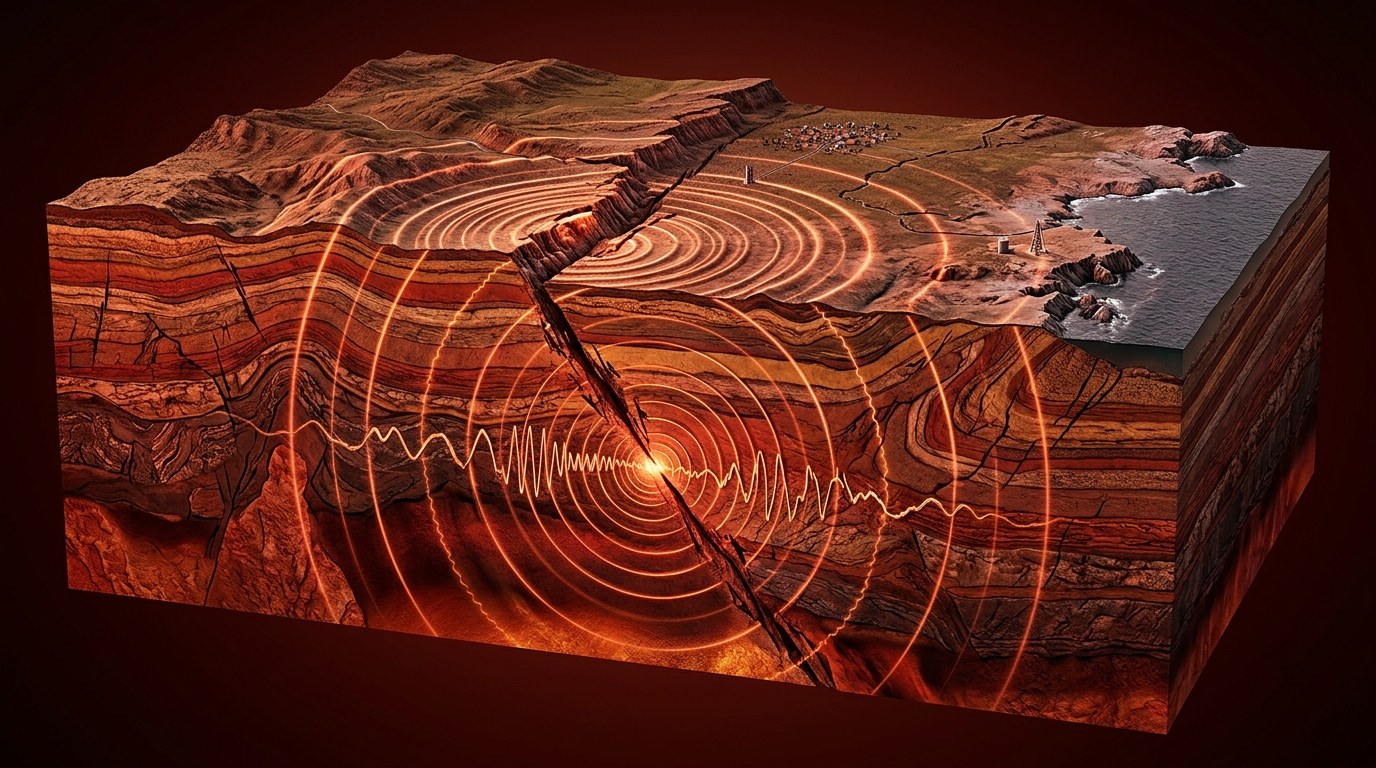
Every earthquake is simultaneously a response to previous earthquakes and a trigger for future ones. The ETAS (Epidemic Type Aftershock Sequence) model captures this self-exciting process mathematically, treating each event as a "parent" that spawns "offspring" according to modified Omori-Utsu decay.
Omori-Utsu Law
The foundational empirical observation: after a mainshock of magnitude M, the aftershock rate decays as n(t) ∝ (t + c)^−p, where c prevents the singularity at t=0 and p ≈ 1.0–1.3 in most tectonic settings. The productivity parameter K scales with mainshock magnitude, encoding that larger earthquakes generate more aftershocks per unit time.
The ETAS Extension
ETAS treats every earthquake (not just "mainshocks") as capable of triggering offspring. The rate at time t and location (x,y) is:
λ(t, x, y) = μ(x, y) + Σ_i K·exp(α(Mi − Mc)) · f(t − ti) · g(x − xi, y − yi)
where μ is the background rate, f is the Omori-Utsu temporal decay, and g is the spatial kernel. This formulation naturally handles swarms, mainshock-aftershock sequences, and foreshock-mainshock-aftershock triplets within a single consistent framework.
ETAS as a Feature, Not Just a Model
Talivio's implementation doesn't use a full ETAS forecast as its output — instead, ETAS-derived quantities become ML features. Specifically, we compute the ETAS-predicted background rate and the "excess rate" (observed rate minus ETAS prediction) at each query point. When observed seismicity significantly exceeds ETAS predictions, it may indicate a regime shift — a change in fault loading conditions not captured by simple Poisson models.
An ETAS residual — observed minus expected clustering — is a data-driven signal of anomalous seismicity that no pure physical model generates. It's one of the most discriminative features in the M 4.0–5.0 band.
Declustering: GK Algorithm
For background rate estimation, the catalog first undergoes Gardner-Knopoff (GK) declustering to remove aftershock sequences, leaving only mainshocks. The background rates derived from this declustered catalog serve as the μ(x,y) baseline in the ETAS model. This two-stage pipeline (decluster → fit background → compute ETAS excess) is more stable than directly fitting ETAS to the raw catalog in regions with incomplete aftershock reporting.