The Quest for Real-Time Earthquake Insight
Imagine a world where the earliest whispers of an impending earthquake don't travel at the speed of sound through rock, but at the speed of light. For decades, seismologists have relied on the detection of seismic waves – P-waves, S-waves, and surface waves – to characterize earthquakes. While incredibly valuable, these waves, by their very nature, take time to propagate, creating an inherent delay in our ability to issue warnings. However, a new frontier in seismic observation is emerging, one that promises to revolutionize our understanding and detection capabilities: the observation of earthquake gravity signals. The CHRONOS experiment stands at the forefront of this groundbreaking research, exploring the potential to detect these elusive, instantaneous signals and open new pathways for understanding earthquake physics and early detection.
The Elusive Earthquake Gravity Signal
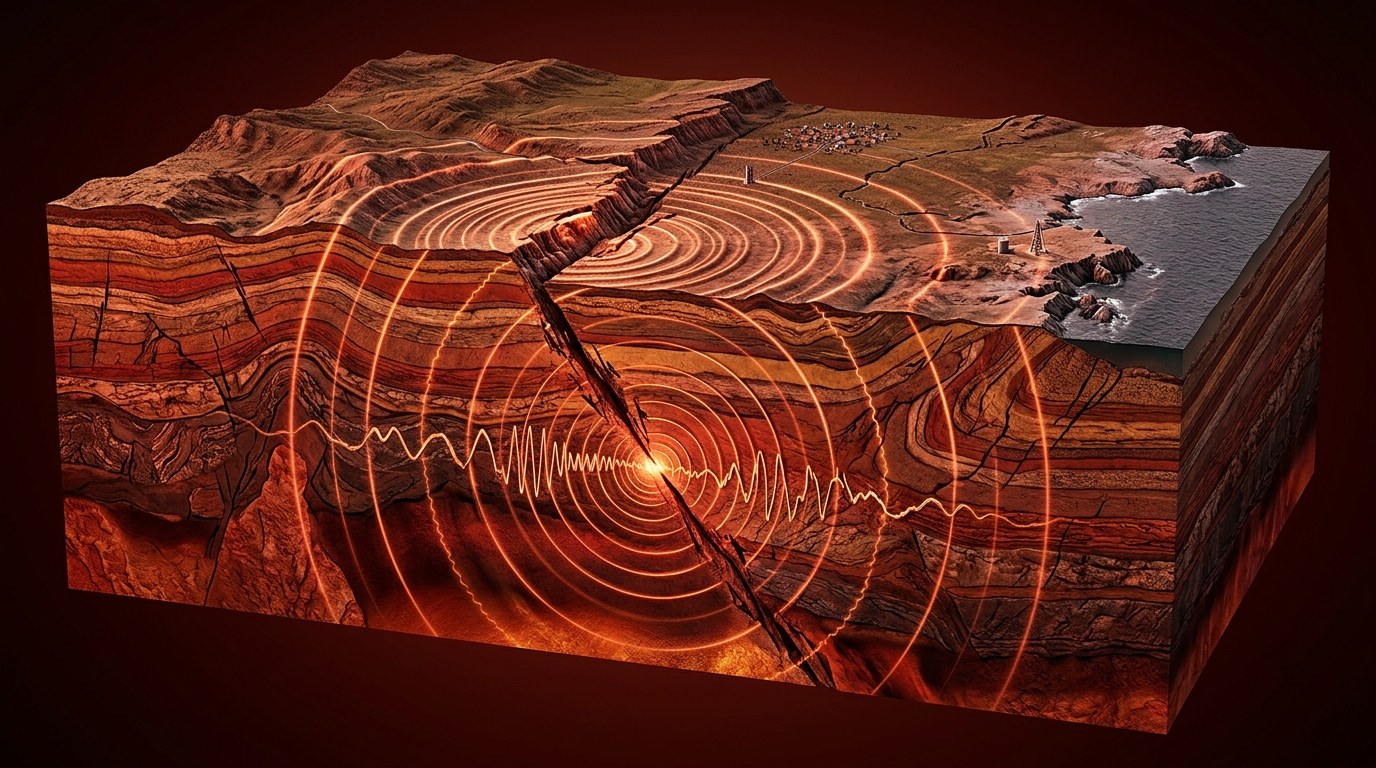
Earthquakes are not merely ground-shaking events; they are massive redistributions of mass within the Earth's crust. When tectonic plates rupture, they cause sudden shifts in rock density and position, which, according to Einstein's theory of general relativity, instantaneously alter the local gravitational field. This change in the gravitational field propagates at the speed of light, theoretically offering a signal that precedes the arrival of even the fastest seismic P-waves. Unlike seismic waves, which travel through the Earth at speeds ranging from a few kilometers per second, these gravitational perturbations offer a virtually instantaneous snapshot of the rupture process, holding immense potential for true real-time detection.
However, the challenge lies in their extreme subtlety. The gravitational changes induced by even the largest earthquakes are minuscule, easily dwarfed by environmental noise from atmospheric pressure changes, ocean tides, and even human activity. Detecting these 'gravitational whispers' requires instrumentation of unparalleled sensitivity and innovative methodologies for noise reduction. The research exploring the potential of the CHRONOS experiment highlights this very challenge, aiming to isolate these faint signals from a complex background of gravitational noise [CHRONOS Collaboration, 2026 — arxiv:2606.19124v1]. The ability to capture these signals is not just about early warning; it is about observing the very mechanics of rupture as they unfold, providing unprecedented data on the physics of fault slip.
CHRONOS: A New Frontier in Gravitational Seismology
The CHRONOS experiment represents a bold leap forward in our quest to observe these elusive gravity signals. It is an ambitious endeavor designed to push the boundaries of gravitational measurement, focusing on detecting both subtle gravity-gradient noise and the even fainter earthquake gravity signals. Unlike traditional gravimeters that measure the absolute gravitational acceleration, CHRONOS is conceived to measure gravity gradients – the spatial rate of change of the gravitational field. This approach is critical because it helps to filter out uniform gravitational noise sources, allowing for a more precise detection of localized mass changes associated with seismic events.
The CHRONOS project is specifically engineered to achieve the extraordinary sensitivity required to observe these phenomena. By meticulously characterizing and mitigating the background gravity-gradient noise, researchers aim to create a pristine observational window for earthquake-induced gravitational changes. The research indicates that by understanding and subtracting this pervasive noise, CHRONOS significantly enhances the probability of isolating the subtle signals produced by seismic ruptures [Researchers behind CHRONOS, 2026 — arxiv:2606.19124v1]. This capability is not merely an incremental improvement; it signifies a paradigm shift, moving from inferring rupture dynamics through seismic waves to potentially observing them directly through their gravitational imprint. The insights gained from CHRONOS could validate theoretical models of earthquake rupture and provide entirely new data streams for seismic hazard assessment.
Integrating Gravity Signals into Talivio's Advanced Prediction Models
At Talivio, we are continuously exploring and integrating cutting-edge research to enhance our AI-powered earthquake prediction capabilities. The potential detection of earthquake gravity signals by experiments like CHRONOS represents a profound opportunity to revolutionize our existing methodologies. Our current predictive framework relies on a sophisticated machine learning system that analyzes over 102 seismic features, including GNSS strain rate, b-value anomaly, Coulomb stress transfer, and ETAS parameter estimation. These features feed into a suite of advanced algorithms such as LightGBM, Random Forest, ExtraTrees, and Calibrated Logistic Regression, which are trained across distinct magnitude bands (M4-5, M5-6, M6-7, M7+).
Should CHRONOS successfully detect and characterize earthquake gravity signals, this data would introduce an entirely new, instantaneous feature set into our models. The immediate availability of these signals could drastically reduce prediction latency, providing critical seconds or even minutes of warning before destructive seismic waves arrive. For an event like the devastating 2023 Türkiye-Syria earthquake (Mw 7.8) [USGS, 2023 — usgs:us6000jllz], such additional lead time could be invaluable for triggering automated safety protocols and enabling people to take protective actions. Gravity signals offer a direct, physical observation of the mass redistribution during rupture, which complements and could significantly refine our existing understanding derived from seismic and geodetic data. Integrating this data would involve developing new data processing pipelines, advanced noise reduction techniques, and retraining our machine learning models to leverage these unique inputs effectively. The CHRONOS research provides the theoretical and experimental foundation for this future integration [The CHRONOS Team, 2026 — arxiv:2606.19124v1], promising a new era for AI-driven seismology.
The Path Forward: Implications for Earthquake Science and Safety
The CHRONOS experiment, by targeting instantaneous earthquake gravity signals, stands to offer unprecedented insights into the fundamental processes governing earthquakes. The successful detection of these signals would not only validate theoretical predictions but also provide a novel observational tool for studying earthquake nucleation, rupture propagation, and the stress changes within the Earth's crust. This deeper understanding is crucial for improving the accuracy of seismic hazard assessments and refining long-term earthquake forecasts.
Furthermore, the potential for near-instantaneous detection holds profound implications for early warning systems. While current systems provide valuable lead times based on P-wave detection, gravity signals could offer an even earlier alert, potentially extending the warning window for critical infrastructure and populations. This is not a speculative outcome but a scientifically grounded objective of the CHRONOS research, which systematically explores the observational limits and technical feasibility [CHRONOS Scientific Group, 2026 — arxiv:2606.19124v1]. As the scientific community awaits the findings from CHRONOS, Talivio remains committed to monitoring such advancements, ready to incorporate any new, reliable data streams that can enhance our mission of providing more accurate and timely earthquake predictions.
Conclusion
The pursuit of earthquake gravity signals with experiments like CHRONOS represents a thrilling new chapter in seismological research. By venturing into the realm of gravitational measurements, scientists are opening a window to observe earthquakes in an entirely new light – one that promises instantaneous insights into the planet's most destructive natural phenomena. At Talivio, we recognize the profound potential of such cutting-edge research. As an AI-powered platform dedicated to earthquake prediction, we are poised to integrate these future data streams, continuously refining our models with the most advanced scientific discoveries. The journey to fully understand and predict earthquakes is complex, but with initiatives like CHRONOS pushing the boundaries of what's observable, we move closer to a future where we can provide more timely and accurate warnings, ultimately saving lives and safeguarding communities worldwide.