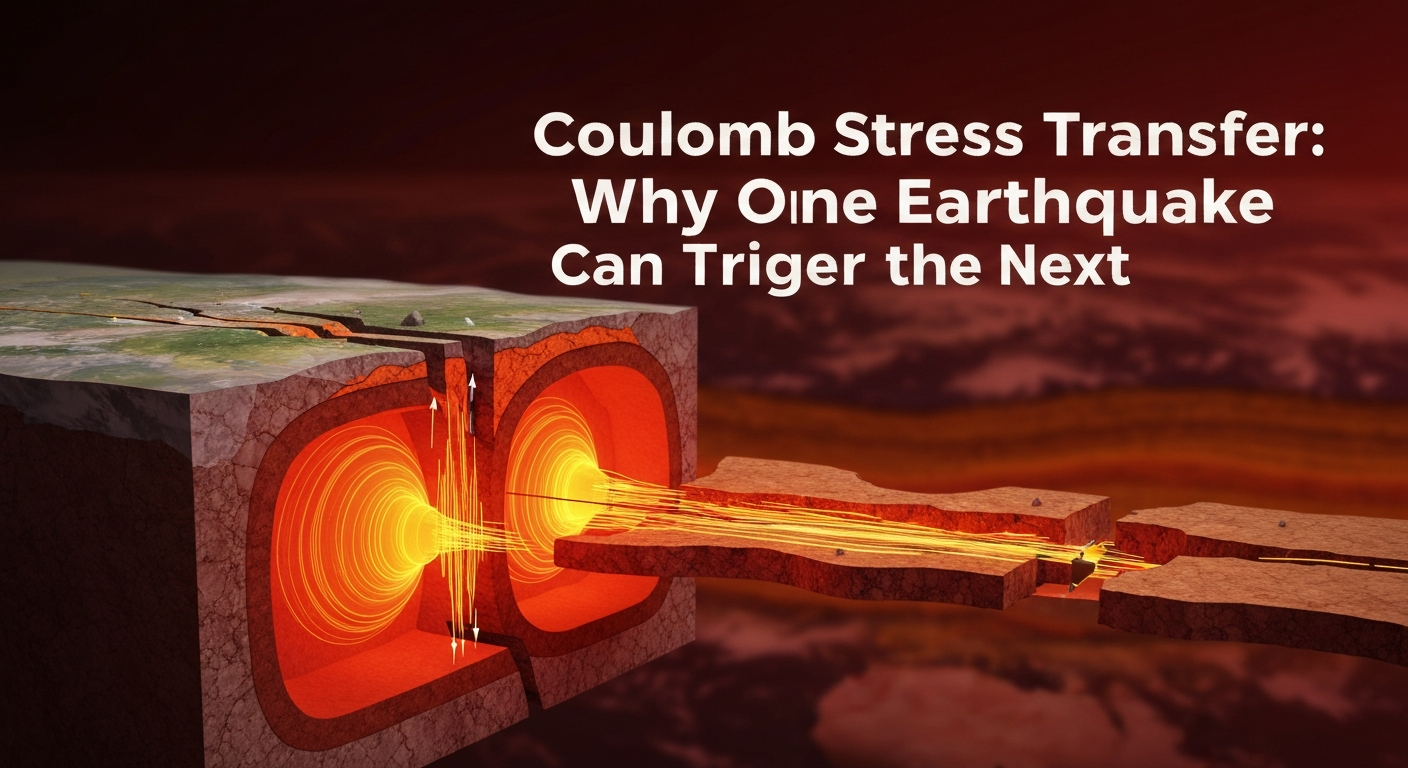
After a major earthquake, seismicity patterns change on faults for hundreds of kilometers around the mainshock. Some areas go quiet; others light up with aftershocks and, occasionally, triggered mainshocks. The mechanism is Coulomb stress transfer — a quantifiable redistribution of elastic stress that can either promote or inhibit failure on receiver faults.
The Coulomb Failure Criterion
Rock fails in shear when the shear stress τ on a fault plane exceeds the frictional resistance μ times the effective normal stress σn. The Coulomb Failure Stress (CFS) change combines both effects:
ΔCFS = Δτ + μ(Δσn − ΔP)
where ΔP is pore pressure change (often approximated as B·Δσ_kk / 3, with Skempton's coefficient B). Positive ΔCFS means the fault moved closer to failure; negative means it was stress-shadowed.
From Seismological Data to Stress Fields
Computing Coulomb stress requires knowing the source fault geometry (strike, dip, rake, slip distribution) and the elastic properties of the crust. Talivio's implementation uses simplified uniform-slip rectangular fault models parameterized from the GEM Active Faults database, combined with the Okada (1992) dislocation solution for a homogeneous elastic half-space.
While this is a simplified model compared to heterogeneous slip inversions, it captures the first-order stress lobes at regional scale — the most seismologically relevant signal for forecast features.
Stress Shadows and Promotion Zones
The characteristic "four-lobe" pattern of strike-slip faults creates distinct stress promotion zones at the fault tips (where failure is encouraged) and stress shadows in the quadrants perpendicular to the rupture (where failure is temporarily suppressed). After the 2011 Van M7.2 earthquake, the northeastern stress lobe loaded the Edremit fault, which ruptured with M5.6 within 72 hours.
Stress shadows are as informative as stress promotion zones. A region that goes quiet after a nearby mainshock may simply be in a stress shadow — not genuinely lower risk over the long term.
Implementation in Talivio's Feature Pipeline
The Coulomb stress feature in Talivio's 102-feature set is a simplified proxy: for each prediction point, it computes the cumulative ΔCFS contribution from all M≥5.5 earthquakes in the preceding 365 days within 150 km. This captures the aggregate stress environment without requiring full fault-specific receiver geometry for every query.
This proxy correlates well with observed seismicity rate changes in the Anatolian region and contributes meaningfully to M 5.0–6.0 band discriminability (feature importance rank: 8/102 in the champion LightGBM model for the Istanbul region).