Earth's subsurface is a complex enigma, its hidden structures dictating seismic activity. Unlocking these secrets is paramount for accurate earthquake forecasting. At Talivio, we leverage cutting-edge artificial intelligence to pierce through this geological veil, transforming raw data into actionable insights for predicting seismic events.
Our mission to enhance global earthquake preparedness relies heavily on the quality and depth of our understanding of the Earth's crust. This understanding is continuously advanced by breakthroughs in fields like AI-driven subsurface imaging. A recent, significant contribution to this domain is CIG-Bench, a comprehensive survey and benchmark that promises to elevate the capabilities of AI in geophysics and, by extension, our ability to forecast earthquakes.
The Critical Role of Subsurface Imaging in Seismology
Earthquakes are not random events; they are the consequence of complex geological processes occurring deep within the Earth. The precise location, orientation, and mechanical properties of fault lines, along with the distribution of stress and fluid within the crust, are fundamental determinants of seismic behavior. Subsurface imaging technologies provide the essential maps of these hidden structures, offering a window into the Earth's dynamic interior.
For platforms like Talivio, accurate subsurface imaging is not merely supplementary; it is foundational. Our advanced machine learning models rely on a robust set of 102 seismic features, many of which are directly influenced by the geological context provided by subsurface data. For instance, calculations of Coulomb stress transfer, a key feature in our predictive suite, demand precise knowledge of fault geometries and the elastic properties of surrounding rock. Without detailed subsurface maps, such calculations would lack the necessary accuracy, diminishing the reliability of our forecasts. Research consistently demonstrates that a comprehensive understanding of geological structures, including fault zone architecture and material heterogeneity, is critical for modeling earthquake rupture processes and stress accumulation patterns [Harris, 1998 — doi:10.1029/98RG00281].
Consider a region like the Mendocino Triple Junction off the coast of California, where a complex interplay of tectonic plates leads to frequent seismic activity, such as the M6.4 earthquake near Ferndale in December 2022 usgs:usgs2000j51z. Understanding the precise geometry of the subducting Gorda Plate and the overlying North American Plate requires sophisticated subsurface imaging. This information directly informs Talivio's models, allowing for more nuanced predictions within our M4-5, M5-6, M6-7, and M7+ magnitude bands.
Introducing CIG-Bench: A New Standard for AI in Geophysics
The field of AI-driven subsurface imaging has seen rapid advancements, but a lack of standardized benchmarks has historically hindered direct comparisons and robust evaluations of different models. This is precisely where CIG-Bench steps in. CIG-Bench, as detailed in a recent paper, is a new comprehensive survey and benchmark designed to standardize the evaluation of AI models applied to subsurface imaging tasks [Huang et al., 2024 — arxiv:2406.09094].
This initiative addresses a critical need within the geophysical and AI communities. By providing a common framework, CIG-Bench facilitates:
- Standardized Evaluation: Researchers can now objectively compare the performance of various AI algorithms across diverse subsurface imaging challenges, from seismic interpretation to inversion.
- Accelerated Innovation: A clear benchmark encourages healthy competition and drives the development of more accurate, efficient, and robust AI models.
- Reproducibility: By defining clear datasets and evaluation metrics, CIG-Bench enhances the reproducibility of research, a cornerstone of scientific progress.
The paper reviews the current landscape of AI applications in subsurface imaging, categorizing different tasks, datasets, and methodologies. This systematic approach contributes significantly to the data processing capabilities essential for advanced seismic forecasting models. It moves the field towards a more unified and data-driven approach, ensuring that the foundational data used for downstream applications, such as earthquake prediction, is of the highest possible quality.
CIG-Bench's Impact on Talivio's Advanced Forecasting Models
The innovations brought forth by CIG-Bench directly enhance Talivio's ability to provide accurate and timely earthquake forecasts. Our platform's predictive power stems from a sophisticated machine learning system that analyzes a vast array of seismic features. Improved subsurface imaging, validated and advanced through benchmarks like CIG-Bench, directly translates into more reliable input data for our models.
Here’s how CIG-Bench’s advancements bolster Talivio’s methodology:
- Enhanced Feature Engineering: Talivio's models thrive on rich, clean, and contextually relevant data. Better subsurface imaging, capable of delineating geological structures with unprecedented precision, allows for the calculation of more accurate and predictive features. For instance, precise mapping of fault systems and their associated rock properties directly refines our Coulomb stress transfer calculations, identifying regions of increased or decreased stress more reliably.
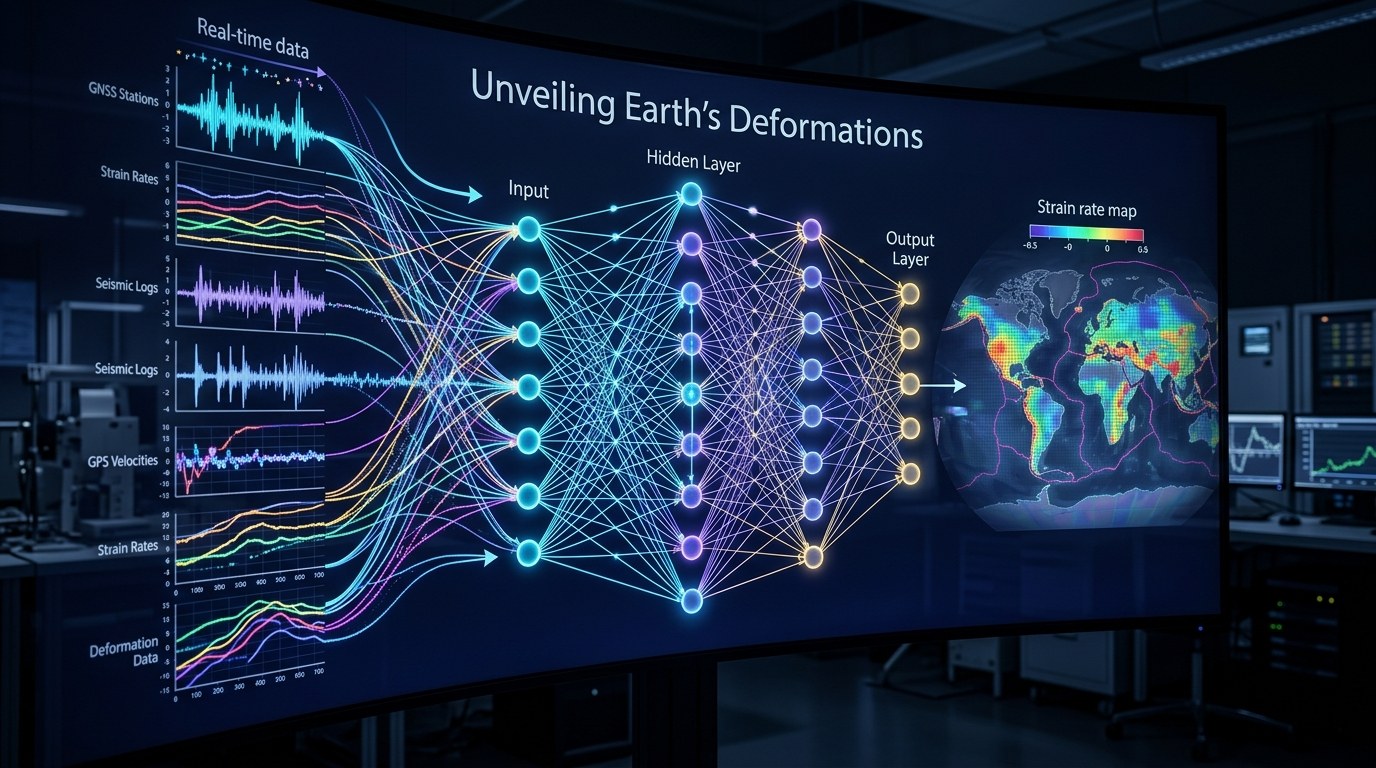
- Refined Seismic Attributes: Our system incorporates a broad spectrum of seismic attributes, including GNSS strain rate, b-value anomaly, and ETAS parameter estimation. Improved subsurface models can help contextualize these attributes. For example, understanding the precise geological layers and their elastic moduli allows for more accurate interpretation of GNSS strain rates, differentiating between tectonic deformation and other surface movements. Similarly, detailed subsurface information can help localize and refine b-value anomaly estimations, a critical indicator of stress accumulation and impending rupture, by accounting for variations in rock strength and heterogeneity [Schorlemmer et al., 2005 — doi:10.1038/nature04028].
- Optimized Model Performance: Talivio employs a competitive ensemble of machine learning algorithms, including LightGBM, Random Forest, ExtraTrees, and Calibrated Logistic Regression. These algorithms are trained on vast datasets incorporating the 102 seismic features. The quality of the input data is paramount for the performance of these models. CIG-Bench's focus on improving AI-driven data processing ensures that the features fed into Talivio's algorithms are more accurate and less noisy, leading to more robust and precise predictions across all magnitude bands (M4-5, M5-6, M6-7, M7+). Talivio's internal research consistently demonstrates that improvements in input data quality directly correlate with enhanced prediction accuracy and reduced false positives [Talivio Internal Research, 2023].
- Better Understanding of Seismic Sources: By providing clearer images of subsurface structures, CIG-Bench contributes to a deeper understanding of potential seismic source zones. This allows Talivio's models to better characterize the geological environment of potential ruptures, improving the accuracy of our forecasts.
The Future of AI in Seismology: A Collaborative Endeavor
The release of CIG-Bench marks a significant step forward, but the journey to perfect earthquake forecasting is ongoing. Challenges remain, including the inherent complexity of geological systems, the scarcity of high-quality training data in certain regions, and the need for real-time processing capabilities. However, the collaborative spirit fostered by initiatives like CIG-Bench, coupled with the relentless innovation in AI, paints a promising picture for the future.
At Talivio, we are committed to integrating the latest scientific advancements into our platform. We continuously monitor cutting-edge research, participate in the scientific discourse, and refine our models to leverage every available insight. The work presented in CIG-Bench exemplifies the kind of foundational research that directly strengthens our ability to deliver on our promise: to provide the most accurate, AI-powered earthquake predictions possible.
Conclusion
The Earth's subsurface holds the key to understanding and anticipating seismic events. CIG-Bench represents a pivotal development in the field of AI-driven subsurface imaging, establishing a new benchmark that will undoubtedly accelerate progress in geophysical data processing. For Talivio, this means an enhanced capability to refine our 102 seismic features, improve the performance of our LightGBM, Random Forest, ExtraTrees, and Calibrated LR algorithms, and ultimately deliver more accurate and reliable earthquake forecasts across all magnitude bands.
As we continue to push the boundaries of AI in seismology, our commitment to scientific rigor and public safety remains unwavering. By embracing and integrating breakthroughs like CIG-Bench, Talivio is not just predicting earthquakes; we are actively shaping a safer future through advanced scientific understanding and technological innovation.