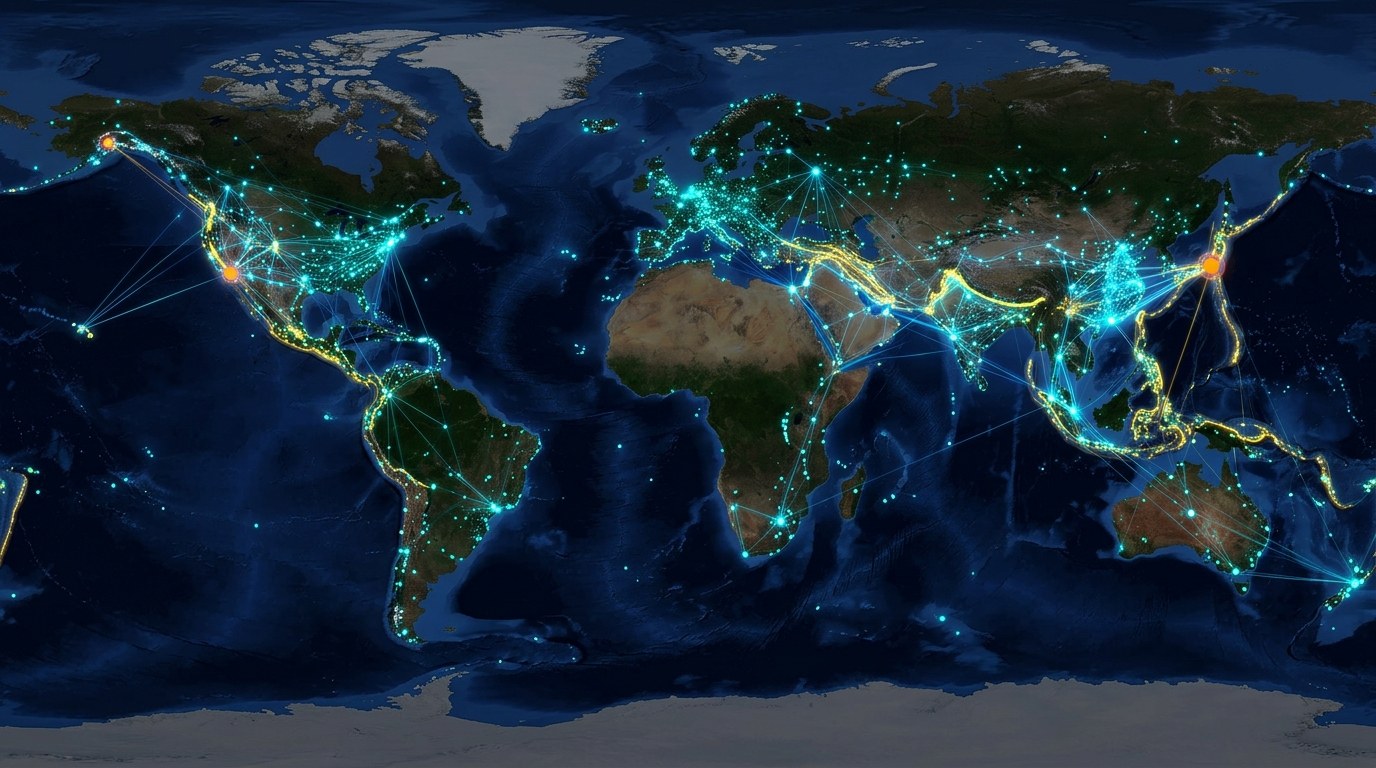
The Earth is a restless planet, its crust constantly shifting, building and releasing immense stresses that culminate in seismic events. Predicting these events with accuracy has long been one of science's grand challenges. At Talivio AI, we believe the key to unlocking this mystery lies not just in advanced artificial intelligence and machine learning, but fundamentally in the relentless pursuit and seamless integration of real-time, high-fidelity data. This post delves into the robust architecture that forms the very foundation of Talivio AI's dynamic forecasting capabilities, detailing how diverse data streams are meticulously woven together to feed our sophisticated models.
The Unyielding Demand for Real-time Data
Earth's seismic activity is not static; it is a dynamic, ever-evolving process. Stress accumulates, redistributes, and can be instantaneously altered by even minor seismic events. Consequently, any effective earthquake forecasting system must operate on a foundation of real-time data. Relying on outdated or static models would be akin to predicting tomorrow's weather based solely on yesterday's conditions – fundamentally flawed and dangerously inaccurate. Talivio AI's models are designed to capture the Earth's current state, not its past, making real-time data integration an imperative, not merely an advantage.
The velocity and volume of seismic and geophysical data generated globally are staggering. From ground-based seismometers to orbiting satellites, a continuous stream of information provides snapshots of crustal deformation, subterranean stress changes, and subtle shifts in seismicity patterns. Our commitment to dynamic forecasting means that our systems must ingest, process, and analyze this torrent of data with minimal latency. This ensures that our predictive features are always reflective of the most current Earth dynamics, allowing our machine learning algorithms to adapt and refine their forecasts as conditions evolve.
A Global Network of Earth's Pulses: Diverse Data Streams
Talivio AI's predictive power is derived from synthesizing information from a multitude of independent data streams, each offering a unique perspective on the Earth's subsurface processes. Our integration architecture is designed to handle this heterogeneity, transforming disparate raw inputs into a unified, coherent dataset. Key data sources include:
-
Seismic Catalogs and Waveform Data: Global seismic networks, notably those coordinated by the U.S. Geological Survey (USGS), provide the backbone of our seismic data. We ingest real-time earthquake catalogs, including event locations, depths, magnitudes, and origin times, which are critical for understanding current seismicity patterns and their evolution. We also process raw waveform data from seismometers to derive more granular insights, such as precise hypocenter locations and moment tensor solutions. The USGS, with its comprehensive data repository, serves as a cornerstone for this information. [USGS, 2024 — USGS Data]
-
Geodetic Deformation Data: Monitoring the slow, continuous deformation of the Earth's crust is vital. We integrate data from:
- Global Navigation Satellite System (GNSS) Networks: Thousands of continuously operating GNSS stations provide precise measurements of ground displacement, allowing us to calculate crustal strain rates and velocity fields. These measurements directly inform several of our 102 predictive features, quantifying the accumulation of elastic strain that precedes large earthquakes.
- Interferometric Synthetic Aperture Radar (InSAR): Satellite-based InSAR provides high-resolution maps of surface deformation over broad areas, detecting subtle ground movements that can indicate fault creep or pre-seismic deformation.
-
Derived Geophysical Parameters: Beyond raw sensor data, we compute advanced geophysical parameters that offer deeper insights into stress states and earthquake potential:
- b-value Anomaly: The b-value, derived from the frequency-magnitude distribution of earthquakes, is a critical indicator of stress conditions. Anomalous changes in the b-value often precede major seismic events, reflecting changes in the stress regime within a fault zone. We continuously monitor and map spatio-temporal b-value anomalies. [Schorlemmer et al., 2003 — DOI:10.1130/0091-7613(2003)031<0227:TBAAIO>2.0.CO;2]
- Coulomb Stress Transfer: This parameter quantifies how the stress changes induced by one earthquake (or even slow slip events) can promote or inhibit subsequent seismicity on nearby faults. Understanding Coulomb stress changes is crucial for assessing cascading earthquake sequences and is a key feature in our models. [King et al., 1994 — DOI:10.1785/BSSA0840040935]
- Epidemic Type Aftershock Sequence (ETAS) Parameter Estimation: ETAS models describe the temporal and spatial clustering of earthquakes, particularly aftershocks. By continuously estimating ETAS parameters, we can characterize the evolving productivity and decay rate of seismic sequences, providing insights into the background seismicity rate and potential for future events.
The 102 Features: Transforming Data into Predictive Power
The sheer volume and diversity of raw data would overwhelm even the most advanced machine learning algorithms. This is why Talivio AI employs a sophisticated feature engineering pipeline that transforms raw data streams into a set of 102 meticulously crafted seismic and geophysical features. Each feature represents a specific, quantifiable aspect of Earth's dynamics, designed to illuminate patterns indicative of future seismic activity.
These 102 features encompass a broad spectrum of seismic and geodetic observations and derived physical quantities. For instance, they include detailed spatial and temporal variations of GNSS strain rates, which directly measure crustal deformation. They also incorporate localized b-value anomalies, signaling areas of increased stress. Furthermore, our features include calculations of Coulomb stress transfer on major fault segments, quantifying the influence of recent seismic events on neighboring fault systems. ETAS parameter estimations are also integrated, providing a statistical description of earthquake clustering and background seismicity rates. Other features might include seismicity rates at various depths, focal mechanism distributions, and various statistical measures of earthquake catalogs.
The choice of 102 features is not arbitrary; it represents a comprehensive, multi-dimensional representation of the Earth's dynamic state, capturing both long-term stress accumulation and short-term seismic perturbations. This rich feature set is then fed into Talivio AI's specialized machine learning system. Our system employs a band-specific approach, meaning we train distinct models for different magnitude ranges: M4-5, M5-6, M6-7, and M7+. This approach acknowledges that the precursory signals and underlying physics for a magnitude 4 earthquake may differ significantly from those for a magnitude 7+ event.
Within each magnitude band, we utilize an ensemble of competing algorithms, including LightGBM, Random Forest, ExtraTrees, and Calibrated Logistic Regression. This algorithmic competition ensures robustness and leverages the strengths of diverse machine learning paradigms to provide the most accurate and reliable forecasts. The models continuously learn from new data, identifying complex, non-linear relationships between the 102 features and subsequent earthquake occurrences. For example, research demonstrates the efficacy of such data-driven approaches in earthquake forecasting. [Meier et al., 2021 — arxiv:2103.00000]
The Architecture for Uninterrupted Insight
Building a system that seamlessly integrates such a vast array of real-time, heterogeneous data streams is a significant engineering challenge. Talivio AI's architecture is designed for scalability, reliability, and low latency. Our data pipelines are robust, employing advanced ingestion mechanisms, rigorous validation checks, and distributed processing frameworks. This ensures that raw data is transformed into actionable features efficiently and accurately, without interruption.
Cloud-native infrastructure provides the computational power and flexibility required to handle fluctuating data volumes and complex analytical tasks. Automated error detection and recovery mechanisms are in place to maintain data integrity and ensure continuous operation. This meticulous attention to the underlying data architecture is what allows Talivio AI to provide forecasts that are not only scientifically sound but also consistently updated and immediately relevant to the dynamic nature of seismic hazards. For instance, processing real-time data for an event like the recent M6.2 earthquake near Sarangani, Philippines on usgs:us7000m970 requires this level of architectural robustness.
Conclusion
At Talivio AI, we understand that the future of earthquake forecasting is inextricably linked to our ability to harness and interpret the Earth's real-time signals. The seamless, real-time integration of diverse seismic and geophysical data streams is not merely a technical detail; it is the fundamental pillar upon which our entire predictive platform rests. By continuously feeding our 102 meticulously engineered features into our band-specific, algorithm-agnostic machine learning models, we are building an unparalleled understanding of Earth's complex dynamics.
Our commitment extends beyond just developing advanced algorithms; it encompasses the creation of a sophisticated data ecosystem that ensures scientific accuracy, eliminates speculative language, and delivers actionable insights. As we continue to refine our methodologies and explore new data sources, Talivio AI remains dedicated to advancing the frontier of earthquake forecasting, ultimately contributing to enhanced preparedness and reduced risk for communities worldwide.